
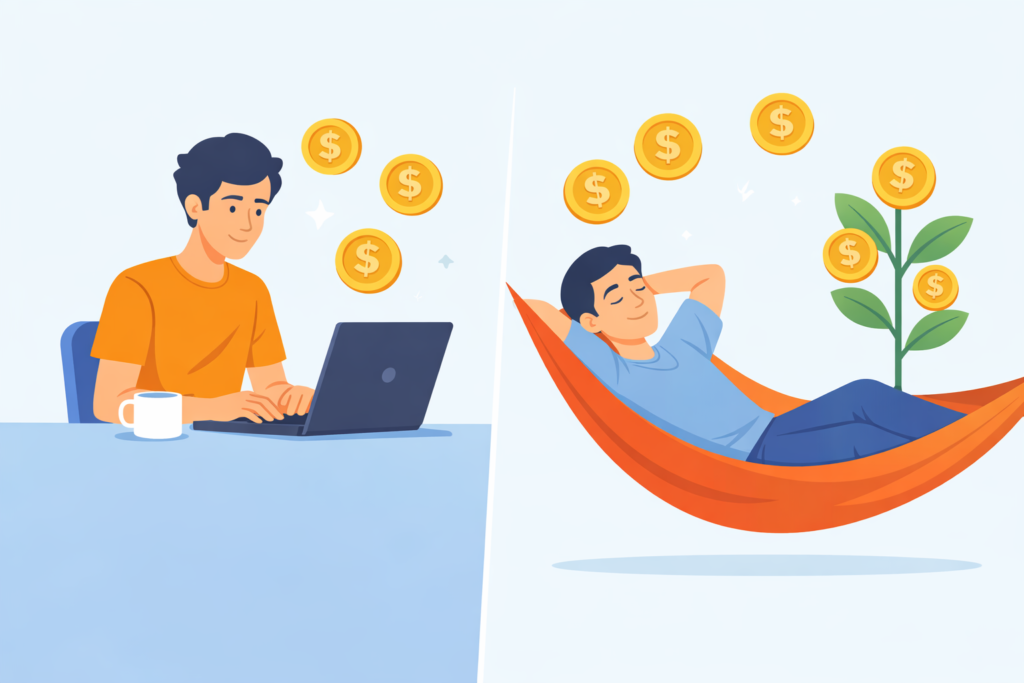
I’ve noticed beginners get stuck on this topic very early. Many people hear “active vs passive online income” and wonder what it really means. It sounds confusing, but it doesn’t have to be. In simple terms, active income means working for money now, while passive income means creating something that can pay you later.
In this article, we’ll explain exactly what active online income is and what passive online income really means. We’ll go over the pros and cons of each, compare them side by side, talk about common beginner mistakes, and show you how to use both to your advantage. By the end, you’ll see it’s not as mysterious as it first seemed.
Table of Contents
What Active Online Income Means
Active online income is money you earn by doing work right away. It’s like a regular job on the Internet. For example, if you tutor someone over video chat or sell products yourself, you only get paid when you do the work. Each dollar comes from your current effort. If you stop working, the money stops too. You usually get paid soon after finishing each task or project. Active work can give you quick results and even help you build new skills on the job.
Pros and Cons of Active Online Income
- Pros: You can earn money quickly. For example, finishing an online project or freelance gig can pay you as soon as it’s done. Active work also teaches you new skills and puts you in control of your earnings. You don’t need much startup money — just your time and skills.
- Cons: You have to keep working to keep earning. If you don’t work, you don’t get paid. This means no work means no income. It can be tiring to trade hours for dollars all the time, and there’s only so much time in a day. Your income is limited by how much you can work. It can also be unpredictable if jobs dry up.
What Passive Online Income Really Means
Passive online income sounds like making money on autopilot. It means you put in work upfront, and then the money keeps coming later, often with very little daily effort. For example, if you write an ebook or create an online course, you do the work once. Later, people might buy it, and you earn money over time. Another example is a blog or YouTube channel with ads. After you make the content, people can watch or visit it, and it can earn ad money even when you’re not online.
I used to think passive income meant no work at all, but that’s not true. Usually, you have to work hard at first to set it up. Once things are running, you often can step back. Your work can keep earning for you, even while you sleep or do other things.
Pros and Cons of Passive Online Income
- Pros: After the initial work, a passive project can keep earning money without you working all the time. You might earn even when you’re busy with something else. Passive income can grow over time — for example, a blog post or video might get more readers or viewers as time goes on. This makes it good for building long-term wealth.
- Cons: It can take a long time and effort to start. You might spend weeks or months creating something (like a course or a blog) before you earn anything. Even then, there’s no guarantee it will pay off. You often need to learn new skills (like marketing) and possibly spend some money on tools or ads. Passive income can also be unpredictable at first, since it depends on the audience and market trends.
Active vs Passive: Side-by-Side Comparison
- Active Income: You work, and then you earn. It’s like getting paid for each task or service. If you don’t work, you don’t get paid. Active income gives quick cash and helps you build skills. It’s reliable as long as jobs are available, but it’s limited by your time.
- Passive Income: You do work ahead of time, and then it can keep earning for you later. It often grows slowly and usually needs little daily effort. Passive income can lead to long-term wealth because it keeps paying you, but it usually starts slower and can be unpredictable.
- Effort: Active income requires constant work (you have to keep putting in hours every day). Passive income requires a lot of work up front and then usually less effort after that.
- Timing: Active income pays you quickly for each task. Passive income pays you later (for example, once a course is live or ads have been shown).
- Control: With active income, you decide exactly how much you work and earn (take more jobs to earn more). With passive income, you’re in control at the start, but after that, earnings depend on outside factors (like how many people see your work).
- Risk and Reward: Active income is usually steady and reliable (like a regular job or freelancing gig). Passive income is less certain at first, but it can grow bigger without your daily work. In short, active income provides stability now, while passive income helps build long-term wealth.
Which One Is Better for Beginners?
Many beginners wonder which is better: active or passive income. The truth is, it depends on your situation and goals. If you need money fast and have a skill you can sell, active income is often easier to start. For example, doing freelance writing or online tutoring can bring in cash quickly. If you have a good idea and can be patient, a passive project might work for you.
Most new earners begin with active income to pay the bills and learn how the online world works. Then they gradually add passive streams. Active income gives you feedback and money right away, while passive income usually takes time and patience. A wise beginner might do a mix of both: do some active work now, and slowly build a passive project for the future.
A Common Beginner Mistake
A common mistake is thinking passive income is a quick shortcut to easy money. Many people picture money falling from the sky. I used to think passive income meant no work at all, so I tried writing an ebook without a plan. It didn’t sell. The truth is, passive income still needs a lot of work up front and some ongoing effort.
Another mistake is ignoring active income completely. Some people refuse to do any work unless it’s “passive.” This can backfire, because active work teaches you skills and gives you steady cash. Plus, relying on just one way to earn can be risky. It’s usually safer to have more than one stream of income.
A Smarter Approach: Combining Both
A smarter approach is to use both active and passive income together. Many experts recommend doing active work to fund and test ideas, then turning what works into passive streams. For example, you could start by freelancing or doing online gigs (active). As you do that, you learn what people need and save some money. Then you could create a digital product (like a guide or course) to solve a common problem. That product can sell over time as passive income.
Here’s a simple plan: 1. Start with active income: Take on a freelance project or online gig to earn money and learn the market. 2. Find passive ideas: Think about what knowledge or content you can turn into a product (like an ebook, course, or blog). 3. Invest in passive creation: Use part of your earnings or some time to build that product or content. 4. Let it run: Once it’s set up, keep doing your active work for a steady income while your passive item brings in extra money over time.
This way, you protect yourself. The active side pays the bills now, and the passive side can grow to help in the future.
How This Connects to Earning Money Online Overall
Active vs passive income is just one part of earning money online. Overall, making money online is about offering value — either by doing work or by creating something useful. As one guide explains, active income provides immediate stability, while passive income helps build long-term wealth. Many successful earners use a mix: they might have a regular online job or freelancing (active) while also building a blog or investing (passive).
For a broader view, check out our main guide “How Earning Money Online Actually Works.” In that article, we explain how different online earning methods fit together. Understanding both active and passive strategies will give you a clearer path in the big picture of online income.
Conclusion
In the end, neither active nor passive income is a magic ticket. Both paths take real effort and time. Active income means work now for money now; passive income means build something now that pays later. Which one is better depends on your situation and goals. Many people find that a mix of both works best. Remember, passive income is not completely effortless, and active income has its limits. Use what fits your needs, stay realistic, and keep learning as you go.