
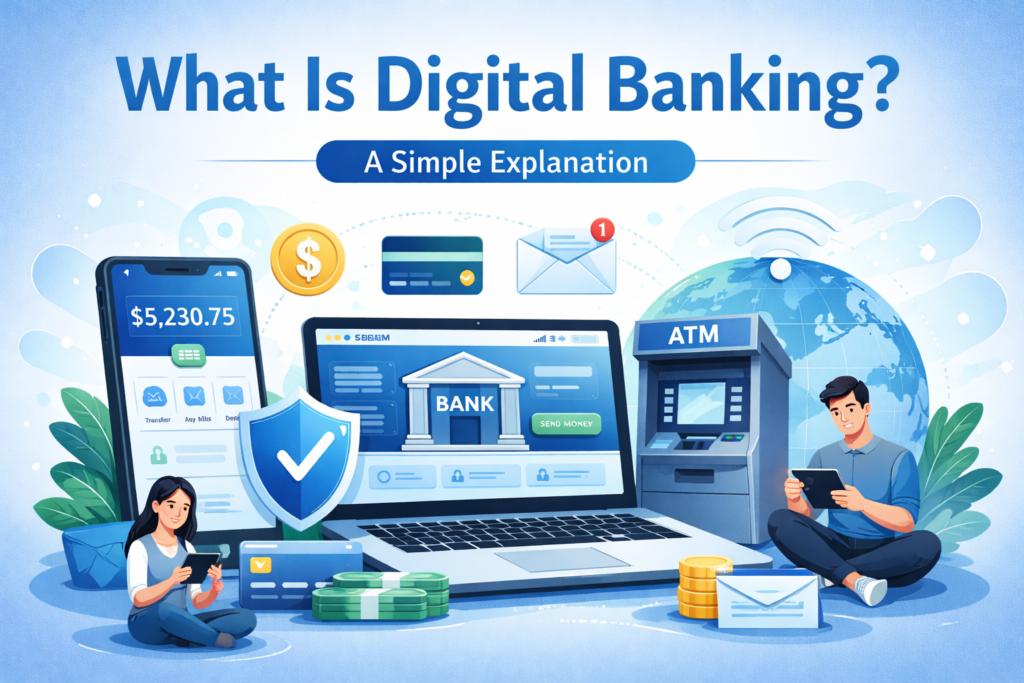
I’ve noticed many people feel confused when they hear terms like digital banking or online banking. It might sound like complicated jargon or just another app on your phone. From what I’ve seen, this confusion is common – beginners often wonder if digital banking is something completely different from “regular” banking or if it’s even safe to use. The good news is that digital banking isn’t as intimidating as it sounds. In simple terms, digital banking means accessing banking services through digital devices (like computers and smartphones) instead of visiting a bank branch in person. Let’s break down what that really means and how banking shifted from physical branches to the online world.
What Is Digital Banking in Simple Terms?
Digital banking (sometimes called online banking or internet banking) basically means doing your banking through electronic platforms. Instead of having to walk into a bank and talk to a teller, you can manage your money using a website or a mobile app. At its core, digital banking lets you access your bank account and financial services remotely, through the internet, without dealing with paper or visiting a building. For example, you can check your account balance on your phone, transfer money to someone with a few clicks, or deposit a check by taking a photo of it. All of these everyday tasks can be done anytime and anywhere with digital banking, which makes it incredibly convenient. In fact, the U.S. Federal Deposit Insurance Corporation (FDIC) notes that key features of digital banking are convenience and instant access, allowing you to handle your finances remotely in real time.
It’s important to understand that digital banking is not a different kind of bank or money – it’s the same bank accounts and services you’re used to, just delivered through digital channels. Whether you use a traditional bank (one with physical branches) or an online-only bank (one that operates entirely on the internet), using their website or app to pay bills, check balances, or transfer funds is digital banking. In short, digital banking is just regular banking made available on your computer, tablet, or phone. It cuts down on paperwork and waiting, letting you manage your money on your own schedule.
From Branches to Bytes: How Banking Moved Online
Banking hasn’t always been digital. There was a time when nearly all banking was done face-to-face at a branch. People would visit their local bank for everything – depositing paychecks, withdrawing cash, or asking questions – and banks kept records on paper. Over the past few decades, technology gradually changed this.
Then, in the mid-1990s, banks started offering internet banking through websites. For the first time, customers could view accounts or transfer money from home. In the 2000s, as internet use spread, online banking grew rapidly. The launch of smartphones around 2007 led to mobile banking apps, putting banking in everyone’s pocket. By the 2010s, using an app or website for banking had become common, replacing many routine branch visits.
Today, digital banking is truly mainstream. As of 2025, an estimated 3.6 billion people worldwide use online banking services – that’s nearly half of the world’s population. Banking moved online because it benefits both customers and banks. Customers enjoy speed and 24/7 convenience, and banks can serve more people at lower cost by automating services. In effect, logging into a banking app or website has taken the place of many trips to the bank, making everyday finances easier for everyone.
What Makes Banking “Digital”?
Several features distinguish digital banking from the old branch-based style of banking. Here are some key aspects that make a banking service “digital”:
- 24/7 Access: With digital banking, you aren’t limited by the 9-to-5 business hours of a branch. You can log into your account any time, day or night, to see your balance or make transactions. Need to pay a bill at midnight or check your balance on a Sunday? Digital banking lets you do that from anywhere with an internet connection.
- Online Money Transfers and Payments: You can transfer funds and pay bills online without handling cash or paper. For example, sending money through your bank’s app is much faster than mailing a check.
- Real-Time Account Updates: In traditional banking, you might not know your exact account balance until you get a monthly statement or passbook update. Digital banking gives you real-time updates on your account. The moment you receive money or make a purchase, your balance updates, helping you keep track of your finances instantly.
All these digital features make banking faster and simpler for users. Many traditional banks now offer the same online and mobile features as “digital-only” banks. The difference is that a digital-only bank has no physical branches at all, whereas a traditional bank gives you both options. But no matter which type of bank you use, whenever you manage your money through an app or website, you are experiencing digital banking in action.
Digital Banking vs. Traditional Banking: Key Differences
Even though digital and traditional banking serve the same basic purpose (helping you manage your money), the experience can be quite different. Here are a few key differences:
- Access & Hours: Traditional banking requires visiting a bank branch during business hours, while digital banking can be done anywhere, anytime (24/7) through the internet. You’re not limited by location or a strict schedule – your bank is as close as your phone or computer.
- Personal Interaction: At a branch, you speak with bank staff in person; with digital banking, everything happens through a screen (via chat, phone, or email). You lose the in-person touch, though many banks offer 24/7 support for online customers.
- Services: Branches are useful for special tasks like handling large amounts of cash or notarising documents, but almost all routine banking tasks can be done online – from checking balances to paying bills, and even opening new accounts or applying for loans.
Remember, you don’t have to choose one or the other. Most people use both: they handle routine things online and visit a branch when they need in-person service. Digital banking is just another option that makes managing your money easier and more flexible.
Common Misconceptions About Digital Banking
Because digital banking is relatively new compared to centuries of traditional banking, it’s natural for some myths and misunderstandings to pop up. Let’s clear up a few common misconceptions:
- “You Need to Be Tech-Savvy to Use It.” This is a common fear, but it’s not true. Banks design their online platforms to be user-friendly for everyone. If you can use a smartphone or the internet for everyday tasks, you can handle online banking. I think this fear is common, but it usually fades after people try one or two simple transactions. Banks also offer help if you need it, so you’re not on your own.
- “Digital Banking Isn’t Safe.” People often worry that online banking isn’t secure. In reality, banks use strong security measures to protect digital banking. They encrypt data and monitor for fraud. As long as you use your bank’s official app or website and keep your passwords private, online banking is very safe. Plus, your money is still insured by government protections just as it would be at a physical bank. In short, digital banking has to meet the same security standards as traditional banking.
- “Online-Only Banks Aren’t Real Banks.” If a bank has no physical branches, it might seem suspicious – but online-only banks are legitimate as long as they’re properly licensed and insured. They have to follow the same rules and offer the same protections (like deposit insurance) as traditional banks, just without brick-and-mortar locations. In other words, a lack of a storefront doesn’t mean a lack of trustworthiness.
By understanding these points, you can see that digital banking isn’t a trick or something to be afraid of – it’s simply a modern way to do the same banking tasks. Clearing up these misconceptions helps people approach online banking with more confidence and less worry.
Why Digital Banking Is So Common Today
You might wonder why digital banking has become the norm worldwide. In summary, it comes down to a couple of big reasons:
- Convenience & Technology: Almost everyone today has access to the internet or a smartphone, so banks offer services online to meet us where we already are. People love being able to manage their finances quickly on their own schedule, and banks benefit by operating more efficiently through digital channels. The result is that online banking has become an expected part of banking.
- Reaching More People: Digital banking has also expanded access to financial services globally. In many developing regions, mobile banking is how people get their first bank accounts. As a result, nearly 80% of adults worldwide now have a bank account, up from about 50% in 2011. By removing the need to live near a branch, online services allow millions more people to participate in banking.
All these factors together have made digital banking the “new normal” in how we handle money. Opening a bank account today almost always comes with online access by default. What used to be considered a bonus feature is now a standard part of banking.
Embracing Digital Banking as a Beginner
If you’re just starting, it’s okay to take it step by step. Digital banking is meant to make your life easier. You can try one simple task online (for example, checking your balance or paying a small bill) and see how it works. Most people find that after one or two tries, they feel more confident.
For more guidance on actually using online banking, you can read our main guide on how online banking works. It walks through the practical side of managing accounts and transactions through websites and apps, complementing what you’ve learned here.
In summary, digital banking is basically regular banking powered by modern technology. It brings your bank’s services to your computer and phone, so you don’t have to adjust your life to the bank’s schedule – the bank adjusts to your life. It’s normal to be cautious with anything new, but millions of people have found digital banking to be safe, convenient, and reliable. By understanding what digital banking is and giving it a try, you can manage your money with more freedom and confidence. Banking has always been about trust and access – digital banking offers both, in a way that fits our modern connected world.