
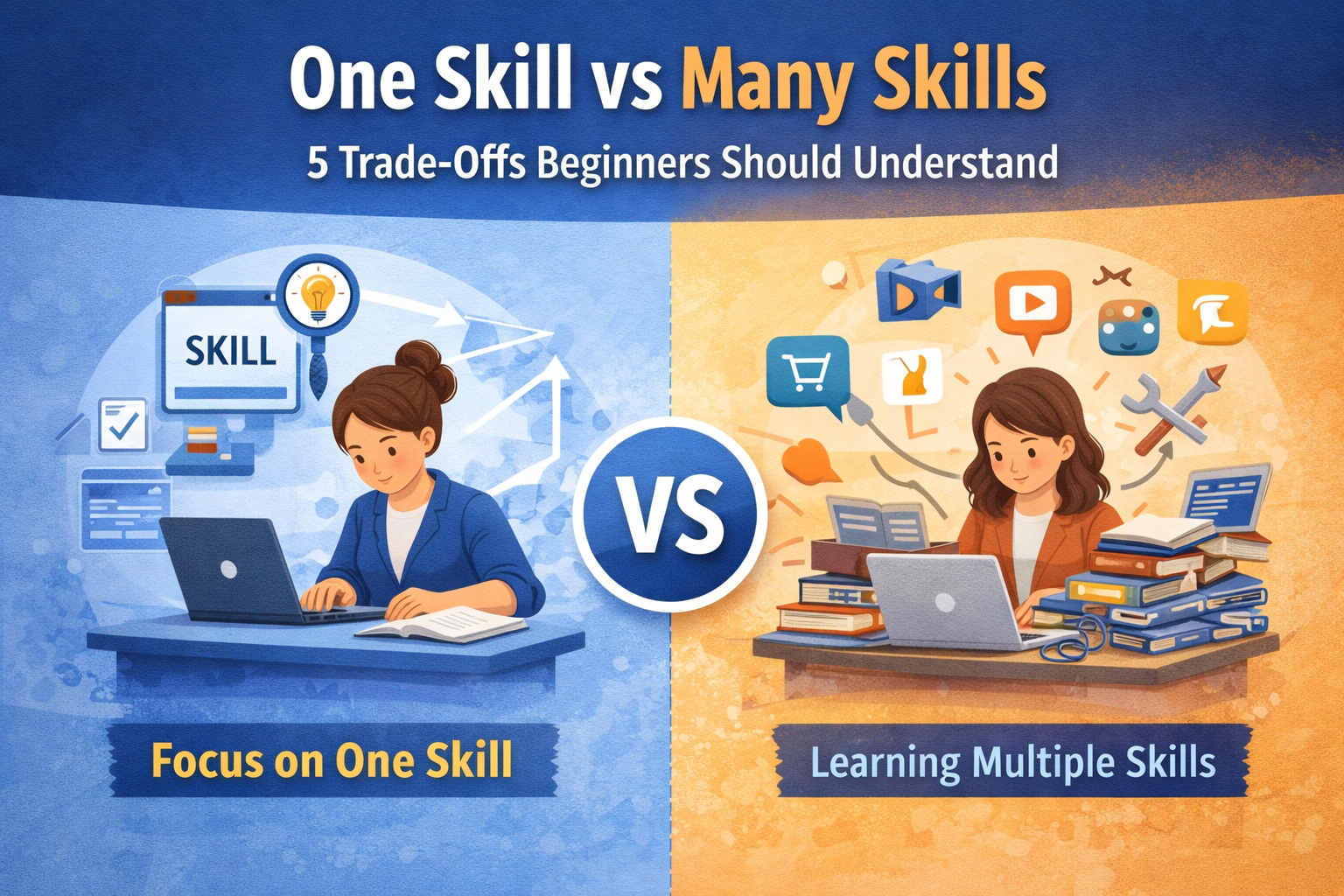
If you’re new to the world of online work, you might have heard that learning one in‑demand skill is the smartest choice, while other voices insist that diversifying your skills is the key to staying relevant. This back‑and‑forth can leave beginners feeling stuck and unable to decide how to spend their time. I’ve noticed beginners often feel pressured to learn everything because the internet makes so many opportunities seem urgent. At the same time, focusing on only one thing can feel risky when there are so many unknowns in an online landscape. In this article One Skill vs Many Skills looks at why that confusion happens and what’s really behind the idea of one skill versus many skills. The aim is not to choose a winner but to provide a calm explanation so you can think clearly about your learning path.
Table of Contents
Why “One Skill” Appeals to Some Beginners
When people talk about “mastering one skill,” they usually mean devoting the majority of their time to a single area of expertise. In freelancing, this could be writing, graphic design, or coding. The attraction is straightforward: focusing deeply on one discipline can make you more efficient and help you develop a reputation for quality. From what I’ve seen, beginners like this approach because it promises clarity—there’s a single path to follow, a single set of tools to practice, and a single client profile to target.
Learning one skill also aligns with how many traditional professions operate. In medicine, law, and engineering, specialisation is rewarded because expertise is built over time. Even outside these fields, it can feel reassuring to become known for something specific. There is research suggesting that incremental improvements come more easily when you continue to refine the same techniques. Deep practice can lead to small but significant gains, making your work faster and more polished.
The flip side, however, is that focusing exclusively on a single discipline may lead to diminishing returns. Once you are competent, each hour of practice produces smaller improvements. Scott H. Young, a writer on learning methods, explains that after the initial phase of getting comfortable with new tools, it becomes harder to see large leaps in performance. For online work where technology and trends change quickly, being too specialised may make you less adaptable.
Why “Many Skills” Seems Like the Safer Bet
The alternative is to learn a variety of skills. In the online world, this might look like combining writing with basic design, or combining marketing with website management. Beginners may gravitate toward this because it feels like hedging your bets—if one skill does not lead to immediate income, perhaps another will. Social media reinforces this idea by showing people who appear to do multiple things at once.
From what I’ve seen, curiosity plays a big role. Some people genuinely enjoy learning different tasks and feel energised by variety. It also reflects a broader cultural narrative about being a “generalist.” Author David Epstein, whose book Range argues that generalists often find success, notes that having a broad toolbox helps you identify the deeper structure of problems and find analogies across domains. In research he cites, students who pursued multiple minors (a generalist approach) performed better on problems outside their main field than students who specialised in a single major. The underlying idea is that diverse experiences build cognitive flexibility.
A second reason is resilience. When industries change, people with a wider skill set may adapt more quickly. Studies across several countries found that learners who had a broader education were more adaptable over time, whereas those with a career‑focused education started with higher wages but were more vulnerable to shocks in their industry. In the uncertain landscape of digital work, this long‑term adaptability can be appealing. A generalist can pivot if a platform changes its rules, a market contracts, or a client’s needs evolve.
Trade‑Offs Between Depth and Breadth
Understanding why both paths seem attractive makes it easier to see their trade‑offs. Focusing on one skill can bring clarity and quicker competence. When you concentrate on a single craft, you can deliver a consistent level of quality and build trust with clients more easily. Specialisation can also command higher rates once you become known for a niche. The trade‑off is that your adaptability may be limited. In a field where tools, technologies, or customer needs shift quickly, you might find yourself relearning fundamental concepts or trying to switch paths without the familiarity that comes from having sampled other fields.
Taking on many skills has its advantages and challenges. It can broaden your thinking and help you recognise patterns across different domains. Epstein points out that generalists often have a better grasp of underlying structures and can transfer knowledge between fields. This broader perspective can help with creative problem‑solving, something valuable in freelancing or content creation, where projects often span multiple disciplines. On the other hand, spreading your attention thinly can slow down the moment when you feel confident enough to sell your services. If every week introduces a new tool or technique, you might struggle to build momentum in any one area.
A useful way to think about these trade‑offs is the difference between speed and patience. Focusing on one skill offers a faster route to competency, but it may narrow your opportunities later. Exploring many skills takes longer to convert into income, but it can lead to a more robust career over time. As Scott H. Young notes, you may gain larger improvements when you learn new tools or areas rather than squeezing out minor gains in an already familiar field. The key is understanding that both approaches involve learning, just at different paces and with different outcomes.
Why Confusion Happens
Beginners often receive contradictory advice because the people giving it have different experiences. Someone who built a career through deep specialisation might encourage you to concentrate on a single craft, while a person who found success by combining skills might emphasise variety. This can feel like being told to zig and zag at the same time.
Information overload also plays a part. Online spaces are filled with lists of “must‑learn” skills, each promising to be crucial for success. Watching others juggle multiple projects can make focusing on one skill seem like you’re falling behind. On the other hand, seeing someone with a single, polished skill set can make diversification look like a waste of time. From what I’ve seen, this pressure is intensified by fear of missing out—if you choose one thing, you worry about being locked out of other opportunities.
There’s also a misunderstanding about what it means to be a generalist or a specialist. Epstein explains that many people who end up highly specialised often go through an early sampling period. They try a variety of activities, home in on what they enjoy, and then focus more deeply. In other words, being a generalist early on doesn’t preclude specialisation later, and vice versa. Confusion arises when beginners treat these stages as mutually exclusive rather than sequential or overlapping.
What “One Skill Focus” Really Means
To appreciate what focusing on one skill looks like, imagine a freelance graphic designer who spends most days refining illustration techniques, learning design software, and studying visual trends. Their income comes from providing a service to clients, and their reputation depends on delivering consistent quality. They might occasionally dabble in related areas like branding strategy, but their main energy goes into one craft. This path is about selling a skill directly and improving it over time. It is also about communicating your value clearly; clients know you do this specific thing well.
A single skill focus does not mean ignoring the outside world. Even specialists need to keep up with trends, learn about clients’ industries, and sometimes coordinate with other professionals. But the primary investment is in-depth. Beginners who choose this approach often aim for freelance or contract work where the value of a single, well‑developed skill is easy to explain. On a site like DollarRaid, this concept is reflected in the difference between service‑based income and product‑based income. Service‑based income involves providing a skill or expertise directly to someone who needs it, which parallels the focus on depth.
What “Many Skills” Thinking Looks Like
Now consider someone exploring content creation alongside basic web design, copywriting, and social media management. They might record videos, write blog posts, and build simple websites for personal projects. This person isn’t trying to master everything but is sampling a range of abilities to see what resonates. They might later narrow down to video editing or writing, but in the early stage, they treat learning as a discovery process.
This approach is less about selling a specific service immediately and more about building a broad base for future projects. It aligns with how many bloggers and content creators operate when they start. They experiment with formats and topics, gradually discovering where they have the most impact. Our article on Starting small with your first online income idea explains that beginning with manageable experiments helps you gauge interest and develop confidence. When you’re learning multiple skills at once, starting small avoids the trap of spreading yourself too thin.
Clarity vs Flexibility – A Closer Look
Speed vs Patience
One of the first trade‑offs is how quickly each approach can turn into income. When you focus on a single skill, you can offer it to clients sooner. This can be important if your immediate goal is to generate revenue. However, long‑term growth may slow as you hit a competence ceiling. A generalist path, by contrast, requires patience. You might spend more time learning and experimenting before you feel ready to sell anything. Yet the payoff could be a broader range of opportunities later. Studies indicate that generalists may adapt better when industries shift, which is valuable in the ever‑changing online economy.
Depth vs Exploration
Another contrast is between depth and exploration. Specialists gain satisfaction from mastering subtleties and delivering refined work. They enjoy seeing measurable improvements in quality and efficiency. Generalists, by exploring different areas, can connect ideas across domains and discover unexpected synergies. Research suggests that a wider skill set helps with problem‑solving because you can identify patterns and analogies. For a beginner, acknowledging that both experiences have value can reduce the pressure to choose prematurely.
Consistency vs Growth Variation
Specialists often experience more consistent progress early on. Each project builds on the last, making it easier to measure improvement. Generalists can feel like they are oscillating between progress and plateaus because learning in one area may temporarily slow down while picking up a new tool or technique. This variability can feel frustrating if you expect linear growth. On the other hand, long‑term growth may be more significant because learning a new tool can lead to substantial leaps. Recognising that growth will look different depending on your path makes it easier to set realistic expectations.
Why Beginners Feel Pressure to Learn Everything
The modern internet environment rewards variety. Social media platforms favour creators who can juggle multiple formats: video, audio, text, and visual design. Job descriptions often combine several tasks—customer support with marketing, or writing with analytics. As a result, beginners see examples of people succeeding with a mix of skills and assume that becoming a “jack of all trades” is the only way to thrive. This leads to the fear that focusing on one discipline will make you obsolete.
There’s also the perception that developing multiple skills opens more doors faster. A generalist resume may seem more adaptable to potential clients or employers. David Epstein points out that people who can explain their varied experiences as part of a narrative often stand out in competitive processes. Yet this advantage depends on how well you connect the dots between different skills. Without a clear story, a scattered skill set can look unfocused.
Finally, information overload contributes to the pressure. The sheer volume of courses, guides, and platforms makes it easy to start learning something new every week. Our pillar article, Choosing Your Online Income Path, reminds readers that decisions become harder when you’re bombarded with options. It’s natural to feel like you need to learn everything right away, but doing so without direction often leads to burnout. Taking a step back to understand why you’re learning something can help you avoid this trap.
Preparing to Learn: A Mental Shift
Before diving into any skill—single or multiple—it helps to build a foundation. That foundation is understanding how you learn best and what you find engaging. Our article on What to learn before trying to earn online emphasizes the importance of exploring topics like digital tools, communication, and self‑management. Even a specialist benefits from broad knowledge in these areas because they make collaboration and project delivery smoother. A generalist, meanwhile, uses these fundamentals to tie disparate skills together.
Another part of preparation is recognising that learning is iterative. You’ll revisit topics, refine techniques, and occasionally switch directions. Epstein notes that even specialists often start with a sampling period. Knowing this can relieve the anxiety of making the “wrong” choice early on. You can begin with one skill and expand later, or sample many and then focus more deeply. What matters is that your decisions are intentional rather than reactive.
Why Neither Path Is Permanent
A critical point for beginners is that choosing a focus or exploring many skills isn’t irreversible. People shift directions throughout their careers. You might start with freelance writing, discover that you enjoy editing videos, and gradually move toward multimedia production. Or you might begin as a generalist, then notice that you enjoy one aspect more and decide to specialise. In either case, the skills you learned along the way are not wasted. They form a toolkit you can draw on when needs arise.
I think this perspective helps reduce the fear of committing to a path. Understanding that transitions are common allows you to make choices with less pressure. The ability to switch or stay depends on your goals, interests, and the opportunities you encounter. Our guide When to Switch or Stick with an Online Income Path explores how to evaluate these decisions calmly. Rather than seeing a change as a failure, you can view it as part of a normal learning journey.
Closing Section
There is no universal rule about whether beginners should focus on one skill or learn many. Both approaches have merits and challenges. Specialists may build credibility quickly and earn sooner, but they risk being less adaptable. Generalists may take longer to see results, but they gain flexibility and creative problem‑solving ability. Confusion often arises because advice comes from people with different experiences and because the internet amplifies extremes. Recognising that early sampling and later focus can coexist helps shift the conversation away from “right vs wrong” and toward understanding personal preferences.
The most important lesson is that your learning path is about alignment, not urgency. Knowing yourself—what interests you, how you like to work, and what kind of projects energise you—matters more than following a trend. By reducing the noise and reflecting on why you want to develop a skill, you can move forward with confidence. Whether you choose depth or breadth, you are still learning and growing. This calm, grounded perspective will serve you better than chasing the latest fad or feeling guilty about not doing enough.