
If you have ever tried to pay a contractor, send money to a friend abroad or top up a digital wallet, you may have noticed how many labels exist for essentially “moving money.” Terms like bank transfer, wire, ACH, card payment and digital wallet are used interchangeably in conversation, yet your statements and apps treat them differently.
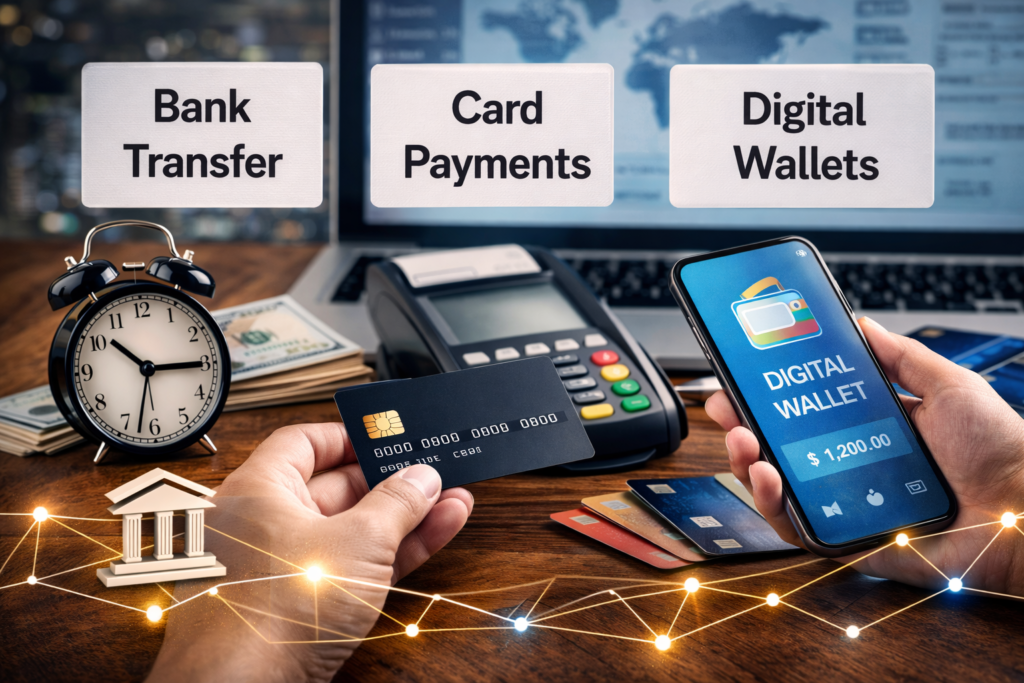
You might see a purchase go through instantly with a credit card, but wait days for a bank transfer to clear. A friend might ask to be paid via a digital wallet, while your utility company insists on a bank transfer. This article unpacks the differences among bank transfers vs card payments vs digital wallets to help you see how each model moves money.
Table of Contents
What We Mean by Bank Transfers, Card Payments and Digital Wallets
To compare these three methods, it helps to define them. Bank transfers include domestic transfers such as ACH or domestic wire payments and international transfers via correspondent banking. In modern payment systems, a transaction is considered complete only when settlement occurs – the release of payment obligations and the final transfer of funds between accounts. Direct participants in a payment system instruct, clear and settle payments on their own, while indirect participants rely on a direct participant to perform those steps.
Card payments run on card networks such as Visa or Mastercard. When you pay by card, merchants send transaction data to their acquiring bank, which forwards it through the card network for authorisation by the issuing bank (the customer’s bank). Clearing delivers final transaction data from acquirers to issuers, while settlement transmits sales information to the card‑issuing bank for reimbursement to the merchant. Funds flow from the issuing bank through the card network to the acquirer, then to the merchant. Because a card network stands between the two banks, it can provide features like chargebacks and fraud checks, but adds layers of processing and fees.
Digital wallets are financial applications on a device that let users store funds, track payments and make transactions through e‑commerce or person‑to‑person payments. Wallets can hold pre‑funded balances and can be loaded from a bank account, card or other source. The Federal Reserve notes that instant payment services allow digital wallet providers to let users fund or defund wallets in real time. In short, digital wallets combine stored value with a user interface, sitting on top of bank or card rails.
READ: The Complete Guide to Payment Systems & International Money Transfers
Bank Transfers: Clearing and Settlement Through Payment Systems
Bank transfers occur through payment systems such as ACH, real‑time gross settlement (RTGS) or interbank networks. In Canada, for example, the Bank of Canada explains that settlement is the release of payment obligations; a payment is complete when funds are transferred from one bank account to another. Direct participants clear and settle payments themselves, often using central bank accounts, while indirect participants rely on direct participants.
Domestic ACH transfers in the U.S. are batch‑processed: payment instructions accumulate and settle together at designated times. Domestic wires through Fedwire are processed in real time but only during operating hours. For international wires, banks send instructions via the SWIFT messaging network and rely on correspondent banks to move funds across borders. These processes involve multiple parties and regulatory checks, which we explore further in our article on What is SWIFT and how do international wires work?
Card Payments: Authorisation, Clearing and Settlement via Card Networks
Card payments follow a standardised three‑stage process. During authorisation, the merchant’s acquiring bank requests approval from the card network and issuing bank, checking that the card is valid and the customer has sufficient credit or funds. Clearing then transmits the final transaction data from acquirers to issuers and calculates fees and currency conversions. Finally, settlement transfers sales information to the issuing bank for collection and reimbursement to the merchant. Funds flow from the card‑issuing bank to the card network, then to the acquirer and finally to the merchant.
Because card networks stand between the customer’s bank and the merchant’s bank, they can enforce standards (like EMV chip protocols), offer fraud protection and manage chargebacks. However, they also charge interchange fees to the merchant and may delay the final settlement until the network processes the transaction. These fees and their impact on international transfers are explored in International money transfer fees explained.
Digital Wallets: Pre‑Funded Balances and Instant Transfers
Digital wallets store value within the application itself, offering a hybrid of card and bank rails. The Federal Reserve describes digital wallets as applications that allow customers to store funds, track payments, and make transactions in e‑commerce or peer‑to‑peer contexts. Users can load money into the wallet from a linked bank account or card and can cash out by transferring the wallet back to their bank account.
The FedNow Service (a U.S. instant payment rail) enables wallet providers to fund and defund wallets instantly, meaning a wallet top‑up or withdrawal can clear and settle in real time. Digital wallets often act as pre‑funded “store of value” accounts: the wallet provider holds the customer’s money until the customer spends or withdraws it. Because the funds are already with the provider, a purchase can happen instantly without waiting for bank settlement. However, this also means the user’s money is exposed to the wallet provider’s risk, and transferring large sums out of the wallet may still involve bank or card rails.
Contrasts and Trade‑Offs
Speed vs Control
Bank transfers that use ACH are typically slower because they settle in batches; domestic wires can be same‑day but only during service hours. Card payments clear quickly at the point of sale, but settle with merchants with a delay of one to several days. Digital wallets offer near‑instant payments when both parties use the same platform and the funds are pre‑funded, especially if instant payment rails like FedNow or RTP are used for wallet funding.
Control differs, too. With bank transfers, the sender must initiate the payment and usually cannot recall it once it is settled. Card payments allow merchants to initiate charges, but cardholders have protections such as chargebacks. Digital wallets offer varying levels of recourse depending on the provider’s policies; in peer‑to‑peer transfers, reversal may be difficult, while in purchases, providers may offer buyer protection.
Reversibility and Consumer Protections
Card networks provide dispute resolution mechanisms. The OCC explains that if a cardholder disputes a charge, the issuer may post a provisional credit, request documentation from the merchant, and, if necessary, reverse the transaction. Debit card transactions are governed by the Electronic Fund Transfer Act, which outlines consumers’ rights and responsibilities in case of errors or unauthorised transfers.
Bank transfers, especially wires, are typically final once settled; reversing a wire requires the consent of the receiving bank and is difficult. Digital wallet reversibility depends on the platform’s terms and regulatory regime. Some wallets provide buyer protection similar to card chargebacks, while others treat transfers as cash and cannot reverse them. Understanding these protections is essential when choosing a payment method.
Pre‑Funding vs On‑Demand Funding
Digital wallets rely on pre‑funded balances. When you load money into a wallet, you effectively convert your bank deposit into a stored value with the wallet provider. This pre‑funding allows the wallet to transfer value instantly between users without waiting for bank settlement. Bank transfers and card payments, by contrast, fund each transaction on demand from the sender’s account. This means they must clear and settle every time, which can slow down the process, but also ensures that your funds remain in your own account until you choose to send them.
Payment Rails: Bank vs Card vs Wallet
Bank rails include ACH, RTGS (like Fedwire or Lynx) and other clearing systems. They move money directly between bank accounts, often using central bank money. Card rails rely on associations (Visa, Mastercard) to route authorisation, clearing and settlement messages. Digital wallets sit on top of either bank rails (for funding and defunding) or card rails (for funding with a card). Some wallets offer their own peer‑to‑peer rails for internal transfers, but cross‑platform transfers still revert to bank or card systems.
The Federal Reserve’s pay‑by‑bank concept shows how bank rails can be used at point‑of‑sale: pay‑by‑bank transactions originate from a customer’s bank account, are routed over ACH or instant payment rails, and settle directly into the merchant’s account without involving card network intermediaries. By contrast, card payments always involve the card network as an intermediary. Understanding this distinction helps explain why some merchants and fintech firms promote pay‑by‑bank: it reduces reliance on card networks and their associated interchange fees.
READ: Currency Exchange Rates and Your Transfer: Understanding the Value Behind Every Conversion
Calm Conclusion: Seeing the Big Picture
Bank transfers, card payments and digital wallets each represent different approaches to moving money. Bank transfers connect bank accounts directly through clearing and settlement systems; they are reliable and are the primary means of moving large sums and salaries, but they can be slower due to batch processing and regulatory checks. Card payments route transactions through card networks, providing convenience, fraud protection, and global acceptance, yet they introduce intermediaries and fees and may delay merchant settlement. Digital wallets combine stored value with instant transfers and convenient interfaces; they rely on pre‑funded balances and can offer near‑real‑time payments but depend on underlying bank or card rails for funding and withdrawal.
There is no single “best” payment method. Each model exists because it balances speed, cost, control and regulation differently. By understanding these differences, you can choose the method that aligns with your needs and appreciate how all three contribute to the wider payment ecosystem.
Frequently Asked Questions
What is the main difference between a bank transfer and a card payment?
A bank transfer moves money directly from your bank account to the recipient’s account through payment systems such as ACH or wire networks; the transaction completes when the funds settle. A card payment uses a card network to authorise, clear and settle the transaction; the network intermediates between the issuing bank and the merchant. Funds travel from the issuing bank to the card network to the acquiring bank and then to the merchant.
Are digital wallets the same as bank accounts?
No. A digital wallet is a software application that stores value and payment credentials on your device. It allows you to store funds, track payments and make transactions, but the balance is held by the wallet provider, not your bank. You typically fund the wallet by transferring money from your bank account or card, and can withdraw funds back to your bank account when needed.
Which payment method is fastest?
Speed depends on the rails used. Card payments are authorised quickly, but settlement can take a day or more. Domestic bank transfers via ACH may take one to two business days, while wires and instant payment rails can be same‑day or real-time but operate during specific hours. Digital wallets facilitate instant transfers within their ecosystem if funds are pre‑funded, especially when supported by instant payment services.
Can I reverse a bank transfer or digital wallet payment?
Bank transfers, particularly wires, are generally final once settled. ACH transfers can sometimes be reversed in cases of error or fraud, but reversal is not guaranteed. Card payments offer chargeback rights; consumers can dispute transactions, and the issuing bank may reverse the charge. Digital wallet reversibility depends on the provider’s terms; some platforms provide buyer protection, while peer‑to‑peer transfers may be final.
Why do merchants encourage pay‑by‑bank or digital wallet payments?
Pay‑by‑bank transactions originate from the customer’s bank account and settle directly into the merchant’s account via ACH or instant payment rails, bypassing card network intermediaries. This can reduce interchange fees and speed up funds availability. Digital wallets can also reduce card fees and offer instant transfers when both parties use the same platform. However, the costs and benefits vary by provider, transaction volume and funding mechanism.
How do digital wallets fund and defund instantly?
Instant payment services like the FedNow Service allow wallet providers to move money between users’ bank accounts and their digital wallets in real time. When you top up your wallet, the wallet provider triggers an immediate bank transfer over the instant payment rail; when you withdraw, the process reverses. This 24/7 capability makes wallets useful for immediate payments and seamless account management.