
If you’ve ever paused before confirming a transfer, you already understand the emotional side of international money transfer safety. The amount might be modest—say, $400 for a contractor invoice or €250 for a family expense—but the uncertainty can feel much larger than the number. One tap, and your money is no longer in front of you.
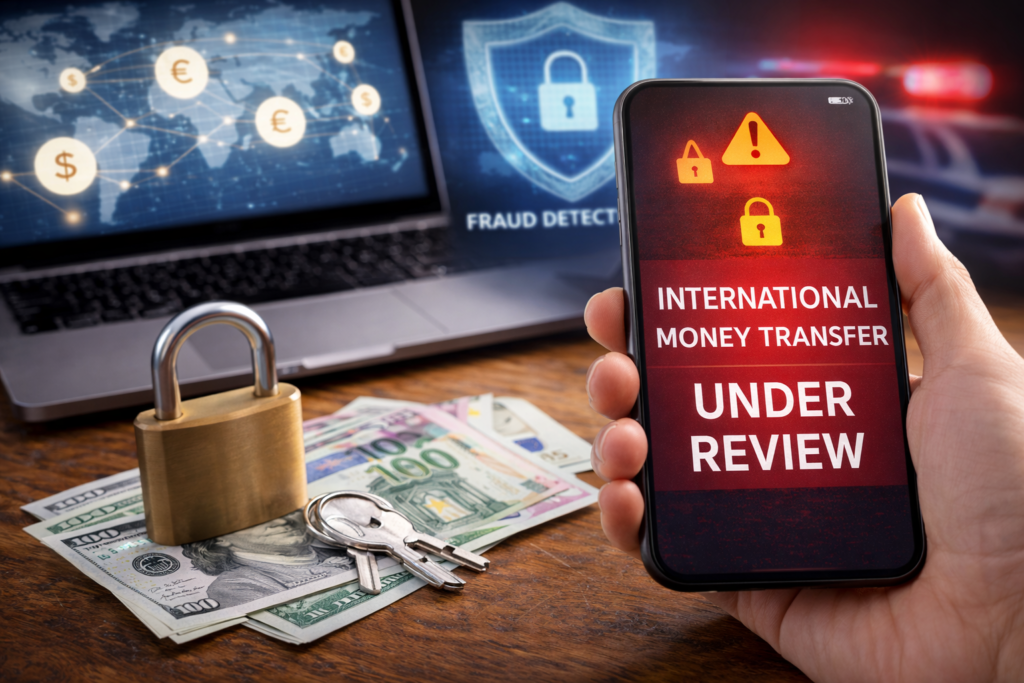
That uneasy feeling is rational. Cross-border transfers often move through more than one institution, sometimes through several intermediaries, and each link follows its own rules for security and compliance. The Bank of England explains that cross-border payments can involve a chain of correspondent banks, and that at each bank, messages are checked against local financial crime requirements, with domestic settlement systems operating mainly during business hours.
The pillar guide, Payment Systems & International Money Transfers, gives the wider map of domestic rails, correspondent banking, and settlement. This supporting piece zooms in on one theme: how the system tries to protect you, and why that protection can sometimes look like friction.
Table of Contents
International money transfer safety is mostly risk management
At a system level, “safe” rarely means “nothing can go wrong”. It means the payment ecosystem is set up to reduce specific risks: fraud, unauthorised account access, sanctions breaches, money laundering, cyber intrusion, and operational failure.
A helpful lens is the language used for critical market plumbing. The internationally recognised Principles for Financial Market Infrastructures state that systems should be designed to ensure a high degree of security and operational reliability, and to manage operational risk with appropriate controls, including continuity planning and timely recovery after disruption.
Retail international transfers don’t always travel through the same infrastructure as major financial market systems, but the design mindset is similar: build layers of controls so that no single failure (a stolen password, a suspicious corridor, a compromised endpoint) becomes a simple path to loss.
This is also why global policy documents talk about compliance and data as both a safety feature and a source of delay. The Financial Stability Board’s work on cross-border payments notes that uneven implementation of AML/CFT and sanctions screening increases the complexity of validating legitimacy, and the same transaction may need to be checked several times as it moves along the payment chain—creating delays or rejection in some cases.
So, international money transfer safety is often the story of trade-offs: more screening can mean less speed; more finality can mean less reversibility; better authentication can mean more friction at login.
What risk controls are doing when a transfer gets flagged
When people say “my transfer got flagged”, they usually imagine a person staring at their payment. More often, it’s a combination of automated checks, rules, and escalation thresholds.
Fraud detection and account protection
A large share of payment loss happens before a cross-border transfer even begins: through account takeover, impersonation, or manipulation of the payer. In Europe, strong customer authentication (SCA) was introduced as a legal requirement under PSD2 to reduce certain kinds of fraud, and the EBA and ECB have reported that SCA remains effective against the fraud types it was designed to mitigate, particularly for card payments—even as fraudsters adapt.
That matters for cross-border transfers because the safest payment in the world is still unsafe if the wrong person initiates it. Authentication, device checks, and behavioural monitoring are designed to answer one blunt question: “Is the real account holder pressing send?”
AML monitoring and suspicious activity reporting
AML monitoring is where safety starts to look like silence. In the FATF standards, if a financial institution suspects money laundering or terrorist financing, it should seek to identify and verify the customer and beneficial owner and make a suspicious transaction report to the financial intelligence unit.
Just as important: FATF standards also prohibit “tipping off”—disclosing that a suspicious transaction report (or related information) is being filed.
That single rule explains why banks sometimes cannot give a detailed reason for a hold. It can feel cold from the outside, but it is part of the architecture of investigations: if people knew they were being reported, they could move funds or destroy evidence.
Sanctions screening and “freezing” obligations
Sanctions screening is one of the clearest cases where safety becomes non-negotiable. If a payment matches a designated person or prohibited activity, the institution may be legally required to stop the movement of funds.
In the United States, OFAC explains that “blocking” refers to freezing assets, immediately prohibiting transfers or dealings with the property; blocked property within US jurisdiction or control must be blocked (frozen) and may not be transferred or withdrawn without authorisation.
In the UK, government guidance describes an asset freeze as generally prohibiting dealing with funds or economic resources belonging to, owned, held, or controlled by a designated person, and prohibiting making funds available to or for the benefit of that person.
These frameworks are part of international money transfer safety, even though they can feel harsh. The point is that some “stops” are not customer service decisions; they are legal controls built into the financial system.
Why compliance checks can create delays
When checks stack up—AML, sanctions, data validation—the payment doesn’t just slow down because of “process”. It slows because the chain becomes harder to automate. The FSB notes that compliance checks can be complex and repeated along a payment chain, and false positives can occur when names resemble those on lists, with the complexity increasing as intermediaries increase.
If you want the specific “time friction” side of this story—cut-off times, intermediaries, weekends, settlement windows—this is explored in Why International Transfers Get Delayed. (The point here is simply that delay is often the visible shape of risk controls doing their job.)
Secure messaging, encryption, and why SWIFT matters for safety
It helps to separate two ideas: the safety of the message and the safety of the money movement. In many cross-border flows, banks depend on secure messaging standards so institutions can exchange payment instructions reliably across jurisdictions.
SWIFT describes itself as a network used by banks and financial institutions to communicate securely about cross-border transactions, providing a universal language for institutions in different countries to communicate, and presenting itself as a secure and resilient network for high-value financial communication.
SWIFT also operates a Customer Security Programme (CSP), described as a mandatory initiative to help financial institutions protect their SWIFT footprint against cyber threats by implementing and attesting to security controls in its Customer Security Controls Framework.
This matters because cross-border risk is not only financial crime risk. It’s also cyber and operational risk: endpoint compromise, credential theft, malicious message creation, or disruption of availability. The CPMI and IOSCO have released cyber resilience guidance aimed at strengthening the ability of financial market infrastructures to pre-empt cyber attacks, respond effectively, and recover safely.
If you want the fuller “SWIFT is messaging, not a pipe of money” explanation, the supporting article What Is SWIFT and How International Wires Work explores that distinction in plain language.
Chargebacks, irreversible wires, and the safety trade-off people don’t see
One reason people disagree about whether international transfers are “safe” is that they quietly mean different things by “safe”.
Some people mean: Can I reverse it if something goes wrong?
Others mean: Can it be intercepted or altered?
And others mean: Will the system reject illegal activity?
Payment methods answer these questions differently, by design.
Card payments and dispute-based protection
Card systems often include dispute and error resolution frameworks that make reversals possible in certain situations. In the US, Regulation Z sets out billing error resolution for credit cards and requires creditors to investigate alleged billing errors under defined procedures.
For electronic fund transfers, Regulation E defines covered errors (including unauthorised transfers) and lays out investigation timelines and provisional crediting rules when an investigation can’t be completed quickly.
This kind of structured dispute handling can feel like “safety” because it creates a pathway for correction. But it also changes the risk picture for merchants and recipients: reversibility can protect consumers while increasing uncertainty for the receiving side.
Wires and settlement finality
Some wire systems emphasise a different safety principle: finality. The Federal Reserve describes the Fedwire Funds Service as a real-time gross settlement system where transfers are immediate, final, and irrevocable once processed.
Finality can be a form of safety, too. It reduces settlement risk and the potential for payments to be unwound after critical obligations are met. But it also means that if a payment is sent to the wrong place, recovery may rely on cooperation and investigation rather than a built-in “undo”.
If you want a focused comparison of how bank transfers, card payments, and wallets distribute these trade-offs, Bank Transfers vs Card Payments vs Digital Wallets covers the structural differences without turning into shopping advice.
Why banks freeze accounts
Account freezes and transfer holds can feel accusatory. But most of the time, they are procedural. They happen because risk controls operate on patterns, thresholds, and legal obligations—not on whether someone “likes” your transaction.
Sanctions regimes show the clearest version of this. OFAC explains that when blocking is required, the property is frozen and may not be transferred or dealt in; reporting obligations apply, and the property remains owned by the blocked person even though it cannot be used without authorisation.
In the UK, the government describes how an asset freeze generally prohibits dealing with frozen funds/economic resources or making funds available to designated persons, and these restrictions exist to enforce sanctions regimes.
On the AML side, FATF standards tie suspicion to identity verification and reporting, while also prohibiting tipping off. That combination can create a familiar user experience: a hold with limited explanation. It can be unsettling, but it is consistent with how suspicious activity frameworks are meant to work.
Calm clarity to end on
So, how safe are international money transfers?
The calm answer is that international money transfer safety is not one feature. It’s a set of layered controls: fraud defences to reduce unauthorised access, AML monitoring and reporting to limit illicit finance, sanctions screening to enforce legal restrictions, secure messaging and cyber controls to protect integrity, and settlement rules that either prioritise reversibility (in some payment types) or finality (in some wire systems).
Those controls can be frustrating because they add friction and sometimes silence. But they exist because cross-border payments move through a world where mistakes, fraud, sanctions, and cyber threats are real. The system’s job is not to feel smooth. It’s to keep moving while preventing the wrong kinds of movement.
Frequently asked questions
Are international money transfers safe in general?
International transfers are designed with multiple layers of risk controls, but “safe” depends on what you mean: protection from fraud, ability to reverse, and legal compliance are all handled differently across rails.
Why do some international transfers get flagged for review?
Transfers can be flagged when automated checks detect unusual patterns, data mismatches, or potential sanctions/AML screening concerns that require extra validation.
Why can a bank freeze my transfer without telling me the exact reason?
Some compliance frameworks restrict what institutions can disclose when suspicious activity reporting is involved, which can limit the detail they share during a hold.
Is a card payment safer than a bank transfer for cross-border payments?
Card payments and bank transfers offer different kinds of protection. Cards often have dispute mechanisms, while some wire systems focus on final settlement and irrevocability.
Are international wire transfers reversible?
Some wire systems are designed for finality once processed, which makes reversals difficult compared with dispute-based payment methods.
Does SWIFT make an international transfer “safe”?
SWIFT is a secure messaging network used for payment instructions, but safety also depends on bank controls, compliance checks, and settlement rules beyond the message itself.
Why do sanctions cause payments to be blocked or frozen?
Sanctions regimes can legally require institutions to freeze assets and prohibit transactions with certain designated persons or entities.
Why do fraud controls sometimes make payments slower?
Stronger fraud prevention often means additional authentication, monitoring, and review, which can reduce losses but introduce processing friction.
Can an international transfer be stopped once it’s sent?
It depends on where the payment is in its lifecycle and what rail is used. Some payment types allow certain cancellations early; others become hard to unwind once final settlement occurs.
What’s the simplest way to think about safety in cross-border payments?
It’s a balance between speed, reversibility, and compliance. The system adds controls to reduce fraud and illicit finance, even when that makes the experience less predictable.