
Money should be simple. You earn it. You pay for life. You save what’s left.
And yet, many people (especially at the start of adult life, or after a job change) realise the “simple” version breaks the moment the calendar gets involved. Bills do not arrive politely on payday. A subscription renews in the middle of the month. A client pays late. A bank transfer clears more slowly than expected. Suddenly, it feels like you need a spreadsheet just to breathe.
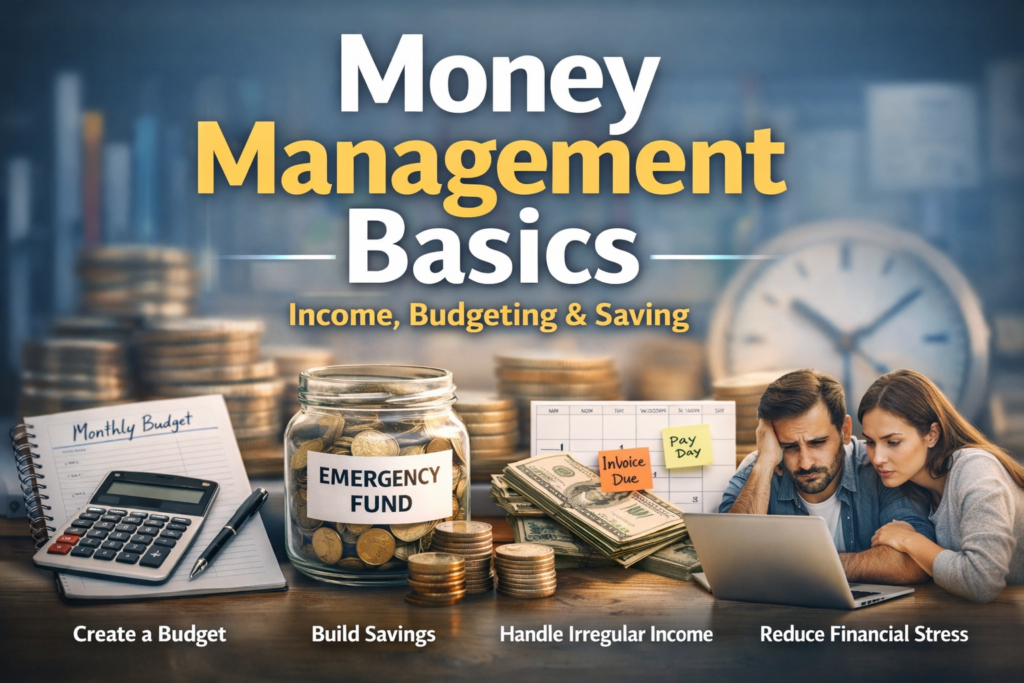
This is where money management basics earn their name. It is not about being strict. It is not about perfect self-control. It is about understanding the system you are already living inside: money arriving, money leaving, and the gaps in between.
Government-backed consumer education tends to describe a budget as a way to avoid running out of money before the next paycheque and to make room for goals or emergencies. That framing matters, because it puts the focus where beginners actually feel the pressure: the week when nothing is “wrong”, but the numbers still don’t add up smoothly.
Also, it helps to say this out loud: financial stability is not purely a personality trait. The Consumer Financial Protection Bureau explains that financial well-being is not fully captured by numbers like income, net worth, or credit score alone, partly because people’s situations are subjective and shaped by context. That’s a calm starting point: you are not “bad with money” because managing it feels mentally heavy.
This pillar is general information, not personalised financial advice. The goal is clarity: to describe how income, budgeting and saving fit together so you can recognise what you’re dealing with before you go deeper.
Table of Contents
Money management as a system of flows and buffers
A useful way to think about money management basics is as an everyday system with three moving parts:
Money coming in (income) → money going out (spending) → money held back (savings buffers)
Most problems happen in the spaces between these parts.
A household can have a decent income and still feel stressed if the timing is mismatched—pay arrives on the 1st, major bills hit on the 28th, and the middle of the month becomes a tightrope. The Consumer Financial Protection Bureau describes “cash flow” in exactly this practical way: the timing of when money comes in (income) and goes out (expenses and spending).
This is why “budgeting” is not really the point. Budgeting is a tool that supports a bigger goal: day-to-day control and shock resistance.
The Consumer Financial Protection Bureau’s definition of financial well-being is especially helpful here because it breaks the big idea into four human outcomes:
- control over day-to-day, month-to-month finances
- The capacity to absorb a financial shock
- being on track to meet financial goals
- freedom to make choices that allow you to enjoy life
Notice what is not on that list: guilt, perfection, or never making a “mistake”.
If you think of money management basics as building those four outcomes, the whole topic becomes less moral and more mechanical. Income supports control. A spending plan supports control. Savings support shock absorption. And all of it supports breathing room when life changes.
One more perspective that is easy to miss: financial literacy is not just knowledge. The Organisation for Economic Co-operation and Development has used a definition that includes knowledge, skills, motivation, and confidence applied to real decisions, with the aim of improving financial well-being. In other words, “knowing” is not enough; the system has to be usable in ordinary weeks.
Managing monthly income
People often say, “I need to manage my income better.” What they usually mean is, “I need my money to stop surprising me.”
Income has three features that affect stability more than most beginners expect:
How predictable it is. A fixed salary is predictable. Commission, tips, self-employment, and freelance work often are not.
How it lands. In New York, a salary might arrive by direct deposit like clockwork. In London or across Europe, pay can still be regular, but additional payments—client transfers, refunds, reimbursement—may move through bank rails that have their own rhythm. If you get paid through an Automated Clearing House(ACH) transfer or a Single Euro Payments Area transfer, timing can matter. Even when money is “yours”, it may not be usable the same day it is sent. (The point is not the acronym. The point is the delay.)
How it is already “spoken for”. Some income is effectively pre-committed: rent, childcare, debt payments, insurance, and basic groceries. If you are new to budgeting, it can feel like the money disappears. In reality, it was allocated the moment it arrived—you just didn’t see the allocation.
This is why a monthly income number can be misleading. Two people may both earn $3,500 a month. One has steady timing and few fixed commitments. The other has variable timing and several obligations that hit early in the month. Same income. Different lived experience.
If you want a deeper understanding of how a simple monthly spending plan is structured (without overcomplicating it), see Budgeting 101: How to Create a Simple Monthly Budget.
There is also a subtle emotional detail here. Many beginners feel calm right after payday and tense near the end of the month. That swing is often described as “self-control”, but it’s frequently a timing issue—cash flow, not character. The Consumer Financial Protection Bureau explicitly links cash flow to the timing mismatch that can leave someone short at the end of the week or month.
It’s worth adding one grounded detail: making income “work monthly” does not require a perfect life. It requires a system that can survive normal mess—an annual expense you forgot, a late client payment, or a week where groceries cost more than expected.
Money management and budgeting
A budget is often described as a plan for your money. That can sound like homework, so people either avoid it or overdo it—building a complex template they cannot maintain.
This pillar is not a instructions manual, so here is the higher-level purpose:
Budgeting is a decision map. It shows what your money is doing, and what trade-offs you are already making—sometimes without noticing.
A practical, government-backed description puts it simply: a budget helps you make sure you have enough money every month so you don’t run out before the next paycheque, and it can help you save for goals or emergencies. That is not about being “good”. It is about avoiding predictable friction.
Where budgeting becomes genuinely useful (and not just a list of expenses) is when it answers three questions:
What is my baseline cost of living? Not in perfect detail, but enough to understand what must be covered.
What is flexible, and what is not? This is where people get stuck. Many expenses feel fixed until you look closely.
What does “normal” look like over a year, not a week? Monthly budgets often fail because the real world is not monthly. Costs arrive seasonally, quarterly, or randomly.
A UK government-backed service summarises what a good budget tool does: it adds up income and outgoings, shows what is left over, and breaks down where spending goes. That’s the core function. Everything else is decoration.
If you want a deeper understanding of how “money in versus money out” becomes clear when you track it over time, see Tracking Income and Expenses: Understanding Your Cash Flow.
The quiet hinge: needs, wants, and the emotional truth of spending
Most people already know the “needs versus wants” idea. The hard part is not the definition—it’s the grey zone.
A needed commute might be non-negotiable, but the cost can still vary. Groceries are essential, yet the way you shop changes the total. A subscription might be entertainment, but it might also be your only consistent leisure in a stressful month. This is where money management basics become emotionally aware: you are not just managing numbers; you are managing trade-offs.
One reason I think this matters is that stress can push spending in either direction: some people freeze and avoid decisions; others spend to feel relief. A peer-reviewed study on financial stress (using a probability sample of Dutch households) notes that financial stress has implications for well-being and decision-making, and that a combination of factors predicts stress better than income alone—buffer savings, in particular, had a large contribution in their analysis. That supports a key pillar message: stability is not only about income; it is also about the system around it.
If you want a deeper understanding of how needs and wants fit into everyday priorities (without turning it into a judgment), see Needs vs Wants: How to Prioritise Spending.
Why budgeting is linked to stress
It is common for official consumer guidance to note that finances are a frequent source of stress, and that budgeting can reduce stress by helping people feel more in control of their money. This is not a guarantee, and it is not therapy. It is simply a realistic observation: uncertainty creates tension, and clarity can soften it.
Budgeting is clarity. Savings is shock resistance. Together, they reduce the feeling that one small surprise will wreck the whole month.
Building savings and an emergency fund
For beginners, saving can feel like something you do after life is sorted.
But in real households, saving is often what makes life feel sortable in the first place.
The Consumer Financial Protection Bureau defines an emergency fund as a cash reserve set aside for unplanned expenses or financial emergencies—car repairs, home repairs, medical bills, or a loss of income. The definition is straightforward, and the point is even simpler: when something breaks, you want it to be an inconvenience, not a crisis.
This is why many “savings conversations” are really “shock conversations”. The Federal Reserve’s Survey of Household Economics and Decisionmaking offers a clear picture of how common it is to be exposed to small shocks. In the 2024 survey results (reported May 2025), 63% of adults said they would cover a hypothetical $400 emergency expense using cash, savings, or a credit card paid off at the next statement; 37% would not cover it that way. In that same section, 13% said they would not be able to pay the $400 expense by any means.
Those numbers are not included to scare anyone. They are included because they explain why “a small emergency fund” is a real-life stabiliser, not a luxury idea.
If you want a deeper understanding of how saving can begin gently—even when income is modest—see Saving Money Basics: How to Start Saving (Even With Low Income).
Emergency fund size is not a single “right number”
You will often hear the idea of saving “three to six months” of essential expenses. This is a guideline, not a law, and it should always be interpreted through your personal risk.
Still, it shows up repeatedly in public-facing guidance because it matches the shape of many real shocks: job gaps, reduced hours, health issues, or a late-paying client.
The Federal Reserve report uses one common resilience measure: whether people have savings sufficient to cover three months of expenses if they lost their primary source of income. In the 2024 results, 55% of adults said they had set aside money for three months of expenses in an emergency savings or “rainy day” fund.
A UK government-backed money guidance service also uses the same “three months’ essential outgoings” idea as a good benchmark for emergency cover, while still noting that even a month saved can protect against some income shocks.
If you want a deeper understanding of how people think about emergency fund sizing (including starter targets and what counts as a real emergency), see Building an Emergency Fund: How Much Do You Really Need?.
The less-talked-about trade-off: accessibility vs temptation
An emergency fund has to be accessible. That is what makes it an emergency fund.
At the same time, accessibility can blur the line between “emergency” and “unexpected but optional”. The Consumer Financial Protection Bureau recognises that people may want their emergency fund to be safe, accessible, and in a place where they are not tempted to use it for non-emergencies.
That tension is normal. It is not solved by willpower alone; it is solved by clear definitions. What counts as an emergency for you? If the answer is fuzzy, the savings will feel fuzzy as well.
Irregular income, cash flow swings, and financial stress
Irregular income is not just “income, but messy”.
It changes the shape of the month.
If you are a freelancer, a gig worker, or anyone paid through invoices, pay can be high in one month and low the next. You might see €3,000 in receipts in a good stretch and €1,600 the following month, even when you did similar work. This is not rare; it is a feature of how self-employment and contract work behave.
A UK government-backed guide frames the issue plainly: when income varies, it is tempting to budget as if every month will be a good one, but that can leave you short in a bad month. That line captures the psychology of irregular pay: optimism becomes a risk factor.
Irregular income also creates a timing problem around obligations. In the United Kingdom, for example, the same guide points out that self-employed people are responsible for paying tax and National Insurance and that early tax bills can be a shock if you are unprepared. You do not need to be a tax expert to understand the system-level point: some part of your income may not be “spendable” in the way it first appears.
If you want a deeper understanding of how irregular income changes budgeting (and how freelancers typically think about “low months” and “high months”), see Budgeting With Irregular Income (Freelancers & Online Earners Guide).
What irregular income teaches you about money management
Here is the grounding insight: irregular income makes the weaknesses of your system show up faster.
With predictable pay, you can survive a shaky plan for a while. With variable pay, the same plan collapses quickly.
That is why irregular income budgeting is not really a different topic; it is money management basics under pressure. It highlights the role of buffers and the value of knowing your baseline costs.
It also pulls financial stress into focus, because uncertainty is tiring. One of the most practical things the Consumer Financial Protection Bureau says about emergency savings is that, without savings, a financial shock—even minor—can set you back, and if the shock turns into debt, it can have a lasting impact. That chain reaction is what many people are trying to avoid when they say, “I want to be more stable.”
And this is where the pillar returns to the simplest meaning of “on track”. The Consumer Financial Protection Bureau’s four-part description of financial well-being includes both present control and future resilience. The goal is not to predict every surprise. It is to build a system that can absorb them without breaking you mentally.
Closing
Money management basics is not a personality makeover. It is a framework:
- Income is more than a number; it has timing and predictability
- Budgeting is a map of trade-offs, not a punishment
- Saving is not what you do “later”; it is what turns shocks into manageable events
- Irregular income is not a moral failure; it simply demands stronger buffers
- Financial well-being is about control and freedom, not perfection
In everyday life, stability often looks quiet. It looks like knowing what the month can hold, even when it is not a great month. It looks like being able to pay for an unexpected €400 expense without panic. It looks like having fewer “money surprises”, not because life got easy, but because your system became clearer.