
Many people picture remote jobs as a shortcut to freedom: working from a laptop anywhere, setting your own hours, and getting paid without a manager. When they hear that a role is remote, they may think it’s the same as freelancing or independent contracting. This confusion creates anxiety and frustration. Is a remote employee the same as a freelancer? If the job is work‑from‑home, does that mean you choose your hours? Will the company pay you like an independent contractor? Social media often blurs these lines, promising endless flexibility without explaining the structures behind different online roles.
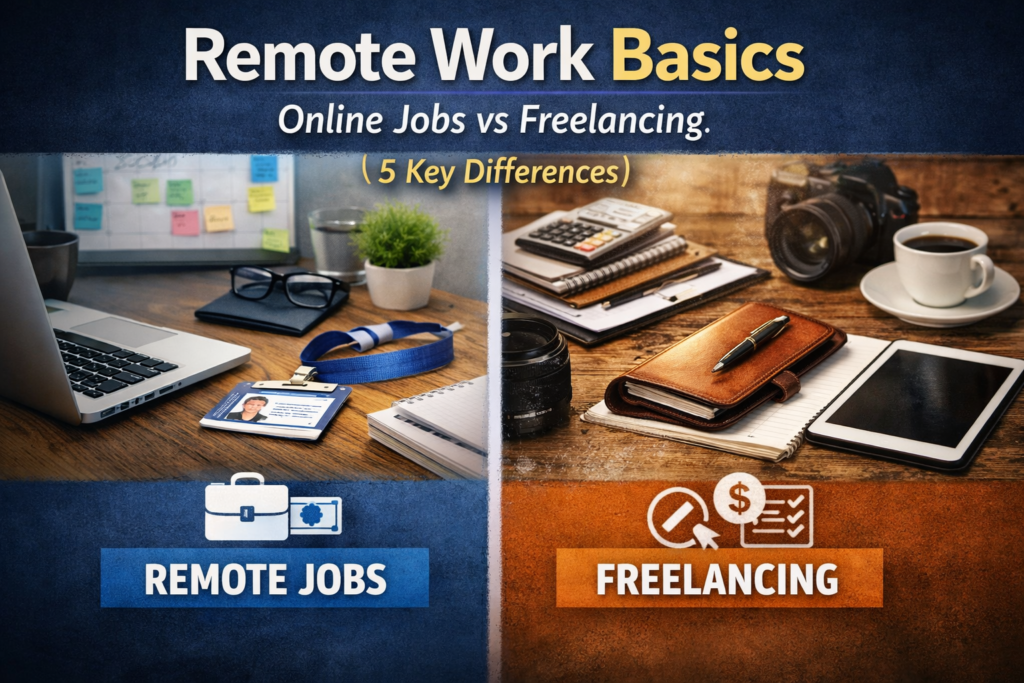
This article addresses that confusion head‑on by calmly unpacking what remote work really means, how payment systems differ, why stability and autonomy vary, and what expectations are realistic. By the end, you’ll see that location and business model are separate concepts—and that clarity reduces stress.
Table of Contents
What Remote Work Actually Means
It’s helpful to start with a clear definition. remote work describes where you work, not how you earn. According to U.S. government guidance, remote work arrangements allow employees to perform all duties at an alternative worksite; the employee’s worksite becomes an officially assigned remote location. Agencies distinguish between telework—which is typically a hybrid arrangement tied to a specific office—and remote work, which may be performed entirely outside a government facility. The U.S. Department of the Interior notes that a remote work agreement means an employee’s official duty station is not located at or near a traditional office and that the agency may not provide the individual with a workspace in a government facility. The government guidance further clarifies that remote work arrangements must follow federal pay rules and that working remotely does not automatically make an employee exempt from standard hours.
In practice, remote work can take several forms:
- Remote employment: You are an employee of a company, but perform your work outside the company’s office. Your employer sets your wages, benefits, and schedule. This can be full‑time or part‑time.
- Work‑from‑home jobs: These roles may be fully remote or hybrid. Hybrid roles require you to come into the office on certain days, while fully remote roles allow you to work anywhere within certain geographic or time zone boundaries.
- Contractor working remotely: Some contractors or freelancers work entirely online for specific clients. They are not employees; instead, they are self‑employed individuals who sell their services to clients.
The key takeaway is that remote refers to location. You can be an employee, a contractor, a freelancer, or a service provider while working remotely. Your income structure and legal classification depend on the relationship with those who pay you, not on where you set up your laptop.
If you want a deeper understanding of how different online income paths fit together, see the main guide in Choosing Your Online Income Path, which places remote work alongside freelancing, content creation and digital products.
Salary vs Project Income
Once you understand that remote work describes location, the next question is how money flows through different arrangements. The payment structure is a fundamental difference between remote employment, freelancing, and service‑based work. Government guidance explains that remote employees remain under standard federal hours‑of‑work rules, meaning they are paid through payroll, accrue benefits, and receive pay entitlements based on their assigned duty station. By contrast, independent contractors “decide how to get the work done” and are not employees. The U.S. Internal Revenue Service (IRS) highlights three categories—behavioural control, financial control, and the relationship type—to determine whether a worker is an employee or an independent contractor.
Remote employee
- Money flow: Employer → Payroll → You. The company pays you a salary or hourly wage on a regular schedule. Taxes are withheld automatically, and you may receive benefits such as health insurance, vacation, or retirement contributions.
- Income structure: Predictable. You have a defined pay rate and usually a fixed schedule or set of hours. Federal guidance states that remote employees must still follow hours‑of‑work rules and do not gain automatic flexibility.
Freelancer
- Money flow: Client → Invoice → You. Freelancers (independent contractors) sell specific skills to clients. They decide how to perform the work and invoice each client for the project or hours. According to the IRS, they pay self‑employment tax and must handle their own insurance and retirement savings.
- Income structure: Variable. Your earnings depend on how many projects you secure, your rates, and how quickly clients pay. There are no built‑in benefits. If you want a deeper look at this structure, see our supporting article What is freelancing?.
Service provider (online services)
- Money flow: Client → Retainer → You. Virtual assistants, online consultants, tutors, coaches or bookkeepers often provide recurring services and charge clients on a monthly or package basis. Although these roles are service‑based like freelancing, the payment terms may be ongoing rather than one‑off. Because of that, they feel more stable than project‑based freelancing, but still do not offer benefits or tax withholding.
Understanding these money flows removes the mystery around remote income. The remote employee receives structured pay; the freelancer invoices; and the service provider often charges retainers. Your cash flow, taxes, and benefits follow the chosen structure—not the fact that you are working from home. For further details on service‑based models, you may explore the supporting article Offering Online Services.
Stability vs Autonomy
One reason people are drawn to remote work is the promise of freedom. However, the reality involves trade‑offs between stability and autonomy. In a remote employee role, your income is stable: you know when and how much you will be paid. You have a legal employment relationship, which often brings benefits and workplace protections. According to official guidance, even remote employees must follow established work schedules; an agency can require core hours and may refuse flexible scheduling. In other words, remote work does not guarantee fluid hours; it simply changes your location.
Freelancing and online service provision sit at the other end of the spectrum. They offer significant autonomy. You choose your projects or clients, set your rates, and decide when and where you work. The trade‑off is income fluctuation. The IRS notes that independent contractors must pay their own taxes, and because clients are not obligated to provide consistent work, freelancers face variable cash flow. You may experience busy months and slow months. Some clients may leave or require more effort than expected. There are no built‑in benefits or paid time off.
Between these two poles lies the service‑based model. Virtual assistants, consultants, tutors and similar providers often secure longer‑term agreements with clients. Instead of one project, you deliver ongoing services. This can lead to more predictable income than freelancing alone, but you still manage your own taxes and benefits. Building a stable roster of clients takes time and trust.
Understanding these trade‑offs helps you choose an income path that fits your needs. If you need stability and benefits, remote employment might suit you. If you value autonomy and are comfortable managing inconsistent pay, freelancing or offering online services may be a better fit. Many people combine short‑term freelance projects with longer‑term service contracts or remote employment. The key is awareness, not judgment.
READ: The Different Types of Online Income Models — And How They Actually Work
Legal and Classification Differences
A major source of confusion involves legal classification. Being labelled an employee or an independent contractor has significant implications for taxes, benefits and workplace protections. The IRS says you should consider three broad categories when determining whether a worker is an employee or independent contractor: behavioural control, financial control and type of relationship.
- Behavioural control refers to whether the company instructs the worker on when, where and how to do the work. If an employer sets training requirements, performance standards and work schedules, the worker is more likely to be an employee.
- Financial control looks at how the worker is paid and whether expenses are reimbursed. Employees are typically paid a regular wage and have taxes withheld. Independent contractors invoice for completed work and are responsible for their own expenses.
- The type of relationship considers whether there are benefits, written contracts, or a promise of an ongoing relationship. Employees often receive benefits and protections. Contractors typically do not.
If a company controls most of these factors, you are likely an employee even if you work remotely. Employees receive pay through payroll, have taxes withheld and may enjoy health insurance or paid leave. Misclassification can lead to penalties for employers and unexpected tax burdens for workers. Conversely, if you control how the work is done, use your own tools, and decide your hours, you are likely an independent contractor. Contractors must handle self‑employment taxes and are not covered by employment laws, such as minimum wage and overtime protections.
Remote work does not change these legal distinctions. A remote employee is still subject to employment law, while a remote contractor is self‑employed. Keeping this distinction clear will help you understand your rights and responsibilities.
Location Isn’t Freedom
Another common misconception is that remote work automatically equals flexibility. Federal guidance reminds agencies that remote employees “must adhere to the same hours of duty and account for their time in the same manner as teleworking employees”. Being away from the office does not exempt you from schedules or performance expectations.
For remote employees, management may set core hours, require attendance at meetings and approve or deny requests for alternative schedules. Working from home does not mean you can travel across time zones or choose your hours without approval. Salaried remote roles may still have fixed shifts.
Freelancers and service providers have more flexibility, but that doesn’t mean immediate or passive income. You will need to market your services, manage client relationships, and handle administration like invoicing and taxes. Building a client base or audience takes time. A new freelancer might spend months securing enough projects to earn consistently. Therefore, patience and planning are essential.
In both cases, remote work should be seen as a change in where you work, not a guarantee of complete freedom. Align your expectations with your role: employees have structured pay and may have less autonomy; freelancers have greater independence but also more responsibility and risk. Clarity in advance prevents disappointment.
Q&A’s
1. Is a remote worker always a freelancer?
No. Remote describes the location of the work, not the business relationship. You can be an employee, a contractor, or a service provider while working remotely.
2. Do remote employees choose their own hours?
Not necessarily. Government guidelines state that remote employees must adhere to standard hours‑of‑work rules. Employers often set schedules and may allow limited flexibility.
3. How does payment differ for remote employees and freelancers?
Remote employees are paid through payroll, receive benefits and have taxes withheld. Freelancers invoice clients for services and must pay their own taxes.
4. What taxes does a freelancer pay?
Freelancers are considered self‑employed. They must pay self‑employment tax and make quarterly estimated tax payments. They also handle their own deductions and retirement savings.
5. Are hybrid roles considered remote work?
Hybrid roles mix on‑site and off‑site work. They often fall under telework, which is different from fully remote arrangements. The distinction matters for pay policies and official duty stations.
6. Can I have both a remote job and freelance clients?
Yes. Many people maintain a remote job for stability and freelance on the side for extra income. Ensure you follow any non‑compete or conflict‑of‑interest policies set by your employer.
7. What protections do remote employees have?
Remote employees are covered by labour laws, including minimum wage, overtime (if eligible), anti‑discrimination protections and benefits offered by the employer. They must adhere to company policies even when working remotely.
8. What happens if I’m misclassified as a contractor?
Misclassification can result in unpaid taxes and a lack of benefits for the worker. The IRS provides guidance on classification and encourages companies to examine behavioural, financial and relationship factors. If you believe you’ve been misclassified, consult a tax professional or labour attorney.
9. Does remote work affect pay scales?
In some organisations, pay scales may depend on your geographic location or duty station. Government guidance ties locality pay to the remote employee’s approved duty station. Private companies may adjust pay based on cost‑of‑living or regional salary bands.
10. What skills do I need for successful remote work?
Communication, self‑discipline, and time management are essential. Remote employees must stay responsive and meet expectations despite distance. Freelancers and service providers need these skills, plus marketing, negotiation, and financial management.