
It’s common to explore different ways of earning online and end up feeling more unsure than when you started. After learning about freelancing, remote work, content income, digital products, and short-term gigs, everything can begin to blend.
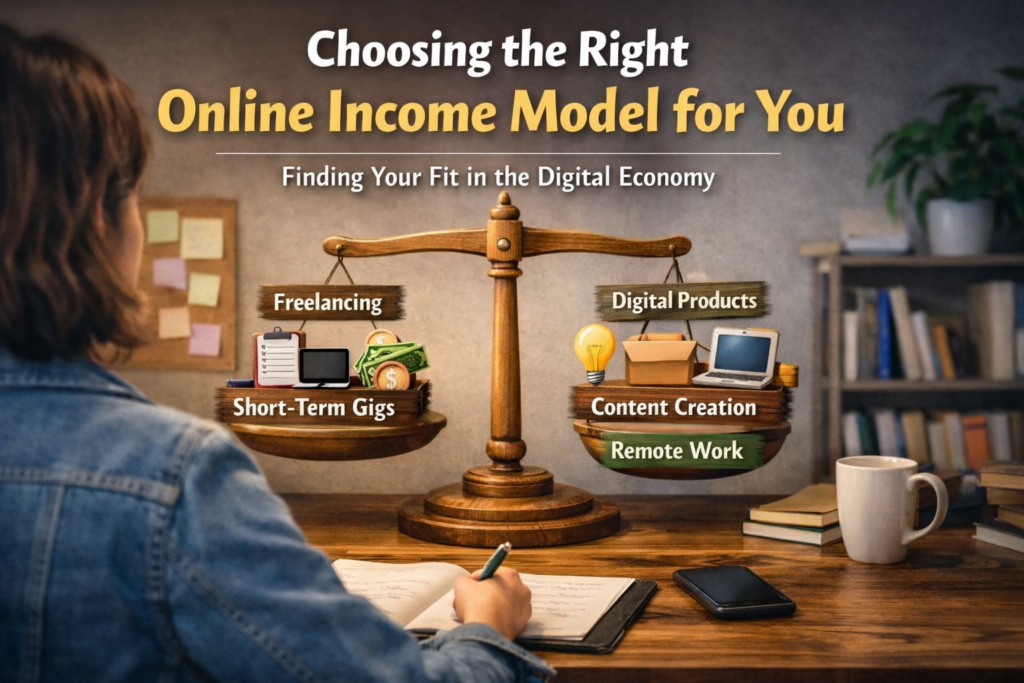
The question of choosing the right online income model often lingers in the background: Should you work with clients? Focus on building an audience? Develop something to sell? This uncertainty is natural because each online income model is designed around different priorities, timelines, and personality types. Instead of pointing toward a single “best” path, this guide looks at how to align an online income model with your real circumstances. When you understand how each structure works, clarity replaces confusion.
Table of Contents
Why confusion arises
When people first dive into online earning, it’s easy to lump every method together. Yet models are fundamentally different. For example, a microtask worker completes tiny assignments for small payments, a content creator develops long‑form articles and videos, and a freelance designer takes on client projects. Their daily tasks, income timing, and required skills are not the same. This article starts by acknowledging the overwhelming number of readers who feel after learning about multiple income types. Recognising that confusion is a sign of curiosity, not failure, sets the tone for a reflective discussion.
Balancing Urgency and Patience
One of the first factors to consider is how quickly you need money. Do you require immediate cash flow to cover rent next month, or can you afford to invest months building a long‑term asset? This tension between urgency and patience plays a huge role in picking an online income model.
When you need income quickly
Short‑term gigs such as microtasks, surveys, or small freelance projects provide fast payouts and low barriers to entry. Platforms that offer microtasks allow workers to earn a small amount for each completed task. Freelancing can also generate money within weeks because you invoice clients as soon as work is delivered. However, these models exchange time for money and rarely scale; you only earn when you perform tasks. They are ideal for bridging a financial gap but should not be mistaken for “passive income.”
When you can wait
Audience‑based and product‑based models, such as blogging, podcasting or selling digital courses, start slowly but build potential for recurring income. A digital product is an intangible asset delivered electronically—like an e‑book, template, course or software. These products require upfront effort and continued marketing, but once created, they can be sold repeatedly without extra production cost. Content creation follows a similar pattern: you invest time in building trust and traffic before monetising with advertising or affiliate links. If you have another source of income and can commit months of consistent work, these models allow your efforts to compound over time.
In either case, the key is to be honest about your needs. There’s no shame in choosing a quicker route to survive while nurturing a long‑term project on the side. Many people blend models—freelancing to pay bills and gradually developing a digital product.
Skills vs Audience – Two Different Foundations
Another axis to examine is whether you prefer to sell a skill directly or cultivate a community that supports your work.
Selling a skill
Freelancing and service‑based income focus on providing expertise. A freelancer is not an employee; they are an independent contractor who charges per job or hour. They enjoy flexibility and choose projects, but must handle their own taxes and do not receive employment benefits like insurance or retirement plans. Service‑based models include graphic design, consulting, tutoring or virtual assistance. The reward comes from delivering quality work and maintaining client relationships. Income is tied to the number of projects you take on, so your capacity sets a ceiling unless you hire others.
If this path resonates, take time to research freelancing in more depth. There’s a dedicated guide on our site that clarifies what freelancing really means and how payment structures such as retainers and milestones work. If you want a deeper understanding, see What is Freelancing? It walks through the distinctions between an employee, a contractor and a self‑employed individual.
Building an audience
Audience‑based models rely on trust and engagement. Content creators publish blogs, videos or podcasts to attract visitors. They monetise through ads, sponsorships or affiliate links. Affiliate marketing involves recommending a product with a tracked link and earning a commission when someone buys, though you don’t control the product or pricing and depend on audience size. Ads generate revenue per impression or click. A key lesson is that no traffic means no income. You need to provide value consistently and wait for your audience to grow.
This route suits people who enjoy sharing knowledge and cultivating communities. If you’d like to explore it further, our supporting article on content creation explains how traffic, ads and sponsorships intersect with audience building. Look at Content creation as income for a calm breakdown.
Stability and Structure vs Flexibility and Risk
It’s also helpful to compare how stable each online income model feels. Some offer predictable pay but less freedom; others offer autonomy but fluctuating earnings.
Structured roles
Remote employment positions provide steady salaries and benefits. You are an employee working from home, often called telework or remote work. This arrangement is defined by performing job duties outside a traditional office. While the location is flexible, the compensation and hours follow company policies. You receive regular paychecks, health insurance and retirement contributions. For many, this stability outweighs the desire for complete autonomy.
If you want to understand how remote jobs differ from freelance work, our guide on remote work basics delves into classification, salary structures and legal considerations. The article Understand the structure of Remote Work and freelancing is linked inside this section for a deeper perspective.
Flexible paths
Freelancing, digital products and content creation offer more control over your schedule and projects. You decide when and where to work, choose which clients or topics to pursue and can scale up by hiring help or automating sales. However, you bear the burden of irregular income, taxes and potential dry spells. You may need to chase payments or manage refunds. Service‑based entrepreneurs can mitigate some volatility by offering monthly retainers or long‑term contracts, but there’s still more variability than in a payroll role.
A middle ground
Some service providers offer ongoing support that feels like a hybrid. For example, a virtual assistant might work with the same clients each month for a stable retainer. A consultant can secure long‑term agreements. These arrangements provide more predictability than one‑off gigs while maintaining independence. They require trust and professional communication to sustain.
Risk, Ownership and Responsibility
Every choice carries different risks and responsibilities.
- Short‑term gigs: Minimal commitment. You can sign up for microtask platforms and complete tasks when convenient. There’s no long‑term investment, but also no ownership of assets. Income stops when you stop working.
- Freelancing and services: You own your business and client relationships. The main risks involve inconsistent demand, late payments and self‑management. You’re responsible for marketing, accounting and continuing education. You pay both income and self‑employment taxes.
- Digital products and content: You own the assets you create. The risk lies in the upfront time and the potential that few people will buy. You depend on algorithms, market trends and your marketing skills. Commissions and ad rates can change without your control.
- Remote employment: The company owns the work product and may set stricter policies. Your risk is job security—companies can restructure or shift remote policies. Nevertheless, benefits and predictable income reduce financial uncertainty.
Owning your work can feel empowering. However, it demands resilience. Freelancers and creators often experience feast‑or‑famine cycles. Remote employees enjoy consistency but may crave more autonomy or creative freedom. Consider which risk profile feels more manageable.
Bringing It All Together
After exploring urgency, skills vs audience, and stability, how do you choose your online income model? The answer lies in self‑knowledge rather than external trends.
- Reflect on priorities: Do you prioritise quick income, flexibility, stability or growth potential? Be realistic about your financial needs and time horizon.
- Identify strengths: Are you happiest solving problems one‑on‑one or sharing ideas with many? Selling a skill may suit those who enjoy client interaction. Building a community works well for those who like teaching and storytelling.
- Assess risk tolerance: Can you handle irregular income and uncertainty, or do you prefer a steady paycheck? Risk tolerance often changes with life stages.
- Blend where appropriate: Many people combine models. It’s common to freelance to cover bills while building an audience or product. Short‑term gigs can fund experiments. A remote job can provide security while you sell templates on the side.
Closing Perspective
Choosing a path is less about following someone else’s formula and more about aligning work with your circumstances. Your decision can evolve. You might start as a freelancer and later create a course, or shift from content creation to consulting. There is no definitive answer; there is only clarity when you understand the structure of each option and how it meets your needs. By considering urgency, skill orientation, stability and risk, you can identify an online income model that feels right for you. Take your time, learn from each experience, and remember that adaptation is part of the journey.
Frequently Asked Questions
Q1. Can I switch between models over time?
Yes. Many people move from freelancing to selling products or from remote work to running a service business. The skills you develop will carry over.
Q2. Is one model more profitable than the others?
Profitability depends on your skills, market demand, and commitment. Digital products and content can scale but require patience. Freelancing can earn quickly, but may hit a ceiling. Remote jobs offer stability but limit upside.
Q3. How do I know if I’m ready to create a digital product?
You should have a clear problem to solve and some understanding of your audience. Start small—like an e‑book or template—before investing months in a full course.
Q4. What if I don’t have a specific skill to freelance?
Consider learning a service skill like transcription, social media management or design. Alternatively, microtasks provide entry‑level work that requires minimal expertise.
Q5. Do I need a large audience before starting affiliate marketing?
A larger audience improves conversion, but you can start recommending products as soon as you have engaged readers or viewers. Focus on trust rather than quick commissions.
Q6. How do taxes differ between models?
Employees have taxes withheld by employers. Freelancers and creators are responsible for paying income and self‑employment taxes. Consult a tax professional for guidance.
Q7. Can I combine a remote job with a side business?
Yes, as long as you respect your employer’s policies and manage your time well. Many remote workers freelance or run online shops outside of work hours.
Q8. Which model is best for someone with limited time?
Short‑term gigs or microtasks suit those with minimal time. Service retainer agreements can also be efficient. Audience‑based models need regular content, so they require consistent commitment.
Q9. How do I handle income fluctuations as a freelancer?
Build an emergency fund, diversify clients, and consider offering retainers. Budgeting conservatively helps smooth out lean months.
Q10. What if I change my mind?
It’s normal to pivot. Your first online income model does not define your entire journey. Each experience provides insight into what suits you best.