
Many people come across stories of affiliate marketing and online advertising that promise easy income. Images of popular bloggers or video hosts earning money while they sleep can make this model seem like a shortcut to freedom.
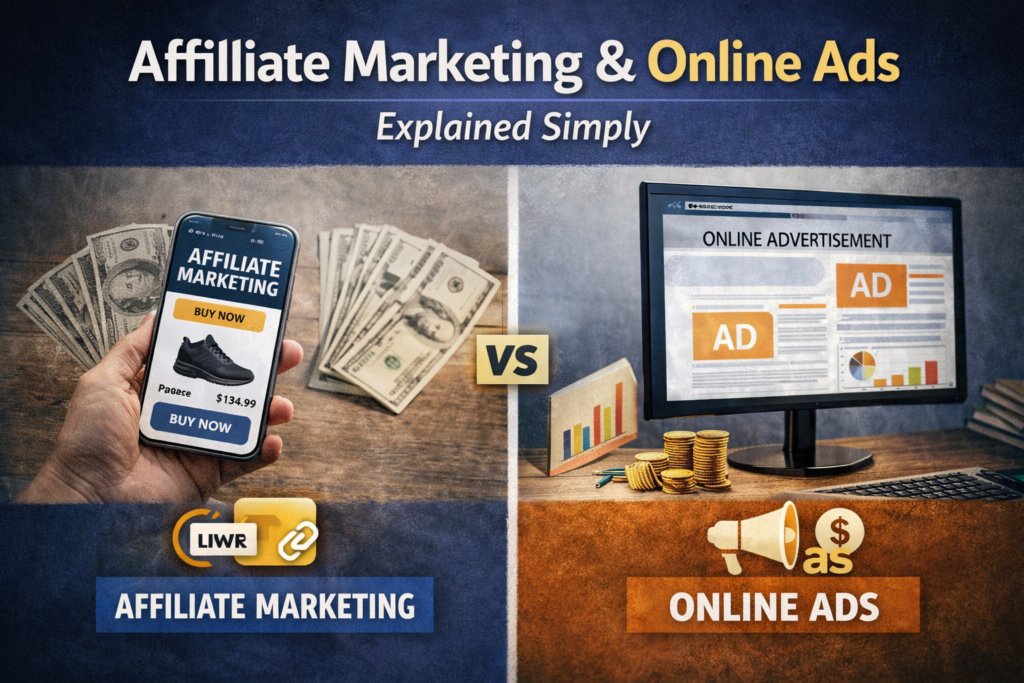
Yet when you start exploring, questions appear quickly. Are you promoting someone else’s product or service, or creating your own? Does money arrive immediately, like when a freelancer finishes a project, or does it depend on unpredictable clicks? Confusion can grow when social media posts simplify complex payment structures into a few upbeat sentences. This article explains the affiliate marketing and advertising model in clear language, showing how money flows, where effort is required, and why patience is essential.
Table of Contents
How Affiliate Marketing Works
At its core, affiliate marketing is a referral system. You recommend a product or service to your audience. This could be anything from a household gadget to a software subscription. Your recommendation includes a special tracked link. When someone in your audience clicks that link and completes a purchase, you earn a commission. The money flow looks like this:
Audience → Click → Purchase → Commission → You.
This structure is different from freelancing, where you create a custom service for a single client. In affiliate marketing, you do not control the product or the price. Your role is to bridge trust between the creator and the buyer. Because you are paid only when a purchase happens, traffic volume and trust matter more than the hours you invest.
The commission rates vary by program and product. Some merchants offer a flat fee per sale, while others pay a percentage of the sale amount. Software subscriptions might pay recurring commissions for as long as the subscriber remains active. Physical products often pay once. These details are outlined in the merchant’s affiliate agreement and can change over time. Understanding these terms helps you set realistic expectations.
What Are Online Ads and How Do They Earn?
Advertising income is another piece of the online income puzzle. Instead of earning per purchase, you earn when ads are displayed or clicked on your content. There are two common models:
- Display advertising (CPM – cost per thousand impressions): You earn a small amount each time an ad is shown to a viewer. The rates are usually quoted per thousand impressions (views). The platform—whether it is a blog, a streaming video, or a mobile app—serves ads that match the audience. The platform collects payment from advertisers and shares a portion with you.
- Pay-per-click advertising (CPC): You earn when someone clicks on the ad. The amount depends on the advertiser’s bid for that click. Topics with high commercial intent (like insurance or finance) often have higher bids than general topics (like hobbies).
The money flow is:
Traffic → Ad impressions/clicks → Platform payout → You.
This model is purely traffic-dependent. If your content receives few visitors or views, the revenue will be minimal. There is no commission for purchases; the advertiser handles the conversion. Because of this, advertising is often used alongside other models, such as affiliate marketing, to diversify income.
Attention and Trust: The Heart of This Model
Both affiliate marketing and online advertising depend on attention, but not all attention is equal. A large audience may generate many impressions, but if viewers do not trust your recommendations, conversions will be low. Building trust takes time. It involves choosing products and services that you genuinely believe will help your audience and being transparent about your relationships with merchants. Disclosure is required by many advertising standards and helps maintain credibility.
The platforms that host ads also affect revenue. Search engines, social networks, and video platforms each have their own rules. They decide which ads appear, how much they pay per impression or click, and what types of content are eligible. Algorithms may change without notice, influencing your income. This dependency on platforms is a trade-off: you can reach a broad audience quickly, but you cannot control the environment completely. If you want to understand another perspective, the main guide on online income models discusses how different approaches intersect and why diversification matters.
When Does the Money Arrive?
One of the biggest differences between affiliate marketing and service-based work is timing. Freelancers often invoice clients as soon as a project is complete, and payment follows within a set period. Affiliate commissions and ad revenue, however, follow payout schedules set by the platform or merchant. Most programs pay monthly, though some have quarterly or even longer cycles. A minimum payout threshold may apply; you receive funds only after your earnings surpass a certain amount. There may also be a delay—commonly 30 days or longer—between the sale and payment to account for refunds or disputes.
This timing can surprise new affiliates. Invoices from traditional clients might be paid within 14–30 days via bank transfer (such as ACH in the United States or SEPA in Europe). In contrast, affiliate marketing earnings may accumulate slowly and reach you only after the platform’s accounting cycle. The variability can feel unsettling if you are used to predictable paydays. Planning for this is part of adapting to the model.
Comparing Income Models: A Broader View
Affiliate marketing and advertising income are pieces of a larger online earning landscape. They often appear alongside other models. For example, someone who builds an audience through blogging or video might earn from ads while also recommending products. If they create their own courses or digital products, those sales become another revenue stream. A calm comparison can help you see where affiliate income fits:
Service-based income—such as freelancing—pays directly for your time or skill. You invoice a client. The terms and payment methods (ACH, SEPA, or card payments) are clear. You know how much you will earn per project or hour. A freelancer might work on several projects at once to manage income fluctuation.
Content-based income—like blogging or podcasts—requires building an audience first. Only then can you monetise through ads or sponsors. If you want a deeper understanding of how content income grows slowly and the patience it requires, you might explore the article on Content Creation as Income for context. It explains why early stages feel slow and how ads, sponsorships, and affiliate links eventually develop into a sustainable stream.
Product-based income—involves creating something once and selling it repeatedly, such as an e-book or online course. The article on Selling Digital Products breaks down this model, highlighting the upfront work and long-term potential. Unlike affiliate marketing, you control the product and pricing, but you also handle support and updates.
By comparing these structures, you can see that affiliate marketing sits somewhere between content-based and product-based income. You do not create the product, but you still need to create content to attract and engage an audience. You cannot control the price or the platform’s rules, yet you can choose what to promote and how to present it. Understanding these trade-offs helps you decide whether affiliate income aligns with your goals.
Managing Risk and Variability
Affiliate programs and ad networks come with risks that are worth acknowledging. First, your income is tied to platform policies. If a platform changes its rules or its algorithm, your traffic or monetisation can drop. Second, merchants can alter commission rates or close their programs. A product that once paid a generous commission might reduce it, or a platform may ban certain types of content. Diversifying income sources across multiple affiliate programs or ad networks can reduce the impact of any single change.
Another risk is audience fatigue. Recommending too many products or placing too many ads can erode trust. Audiences may feel that content exists solely to drive sales rather than provide value. Balancing promotional content with genuine information is key. Finally, payment delays or disputes can affect cash flow. Reading the terms of each program, keeping records of clicks and sales, and understanding the dispute process can help mitigate surprises.
What Realistic Progress Looks Like
The idea of “passive income” often appears alongside affiliate marketing. While it is true that commissions can arrive while you sleep, the effort required to reach that point is active. You need to create content, nurture an audience, test different products, and maintain relationships with merchants. Earnings usually start small and grow gradually as your audience expands and your content library increases.
Patience is essential. Many affiliates work for months before seeing consistent income. During this period, it may be helpful to pair affiliate efforts with more immediate work, such as freelancing or part-time services. Over time, the foundation you build can provide a steady stream of commissions. Just like other online income models, there are no guarantees, but a clear understanding of how it works can reduce frustration and set realistic expectations.
A Calm Perspective
Affiliate marketing and advertising income are neither magical nor inherently flawed. They are structured systems that reward creators for directing attention and trust toward products and services. If you approach them with a clear understanding of how money flows, the importance of audience building, and the timing of payments, you will avoid common misconceptions. This model may complement other income streams or serve as a primary focus, depending on your interests and capacity.
Frequently Asked Questions
What is affiliate marketing in simple terms?
It is a system where you recommend a product or service using a tracked link. If someone buys through your link, you earn a commission. You do not control the product or its price; your role is to connect the audience to the merchant.
How do online ads pay content creators?
Ads pay through two main structures: per impression (CPM), where you earn a small amount each time an ad is shown, and per click (CPC), where you earn when someone clicks. The platform handles the sale of ad space and shares a portion of the revenue with you.
Is affiliate marketing passive income?
It can feel passive once content and links are in place, but building to that point requires active effort. You need to create content, attract an audience, and maintain trust. Income starts slowly and grows as traffic and conversions increase.
How long does it take to earn a significant income from affiliate marketing?
There is no fixed timeline. Some creators see results in a few months; others take longer. It depends on factors such as niche interest, audience size, product selection, and content quality. Consistency and patience are important.
Do I need a large audience to succeed?
A large audience can increase revenue, but even a smaller, highly engaged community can convert well if trust is strong. Quality of traffic often matters more than quantity. Building a targeted audience improves conversion rates.
What happens if a merchant changes the commission rate?
Commission rates and program terms can change at any time. Staying informed and diversifying your programs helps reduce reliance on a single source. If a rate decreases, you can adjust your promotion strategy or explore alternatives.
Are there any legal requirements for affiliate marketing?
Most regions require you to disclose when you use affiliate links. This helps maintain transparency and trust with your audience. Ad networks and merchants also have terms you must follow regarding promotion methods and prohibited content.
How is tax handled on affiliate and advertising income?
Income from affiliate commissions and ads is usually considered self-employment or business income. You are responsible for reporting it and paying any taxes owed. It is wise to keep detailed records of earnings and consult local tax guidelines or a professional if needed.