
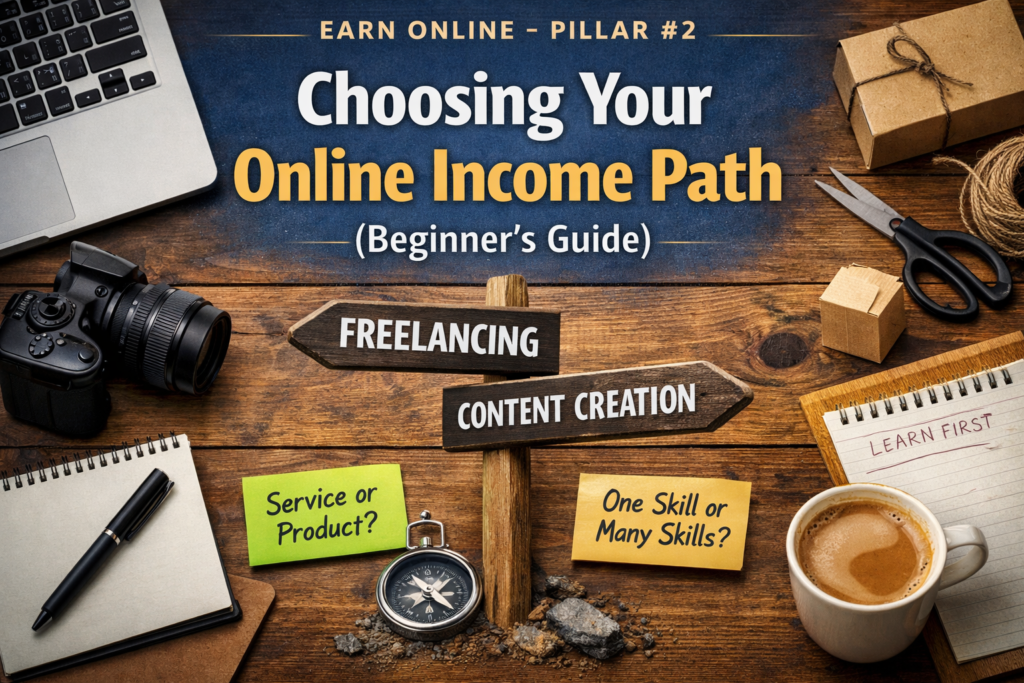
If you are trying to choose an online income path, the internet can feel like a loud room where everyone is giving different advice at the same time. You see dozens of ways to earn, each with its own rules, words, and “success stories”. It is easy to think the solution is more research, but more research usually adds more choices.
Having more options can sound helpful, yet research suggests “too much choice” can sometimes backfire. Studies and meta-analyses on choice overload show mixed results overall, but they also show clear patterns: when options are hard to compare, when you are unsure what you want, or when the decision feels high-stakes, more options can make people feel stuck or less satisfied with what they pick. This is a useful lens for online income ideas, because many options look similar at the start.
This article is not here to sell you a method, push you towards a platform, or promise an income. The goal is calmer: to help you reduce the noise and make a clear, realistic decision you can live with for a while. From what I’ve seen, most beginners do not need more ideas; they need a better way to sort the ideas they already have.
A useful starting point is this: there is no single “best” online path for everyone. The right direction depends on your time, your needs, and what kind of work you can repeat without burning out. That is why this guide focuses on direction choices (the type of work and how income tends to flow), not on where you post, what tool you use, or what people are trending today.
A quick promise of what this guide will and won’t do
What this guide will do is give you a small decision framework. It will help you classify ideas, spot trade-offs, and pick one direction for your next stage of learning.
What this guide will not do is tell you “the best niche”, list platforms, or give tactics for making money fast. If you came here for clarity, you are in the right place.
Table of Contents
Why choosing a direction matters
When you act without direction, you are usually doing random actions. Random action feels busy, but it does not build skill in a clean line. Focused learning looks slower at first, but it makes each week connect to the next week.
There is also a brain reason this matters. Your working memory can only hold a small amount of information at one time. Cognitive Load Theory explains that learning breaks down when working memory is overloaded, and common estimates put the “few items at once” limit in a very small range. When beginners try to learn several directions at once, they often overload themselves with new terms, new rules, and new “must-do” steps.
Task switching makes that worse. Even when you think you are “doing two things”, most people are actually switching attention back and forth. Psychologists studying multitasking show that the mind and brain were not designed for heavy-duty multitasking, and task switching comes with measurable “switch costs”. So, jumping between paths can drain energy without producing much progress.
Finally, constant choosing has a cost. Research on decision fatigue describes how repeated decision-making can make later decisions harder and can lead to avoidance, defaults, or impulsive choices. You do not need to “optimise” your whole future today. You just need to choose one direction that reduces decisions for the next stage.
A short decision filter you can use today
Use these questions as a simple filter. You are not looking for perfect answers—just a clearer fit.
| Filter | Ask yourself | What it usually suggests |
| Time | “Can I give steady time each week for a few months? | Low time often needs a narrower, simpler direction first. |
| Tolerance for uncertainty | “Can I keep going without quick feedback?” | Lower tolerance usually fits work with clearer feedback loops. |
| Social comfort | “Am I okay speaking with people to clarify needs?” | If not, choose a direction with less direct negotiation early on. |
Two big beginner paths you can understand in one sitting
Freelancing vs Content creation
Many online income ideas can be grouped into two beginner-friendly buckets:
Freelancing is when you provide a service to clients as a self-employed person, often on projects or contracts. Content creation is when you produce and share helpful or interesting material (text, audio, video, images) for an audience.
Both can be real work. Both can also feel confusing at the start because the early feedback is different.
Freelancing tends to reward clear, direct value. You help a client solve a problem, and the client can often see the result quickly. This can create faster feedback: “this worked” or “this didn’t”.
Content creation tends to reward consistency over time. You are building a library of work and trust with an audience. The feedback loop can be slower and less clear because the “value” is spread across many people and many pieces of content.
If you want a side-by-side explanation in plain language, the internal guide Freelancing vs content creation explained simply can help you compare them without going deep into platforms.
A calm way to choose between them is to ask one question: Do you want your early learning to come from client feedback (freelancing) or from audience response over time (content creation)? Neither is “better”. They are just different learning environments.
Service-based vs Product-based income
Another simple split is how income is “delivered”.
Service-based income usually comes from doing work for someone else. The value is tied to your time, attention, and skill. Product-based income usually comes from building something that can be sold repeatedly. The value is tied more to the “thing” you make and the system around it. Practical business resources often describe this as a core difference between selling services versus selling products, with different costs and operating patterns.
Beginners often assume product-based income is always “better” because it can be repeated. I’ve noticed the hidden cost is that products often require more building and more testing before you know if they fit the market. Services can usually start smaller, but they also rely on you showing up and doing the work each time.
To keep this decision calm, compare the two questions:
How soon do you need feedback? Service work often gives faster feedback because one client reacts quickly. Product work often gives slower feedback because patterns need time to show up.
How predictable is your time? Services tend to trade time for income. Products tend to trade upfront time for the chance of repeat sales later, while still needing time for updates and improvement.
For a clearer breakdown of the trade-offs, see Service-based income vs product-based income.
Here is a brief, beginner-friendly comparison table:
| Dimension | Service-based income | Product-based income |
| What payment is tied to | Delivery of work and outcomes | The value of an offer someone chooses to buy |
| What you do most often | Customise, communicate, deliver | Build, explain, support, refine |
| Main beginner risk | Under-scoping and over-promising | The value of an offer someone chooses to buy |
One skill vs many skills
A common beginner trap is trying to become “good at everything” at the same time. It feels safe because you are not committing. But it often slows learning.
Skill growth usually comes from focused, repeated practice on specific tasks. Research on “deliberate practice” links improvement to structured effort aimed at getting better at particular parts of performance, not just doing random work. At the same time, research also shows practice is not the only factor explaining performance, especially in real professions where many factors matter.
For beginners, the practical lesson is simple: start by going deep enough in one core skill to produce a clear result. Then add supporting skills later.
Cognitive Load Theory helps explain why. When you try to learn too many unfamiliar things at once, you overload working memory and learning drops. That is not a character flaw. It is how learning works.
If you want a clean way to decide what to focus on first, read One Skill vs. Many Skills for Beginners.
How to evaluate options realistically without getting stuck
A simple reality check you can apply to any idea.
Before you decide, it helps to run a quick “reality check”. This is not about being negative. It is about matching the idea to your real life.
Try these five questions. Keep the answers short:
How much time can you protect each week for learning and doing the work? If your time is limited, you need fewer moving parts.
How soon do you need a sign that you are improving? Some people need quick feedback to stay grounded. Others are comfortable building longer before results are obvious.
How much uncertainty can you handle without checking new ideas every day? If uncertainty makes you spiral, choose a direction with clearer signals.
How much interaction do you want with other people? Some directions require regular conversation and negotiation. Others are quieter but need more self-direction.
How comfortable are you with repeating the same type of task many times? Sustainable work is often repetitive.
From what I’ve seen, answering these questions removes more confusion than reading another “top 50” list of methods.
What beginners should prepare before they expect results
What to learn before trying to earn
“Trying to earn” without preparation often creates stress, because money adds pressure. A small amount of preparation turns pressure into structure.
Before you lean on any online income idea, it helps to understand four basics:
First, understand work boundaries. This means knowing how many hours per week you can realistically protect. A plan that needs ten focused hours is not “bad”, but it will fail if you only have two.
Second, understand communication basics. Any path that involves other people (clients, partners, an audience) needs clear writing, clear expectations, and calm follow-up.
Third, learn simple money hygiene: keeping basic records, separating personal and work money when you can, and remembering that rules differ by country. The key is being able to answer: what did I earn, what did I spend, and what do I owe later?
Fourth, learn safety basics. Online work is also a place where scams target beginners. Consumer protection agencies warn that scammers advertise jobs online and use job offers to get money or personal information. A simple safety rule is to treat any “job” that asks you to pay upfront as a serious red flag.
This preparation is not exciting, but it reduces overwhelm because it removes surprises.
For a fuller preparation guide written for beginners, see What to learn before trying to earn online.
Passion vs market demand
This topic creates stress because it is easy to turn it into an extreme: “follow passion only” or “ignore passion and chase demand”.
A calmer view is to treat passion and demand as two separate questions:
- Passion: Can you keep doing this even when it feels repetitive?
- Demand: Do people want the result enough to exchange money or attention for it?
Market demand is not the same as “trends”. Demand can be boring and still real. It often looks like people are paying to solve the same problem again and again.
Passion also does not need to be a lifelong calling. It can be a simple preference: “I can tolerate this work” or “I like improving at this”.
I’ve noticed beginners get stuck when they try to find the perfect match before they start. A better approach is to pick something you can practise, then let feedback adjust your direction.
If you want a grounded explanation of how to balance both sides, read Passion vs. Market Demand in Online Work.
Starting with clarity: small tests, simple rules, and fewer decisions
Starting small without overthinking
When you are new, your goal is not to build a full income system in one move. Your goal is to run a small test that teaches you what your next step should be.
A “small start” is not about doing less work. It is about narrowing the scope so you can finish something and learn from it.
One calm way to do this is to set a short time window and a single output. For example: “For the next four weeks, I will practise one skill and produce one simple sample each week.” This keeps your learning visible.
This approach fits what we know about learning: structured efforts aimed at improving specific tasks are more likely to build skill than scattered activity. It also reduces decision fatigue because you are not choosing a new plan every day.
If you want a gentle guide to making a first “small test” plan, see Starting small with your first online income idea.
Mixing paths without burning out
Many people do not fit into one box. You might like service work, but also want to create content. You might want to build a product later, but need service income first.
Mixing paths can work, but only if you are honest about limits.
The biggest risk is constant switching. Cognitive research suggests that heavy multitasking is not how the mind works best, and task switching carries a cost. If you mix paths, you want fewer switches, not more.
A practical boundary is to mix by blocks, not by minutes. For example, you might spend a block of weeks building one direction, then a later block adding the second direction. This helps you notice what is actually working.
If you want a simple way to combine paths without turning your week into chaos, see Mixing online income paths without burning out.
How the “wrong” choice slows you down
Beginners often fear “wasting time”. That fear can cause endless planning, which is another kind of waste.
Picking a direction that does not fit you can slow you down, but not because you “failed”. It slows you down because switching directions has real costs.
There is a learning cost: each direction has its own basics, and learning resets when you jump. Cognitive load increases when you hold too many new rules at once.
There is the attention cost: switching tasks brings friction, and experiments show people slow down when they switch between different tasks in succession.
And there is the decision cost: repeated choosing can drain you until you avoid decisions or choose what feels easiest in the moment.
For a deeper unpacking of this pattern, read Why choosing the wrong path slows beginners.
Sticking, switching, and ending with calm clarity
When to Switch or Stick
Sticking is useful when you are still learning basics and your results are improving, even slowly. Switching is useful when you can clearly see that the direction does not fit your real life or your strengths.
A calm way to decide is to review your direction on a schedule, instead of reviewing it every day. Daily review creates decision fatigue. Scheduled review creates stability.
Here are signs it may be worth sticking a bit longer: you can describe what you learned recently in simple terms; you are making fewer beginner mistakes; you can complete small tasks with less stress than at the start.
Here are signs it may be time to adjust: the work consistently clashes with your available time or health; you cannot practise regularly because the system demands too many moving parts; you dislike the daily work itself, not just the slow progress.
If you want a fuller decision guide with examples of healthier switching, read When to switch or stick with an online income path.
Closing section
You do not need to make a perfect choice. You need to make a clear choice that reduces decisions and lets you learn.
A direction is not a life sentence. It is a working decision for the next season of learning. When you finish that season, you can review what happened with evidence instead of guesses.
If you remember one idea, let it be this: progress matters more than perfect planning. When you build one skill in one direction, you create options later without chasing everything now.