
When people talk about sending money abroad, they often mention the currency exchange rates and money transfers as if they were a single, predictable figure. One friend might quote a rate they found online, while your bank shows a very different number. If you check a currency converter, you see yet another rate.
This patchwork of quotes leaves many people wondering why the number shifts so much and why the final amount received by a loved one overseas sometimes feels disappointingly low. The terminology itself — mid‑market rate, retail rate, spread or markup — adds to the confusion, especially when you hear that banks don’t actually “set” exchange rates in the same way they set service fees. Understanding these differences and the mechanics behind them can turn a seemingly mysterious process into a clear, predictable part of international payments.
Table of Contents
Mid‑market vs retail: the core concept
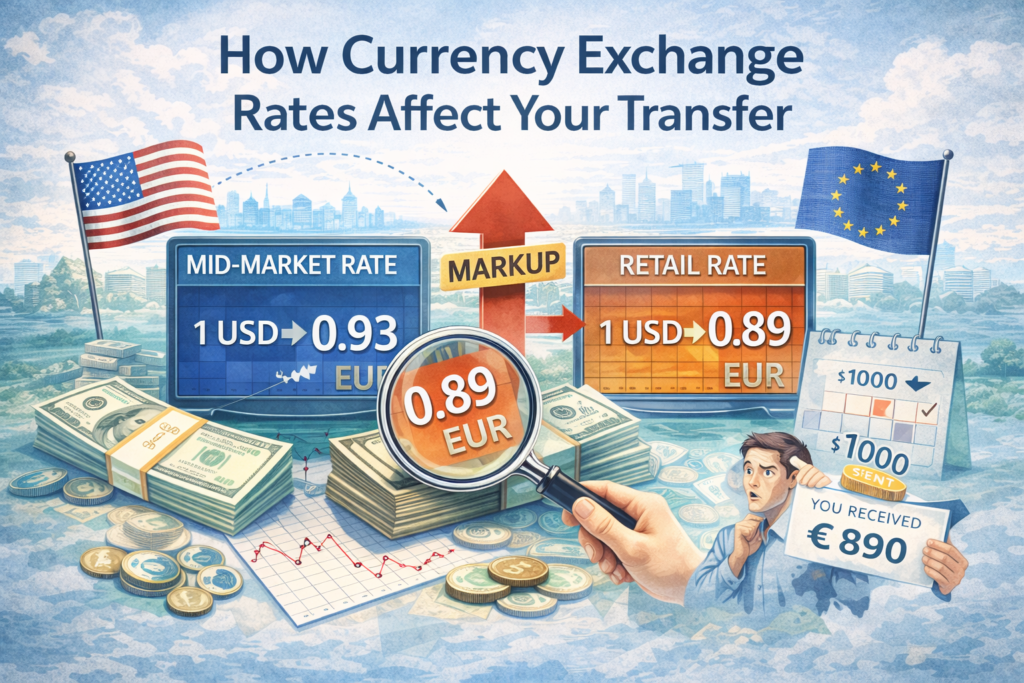
At the heart of all currency conversions is the mid‑market rate. The International Monetary Fund handbook explains that central banks publish a single mid‑rate — essentially the midpoint between the buying and selling prices of a currency — as an unbiased reference for their economies. Because this mid‑rate is free from transaction costs and profit margins, it reflects the fair market value of one currency in terms of another and serves as a benchmark for conversion. By contrast, the rates you encounter as a consumer or business — sometimes called the retail exchange rate — include a spread or markup. Financial institutions quote a buying rate (for customers who want to sell a foreign currency) and a selling rate (for customers who want to buy the foreign currency), and the difference between these two quotes represents the service’s gross profit and hedging buffer. The IMF emphasises that publishing the unbiased mid‑rate increases transparency and trust, while dealers are free to adjust their own buy and sell prices around it.
This distinction explains why the rate you find on a currency converter or a news site is rarely the rate you actually get. The mid‑market rate you see on financial news feeds is the midpoint used for large interbank transactions, whereas banks and money‑transfer providers add a margin to cover their costs and risks. The spread can vary depending on the currency pair, market volatility and the provider’s pricing model. Understanding that there is a fundamental difference between a mid‑market benchmark and a retail quote is the first step in demystifying currency exchange.
Markups, spreads and hidden costs
Once you understand the mid‑market benchmark, the next question is why banks and transfer services charge more than that benchmark. The answer lies in exchange rate markups and spreads. When a bank quotes a retail exchange rate, it usually embeds a margin above or below the mid‑market rate. For example, if the mid‑market rate for USD/EUR is 1.10, a bank might buy euros from you at 1.07 and sell euros at 1.13. The difference between 1.07 and 1.13 is the spread. This spread covers operational costs, risk management and profit; it also protects the bank against sudden market movements. A European regulation on cross‑border payments notes that currency‑conversion charges often form a significant part of the total cost and that these markups should be expressed as a percentage over a reference rate such as the European Central Bank’s daily rate. The regulation underscores that transparency helps consumers compare providers and prevents hidden overcharging.
Spreads vary widely. In competitive corridors, technology‑driven providers might offer rates very close to the mid‑market benchmark with a small, transparent fee. Traditional banks, especially when facilitating large cross‑border wires, may include higher markups. The difference becomes especially notable for currencies that trade less frequently or are considered riskier: higher volatility leads to wider spreads to compensate for potential price swings between the time a rate is quoted and the transaction is settled. It’s important to remember that exchange rate markups are effectively a hidden fee — even if a provider advertises “zero transfer fees,” the markup still means you receive less than if you were converting at the mid‑market rate.
Why rates change daily
Exchange rates are not static. They fluctuate constantly as millions of buyers and sellers trade currencies on global markets. These fluctuations matter because they influence the final amount your recipient receives. The Bank of Canada explains that the value of the Canadian dollar rises or falls according to how much people in foreign‑exchange markets want to buy or sell it, which is why the bank allows the currency to float freely. Demand for the Canadian dollar is affected by demand for Canadian goods and services and by economic fundamentals like interest rates, inflation and the relative strength of the economy. If investors believe Canada offers higher returns relative to other countries, demand for Canadian dollars increases and the dollar strengthens; if global demand for Canadian commodities falls, the dollar may weaken. These forces apply to all freely traded currencies: the supply and demand for each currency pair — shaped by trade flows, investment flows and market expectations — cause exchange rates to move up and down.
READ: The Complete Guide to Payment Systems & International Money Transfers
Another reason rates change daily is monetary policy. Central banks adjust interest rates to control inflation and influence economic growth, and those decisions can shift currencies quickly. Higher interest rates in a country often attract foreign capital seeking better returns, which increases demand for that country’s currency and strengthens it. Conversely, rate cuts can weaken a currency. Economic data releases, geopolitical events and market sentiment can also trigger abrupt changes. Because the foreign‑exchange market operates 24 hours a day and across time zones, rates can shift between the time you initiate a transfer and the time it settles. When sending a payment internationally, you should be aware that the final exchange rate might differ slightly from the rate you see when you start the process, especially if there is a delay between initiating and funding the transfer.
Trade‑offs between speed, price and certainty
The variability in exchange rates introduces several trade‑offs. If you prioritise certainty, some providers offer a locked‑in rate for a short time (often called a guaranteed rate) once you initiate a transfer. This means the provider absorbs the risk of rate fluctuations during that period, but you may pay a slightly higher spread to compensate for that guarantee. Alternatively, if you’re comfortable with rate fluctuations, you can opt for a provider that executes your conversion at the prevailing mid‑market rate at the moment of execution. This may result in a better rate if markets move in your favour, but the final amount could also be lower if markets move against you.
Speed also matters. Same‑day or instant transfers may execute the conversion more quickly, reducing the window for rates to shift. However, faster services may command higher fees or spreads, especially when intermediary banks are involved. A slower service might provide a better rate or lower fee, but exposes you to more uncertainty. As you consider these trade‑offs, remember that fees and exchange rates together determine the cost, so a provider offering a low fee but a poor rate may be more expensive overall than a provider with a transparent fee and a competitive rate.
How currency conversion fits into the broader system
Currency conversion does not happen in isolation; it sits within the wider ecosystem of domestic, regional and global payment networks. Inside the euro area, the Single Euro Payments Area (SEPA) allows euro transfers across participating countries at low or no cost and without conversion; transfers within SEPA therefore avoid exchange‑rate risk because they use a single currency. To understand how euro transfers work in this harmonised context, you can refer to our guide on how SEPA transfers work in Europe. Once funds leave SEPA or involve another currency, they often rely on the SWIFT messaging network to instruct correspondent banks to move money. Our article on what SWIFT is and how international wires work explains how banks communicate through SWIFT and why correspondent banks add complexity and cost. Those intermediary banks may conduct currency conversions at their own rates, introducing additional spreads and potential delays.
The cost of cross‑border transfers is not limited to exchange rates. As detailed in our analysis of international money transfer fees, transfer fees and intermediary deductions can be significant. Understanding the fee structure helps you see how much of the total cost arises from the spread versus explicit charges. Additionally, because compliance checks and anti‑money‑laundering reviews can slow down transactions, delays may occur. Our article on why international transfers get delayed explores these factors. By recognising that currency conversion is only one part of the broader cross‑border payment system, you can make more informed decisions about timing, fees and the value you receive.
Final reflection: clarity through awareness
Exchange rates might seem like a maze at first, but with a few key insights, the picture becomes much clearer. The mid‑market rate is an unbiased benchmark that reflects the true market value of a currency pair, while the retail exchange rate you receive from banks and money‑transfer providers includes a spread to cover costs and risks. These spreads, often expressed as a percentage over an official reference rate, are essentially hidden fees. Rates change constantly because currencies float on global markets, their values shaped by supply and demand, interest rates and economic conditions. The interplay between certainty, speed and cost means there is no single “best” rate for everyone; it depends on your priorities and risk tolerance.
By understanding how currency conversion works and how it fits into the wider payment landscape, you can approach international transfers with calm clarity. You’ll be able to recognise whether a quoted rate is fair, see how markups affect the amount your recipient receives, and appreciate why timing matters. When combined with a clear grasp of fees, payment networks and potential delays, this knowledge helps ensure your money goes where it’s needed with minimal surprises.
Frequently asked questions
1. What is the mid‑market exchange rate?
The mid‑market rate (sometimes called the interbank rate) is the midpoint between the buying and selling prices of a currency in the wholesale foreign‑exchange market. It reflects the fair value of a currency pair without any transaction fees or profit margins and is often used by central banks as a reference. Consumer rates quoted by banks and money‑transfer services add a spread around this benchmark to cover costs and risks.
2. Why is the rate my bank offers different from the one I see online?
Publicly quoted currency rates (for example, on financial news sites) show the mid‑market benchmark. Banks and payment providers add a margin to that rate, creating separate buying and selling rates. This spread covers operational costs and market risk. Providers also set their spreads based on the currency pair, transaction size, market volatility and their own pricing strategies.
3. Do exchange rates change every day?
Yes. The foreign‑exchange market operates continuously, and rates fluctuate as buyers and sellers respond to economic data, interest‑rate changes, trade flows and market sentiment. The Bank of Canada notes that the value of its currency rises or falls according to how much people in foreign‑exchange markets want to buy or sell it. Factors such as relative interest rates, inflation and demand for financial assets all influence exchange rates.
4. Why do I sometimes receive less than expected when sending money abroad?
If the sender or recipient account is in a different currency from the one being sent, the provider will convert currencies at a retail exchange rate that includes a markup. Even if a provider advertises “no transfer fee,” the spread may be significant. Intermediary banks involved in international wires may also apply their own currency‑conversion rates, further reducing the final amount. Additionally, exchange rates can move between the time you initiate a transfer and the time it is processed, especially for slower services.
5. How can I minimise the impact of exchange rate markups?
Compare providers not only on advertised fees but also on the rates they offer relative to the mid‑market benchmark. Some services provide transparent spreads and separate fees, making it easier to see what you’re paying. If timing is flexible, monitoring rates and transferring when the currency is strong relative to your base currency can help. For frequent transfers, multi‑currency accounts may allow you to hold funds in different currencies and convert when rates are favourable.
6. Do currency conversion charges have to be disclosed?
In the European Union, regulations require payment service providers to present currency‑conversion charges as a percentage mark‑up over a reference rate and to inform consumers about these costs before a transaction. The goal is to improve transparency and help consumers compare providers. Other jurisdictions have similar disclosure rules, but practices vary worldwide.
7. Can exchange rates cause delays in international transfers?
While currency conversion itself does not usually delay a transfer, the process of routing payments through correspondent banks and foreign‑exchange desks can add time, especially when checks and settlement windows are involved. Our article on why international transfers get delayed explains how compliance reviews and cut‑off times contribute to processing time, which may also influence the rate you receive if markets move during the delay.
8. Are exchange rates more favourable when transferring large amounts?
For high‑value transfers, some providers offer more competitive spreads, reflecting economies of scale. The difference is especially noticeable for wholesale transactions conducted at interbank rates. However, the size threshold for preferential rates varies by provider, and even large transfers will still be subject to some form of spread to cover risk. It’s advisable to request a quote and compare providers before sending large sums.
9. Does SEPA eliminate exchange‑rate risk?
Within the Single Euro Payments Area, all transfers are executed in euros, so there is no currency conversion within SEPA. That means no exchange‑rate risk for euro‑to‑euro payments and usually very low or no fees. However, if your transfer involves converting from a non‑euro currency into euros before entering SEPA, the exchange rate and associated markup will still apply. Our article on how SEPA transfers work in Europe provides more detail about this system.
10. Why are some currencies more volatile than others?
Currencies of countries with stable economies, credible monetary policy and deep financial markets tend to fluctuate within narrower ranges than those of economies that are more exposed to commodity price swings, political risk or high inflation. Market participants demand higher premiums to hold riskier currencies, resulting in larger daily moves and wider spreads. This is why conversion costs can be higher for exotic or less‑traded currency pairs — providers charge more to compensate for volatility and limited liquidity.