
Why this topic matters
I’ve noticed many people think digital‑only banks vs traditional banks is simply a question of modern versus old. From what I’ve seen, this confusion is common – people often assume a digital‑only bank is not a “real bank,” or that a traditional bank is outdated. In reality, the difference lies more in structure and operations than in legitimacy. Both models serve millions of people worldwide, and both are regulated financial institutions. This article explains, in simple terms, what digital‑only banks are, what traditional banks are, how they operate, and why both exist today. We won’t recommend any particular bank or app; instead, we’ll help you understand the landscape so you can feel informed and at ease. (For a broader look at the basics of digital banking, see our digital banking basics article.)
Table of Contents
What are digital‑only banks?
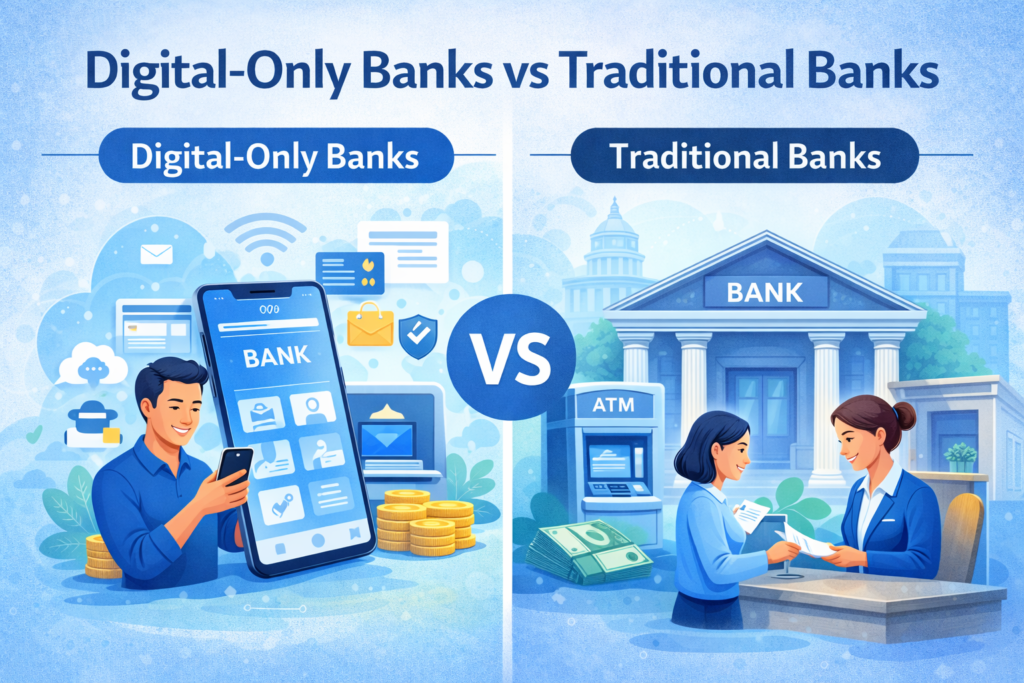
A digital‑only bank, sometimes called a neobank or online‑only bank, is a financial institution that operates entirely online. These banks have no physical branches. Instead of visiting a building, customers open accounts, manage money, transfer funds, and pay bills through a website or mobile app. Because they don’t maintain branches, digital‑only banks can operate with lower overhead costs. This lower cost structure allows them to offer higher interest rates and lower fees compared with many branch-based banks.
Digital‑only banks rely on modern technology. When you open an account, the process happens entirely online. A customer uploads identification, takes a selfie for verification, and receives account details within minutes. Once the account is open, everything from check deposits to bill payments happens digitally. Features often include:
- Mobile and web access 24/7: You can check balances or transfer money at any time.
- Remote deposit and transfers: By taking a photo of a check, you can deposit it; you can also move money between accounts or send payments electronically.
- Automated tools and alerts: digital‑only banks often integrate budgeting tools, spending summaries, and instant alerts for transactions.
However, because they lack physical branches, digital‑only banks typically do not accept cash deposits in person. Customers deposit cash through partner ATMs or by converting cash to a money order. Customer service is usually delivered by chat, phone, or email; there is no option to sit down with a teller.
Digital‑only banks are legitimate financial institutions. They must follow the same regulations as their brick‑and‑mortar counterparts. Many digital‑only banks partner with a licensed bank to hold deposits and ensure they are insured by deposit insurance schemes (for example, the FDIC in the United States). This insurance protects your deposits (usually up to \$250,000 per depositor in the U.S.) regardless of whether you use a branch or an online-only institution.
What are traditional banks?
Traditional banks, also known as brick‑and‑mortar banks, operate through physical branch offices. You can walk into a branch to open an account, deposit cash, withdraw funds, discuss loans, or seek help from a teller or banker. Traditional banks have been the mainstay of banking for centuries. They handle everyday transactions—cash deposits, money orders, wire transfers—and provide in‑person services such as notarising documents or offering safe‑deposit boxes. They also often supply a wide range of products, including mortgages, business loans, investment accounts, and speciality services.
Modern traditional banks still provide online and mobile access (sometimes called digital banking), but their core structure includes branches, offices, and ATMs. This network of physical locations means customers can speak to staff face to face, deposit large amounts of cash quickly, or resolve complex issues in person. The drawback is that maintaining branches and personnel leads to higher overhead costs, so these banks may charge more fees and offer lower interest rates.
How do digital‑only banks vs traditional banks differ in structure and operations?
Cost and fees
Because digital‑only banks don’t operate branches, they save on real estate, staffing, and utility costs. These savings can be passed on to customers in the form of higher interest rates on savings and fewer fees. Many digital‑only banks have no monthly maintenance fees and reimburse ATM fees. In contrast, traditional banks must support branch networks and extensive staffing; they often charge monthly service fees, overdraft fees, and other charges to cover these costs. This difference in cost structure is one of the main reasons customers might choose one model over the other.
Access and convenience
A key difference between digital‑only banks vs traditional banks is how you access your money. With digital‑only banks, all transactions happen through the internet. You can log in from your phone or computer at any time to transfer funds, deposit checks, or pay bills. There is no need to wait for business hours. Traditional banks also offer online banking, but they rely on branches to provide certain services. If you need to deposit cash or want to speak to a banker, you must visit during branch hours. For people who handle cash frequently or prefer face‑to‑face support, this physical presence can be important.
Customer interaction
Another point of confusion in the digital‑only banks vs traditional banks discussion is how customers interact with their bank. In a traditional bank, you might know the staff at your local branch; you can discuss issues, ask questions, and build a personal relationship. Many people value this human touch. In a digital‑only bank, customer support is delivered remotely via chatbots, phone calls, or email. Some banks use AI or messaging services to provide quick answers. For straightforward issues (like checking your balance or resetting a password), remote support is usually sufficient. But if you want guidance on a mortgage or small business loan, you might prefer to sit down with a banker in person.
Range of products and services
Traditional banks often provide a broader product menu. They might offer mortgages, small‑business loans, investment accounts, safe deposit boxes, and financial planning services. Digital‑only banks typically focus on core deposit accounts (checking and savings) and basic services like money transfers and budgeting tools. Some digital banks are expanding into lending and investment via partnerships, but they may not match the full suite of products offered by large branch‑based banks. For many beginners or freelancers who primarily need to receive and send money, digital‑only banks may be sufficient. Those requiring complex financial products might still rely on a traditional bank.
Deposits and ATM access
Since digital‑only banks have no branches, they usually partner with ATM networks or other banks to give customers access to cash. These partnerships allow fee‑free withdrawals at thousands of ATMs. However, depositing cash can be inconvenient; you may need to purchase a money order or use a specific ATM that accepts cash for your digital bank. Traditional banks, with their own ATMs and branch tellers, make cash deposits straightforward and instantaneous.
Technology and reliability
Digital‑only banks rely heavily on technology. While this allows for modern features like instant notifications and real‑time transaction processing, it also means that service availability depends on internet connectivity and the bank’s app or website. Outages can temporarily prevent access. Traditional banks also use technology, but customers can still visit a branch or call local staff if online systems fail. Despite these differences, both models are considered secure when they follow regulatory standards. The FDIC notes that both brick‑and‑mortar and online banks are insured and that a bank’s location does not affect the safety of your deposits.
Fees and interest rates
A recurring theme in discussions about digital‑only banks vs traditional banks is the difference in interest and fees. Because digital‑only banks operate more cheaply, they typically pay higher annual percentage yields (APYs) on savings and charge fewer service fees. Traditional banks, facing higher costs, often offer lower interest rates and impose fees for monthly maintenance, ATM usage, or overdrafts. This doesn’t mean digital banks are always cheaper; some specialised services or premium accounts in traditional banks can offer competitive rates, and some digital banks charge fees for certain features. The key is that cost structures differ, not that one model is universally cheaper or better.
Why trust perceptions and security differ
I think people often mix up convenience with reliability when discussing digital‑only banks vs traditional banks. Some believe online‑only institutions are less trustworthy because they lack a physical presence. In reality, legitimacy comes from regulation and insurance, not from owning a building. The FDIC explicitly states that digital‑only banks can be insured in the same way as traditional banks. Depositors should look for clear evidence of deposit insurance (e.g., FDIC or national equivalent) when choosing any bank.
Digital‑only banks tend to innovate quickly – they use modern encryption, multi‑factor authentication, and real‑time monitoring to protect customer data. Traditional banks also invest heavily in cybersecurity, but they may adopt new technologies more slowly due to legacy systems and regulatory hurdles. However, both types of banks are subject to data breaches or fraud if users are careless with passwords or device security. The safest approach is to follow good practices: use strong, unique passwords, enable two‑factor authentication, and monitor account activity frequently.
In terms of reliability, digital‑only banks rely on their servers and internet connectivity. Outages can occur, making it temporarily impossible to access your account. Traditional banks can also experience system issues, but you might still be able to visit a branch for assistance. This difference contributes to the perception of stability. For some, knowing that there is a physical branch to visit provides reassurance. Others are comfortable relying on digital systems and appreciate the benefits of constant access.
Why do both models continue to exist
The existence of digital‑only banks vs traditional banks is not a battle but a reflection of diverse customer needs. Here are some reasons both models thrive:
- Different customer preferences: Many younger or tech‑savvy users appreciate the convenience, low fees, and modern features of digital‑only banks. They seldom use cash and manage finances entirely from their phone. Conversely, individuals who value personal relationships, need to deposit cash frequently, or live in areas with limited internet access, prefer traditional banks.
- Complementary roles: Some people maintain accounts at both digital‑only and traditional banks. They enjoy the high interest rates and budgeting tools of a digital bank while using a traditional bank for cash deposits, safe deposit boxes, or specialised loans.
- Evolution of services: Traditional banks are integrating digital technologies to provide robust online platforms and apps. This hybrid approach meets customers’ expectations for digital access while retaining in‑person service. At the same time, digital‑only banks are expanding product offerings through partnerships, such as loans or investment options.
- Global reach: Digital‑only banks can serve customers across regions or even internationally, as long as regulations permit. This appeals to freelancers, remote workers, and travellers who need to manage money while moving around. Traditional banks often focus on local communities and provide services that support local businesses and economies.
In short, both digital‑only and traditional banks meet genuine needs. There is no single “better” model – it depends on what you value: convenience, human interaction, cost, or specialised products.
Making sense of digital‑only banks vs traditional banks
From my experience, the confusion around digital‑only banks vs traditional banks stems from misconceptions. A digital‑only bank isn’t “fake,” and a traditional bank isn’t obsolete. They represent different ways of delivering banking services. Digital‑only banks operate without branches, often offering higher interest rates and fewer fees due to lower overhead costs. They rely on websites and apps for account opening, deposits, transfers, and customer service. Traditional banks maintain branch networks, providing face‑to‑face support, cash handling, and a wider range of financial products. The trade‑off is higher costs that may translate into fees.
Both models are regulated and can be insured by government deposit schemes, making your money safe when managed responsibly. Your choice isn’t about which is “better” but about what fits your lifestyle and comfort. If you rarely use cash and value instant, anytime banking, a digital‑only bank may suit you. If you rely on cash deposits, prefer in‑person guidance, or need specialised services, a traditional bank might be your primary choice. Many people even mix the two.
As digital banking continues to evolve, understanding the difference between digital‑only banks and traditional banks will help you navigate the financial world with confidence. Remember that the basics of good banking—keeping your information secure, monitoring your accounts, and knowing your options—are the same, no matter which model you choose.
For more on how digital banking works and deposit insurance, see the U.S. FDIC’s consumer guide “Is Digital Banking for Me?”