
The idea of an emergency fund can sound abstract until you imagine a real situation. At its core, an emergency fund is money set aside for the unexpected. But what exactly counts as “unexpected”?
Typically, this includes sudden costs that you cannot easily plan for:
- Medical expenses: An unexpected injury or health issue requiring urgent care.
- Urgent repairs: A leaking roof, a broken boiler, or a car accident needing immediate repair.
- Job loss or income drop: Losing a job, reduced hours, or delayed freelance payments that leave you without your usual income.
- Essential travel: Last-minute travel for a family emergency, such as attending a funeral or caring for an ill relative.
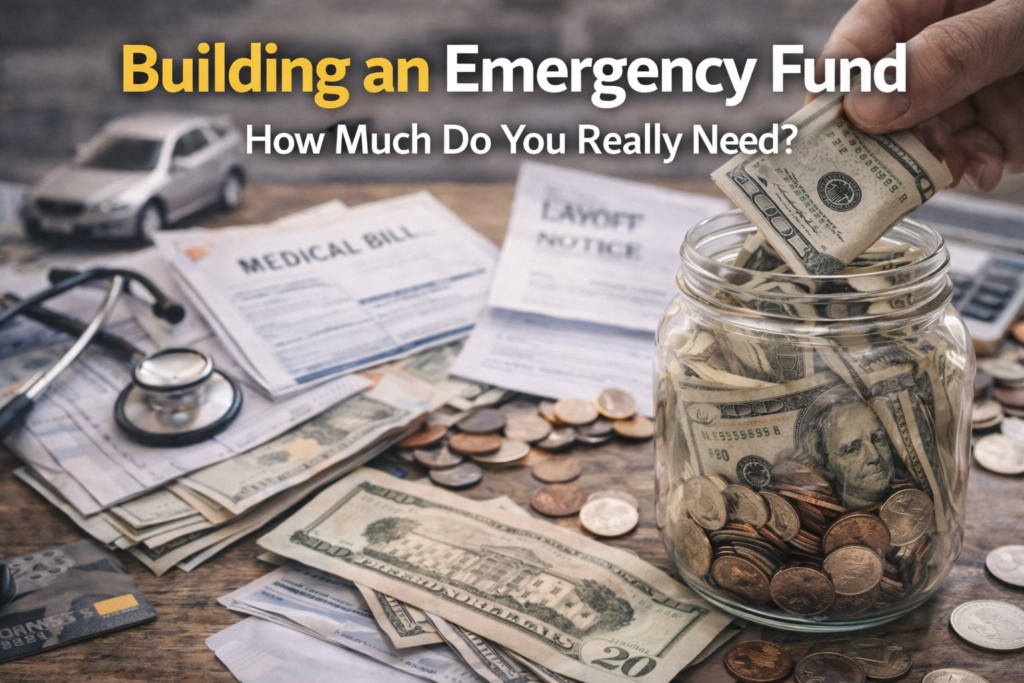
On the other hand, some events that might feel important usually don’t count as emergencies: vacations you planned months ago, optional home upgrades, or routine car maintenance that could be scheduled. Those are normal expenses that should fit in your budget or savings goal, not your emergency stash.
Clearly defining an emergency helps focus what your fund is for. A government financial education site (Consumer.gov) suggests making sure your money is earmarked for unpredictable costs only. This way, your emergency fund remains untouched unless a real urgent need arises. The goal is clarity, not restriction – knowing what qualifies keeps you honest with yourself about using this money only when it truly matters.
Why do people talk about 3–6 months of expenses?
You’ve probably heard that you should save “three to six months of expenses.” Many financial experts and institutions use this guideline. For example, the Consumer Financial Protection Bureau and central banks often reference a multi-month buffer for basic living costs.
There are a few reasons for this recommendation:
- Expenses, not income: It’s measured in months of essential expenses (rent, food, utilities), not total income. This reflects the actual cash you need to cover bills if your pay stops.
- Range varies: Three months is a common starting point; six months provides a larger safety net. The exact number can depend on your situation. Someone with a very stable job might lean toward three months, while someone with a volatile income might aim for more.
- Start small: Importantly, experts stress this as a goal, not a strict rule. Starting with even a fraction of that (like one month’s expenses) can make a big difference. The Consumer Financial Protection Bureau notes that control over finances and the ability to absorb shocks are key aspects of financial well-being. Even a small emergency fund moves you closer to that control.
In fact, surveys show many people have some savings already. In one Federal Reserve report, a large majority of adults who usually had some money left over each month already had about three months’ worth of expenses saved. That suggests three months is a meaningful benchmark for resilience. But again, this is a spectrum, not a test. The point is to build up slowly – every bit of savings raises your ability to handle surprises.
READ: Money Management Basics: Managing Income, Budgeting, and Building Financial Stability
Starting with a smaller buffer
Before you reach the full 3–6 months target, any amount of savings is helpful. Even $500–$1,000 can act as a first safety net.
Here’s why a small buffer matters: It gives you breathing room. Suppose your essential costs are $2,000 a month. Having just $1,000 means you can handle half a month of bills without going into debt or overdraft. That might cover a minor car repair or a co-payment at the doctor. It won’t solve a major crisis, but it prevents immediate scrambling.
To illustrate:
- If your goal is 3 months ($6,000 in this example), the first $1,000 already covers some immediate needs.
- Reaching that initial $1,000 is achievable faster, which can build confidence.
This approach aligns with advice from financial educators who encourage starting with a modest savings goal. It quickly changes outcomes. A small emergency fund means a flat tyre or minor medical bill doesn’t automatically become a big headache. Over time, you can keep adding to it. In our Saving Money Basics: How to Start Saving article, we talked about growing your savings habit. Here, we see how that habit transforms into a buffer that literally protects you.
Where to keep your emergency fund
Once you have an emergency fund, how do you store it? The key is accessibility. You want these savings to be as ready as cash, but safer and slightly rewarding:
- Easy access: Keep the money where you can get it quickly. A regular savings account at a bank or credit union is common. It earns a bit of interest but lets you withdraw or transfer funds to your checking account at any time.
- Safety: Avoid risky investments for emergency cash. Volatile stocks or complex assets can be down when you need them. Instead, use an account that’s protected (for example, FDIC-insured in the U.S. or government-backed in Europe).
- Separation: Don’t mix your emergency fund with everyday spending. If possible, use a separate account or sub-account. That way, you won’t accidentally spend it.
This setup is not about getting high returns – it’s about peace of mind. Consumer financial educators often emphasise keeping emergency money separate. (For example, MoneyHelper in the UK and similar guides suggest a dedicated savings account for emergencies.) The slight interest you earn is a bonus, but the real benefit is that your emergency money is off-limits for daily spending. Having a clear boundary (even a separate login in your bank app) helps you treat it differently from your regular funds.
Emergency funds for irregular income
If your income jumps around (say between $1,500 and $3,500 monthly), an emergency fund becomes even more important. Think of it as levelling out the waves:
- In high-income months, you can add more to the fund, boosting the balance.
- In low-income months, instead of cutting back on essentials or borrowing, you tap the fund to cover the gap.
This fits with what we said about saving and budgeting. Tracking your income and spending (as in Tracking Income and Expenses: Understanding Your Cash Flow) helps you see how short months can occur. An emergency fund acts like a buffer in those months when expenses cluster or pay is delayed.
It’s crucial to remember: the emergency fund doesn’t replace income or make you spend more. It just smooths out the bumps. If you’re a freelancer, treat your emergency fund as part of your normal financial toolkit. Build it when you can. Then, in tougher months, it quietly covers what you need so you can focus on earning without panic.
Questions people ask about emergency funds
What exactly is an emergency fund?
It’s money set aside for unexpected expenses. Think urgent bills or loss of income. It’s not for planned costs or regular bills.
Why do people say “3–6 months of expenses”?
Because three months of necessities (rent, food, utilities) often covers many crises. Six months provides more cushion. It’s a guideline from financial experts and institutions, not a strict rule.
Can I start with less than 3 months?
Absolutely. Even $500–$1,000 can help with minor emergencies. The key is to start somewhere. Build it gradually.
What counts as an “essential expense”?
Housing, food, healthcare, utilities, and basic transportation. These are the costs you can’t skip paying.
Where should I keep this money?
In a safe, easily accessible place like a savings account. It should be separate from your regular spending account.
Is credit card debt an emergency?
No. Credit card debt is the result of spending. Emergencies are events, not consequences. Use the fund for real unexpected events, so you don’t have to add more debt.
Do I need an emergency fund if I have insurance or family help?
Insurance and support help, but they can have limitations or delays. An emergency fund offers immediate coverage when something happens.
Does an emergency fund ever get used on fun things?
Ideally no. It’s named “emergency” for a reason. Once it’s spent, you start rebuilding it. The discipline of keeping it for emergencies only is what makes it work.