
Table of Contents
Why banking terms feel confusing
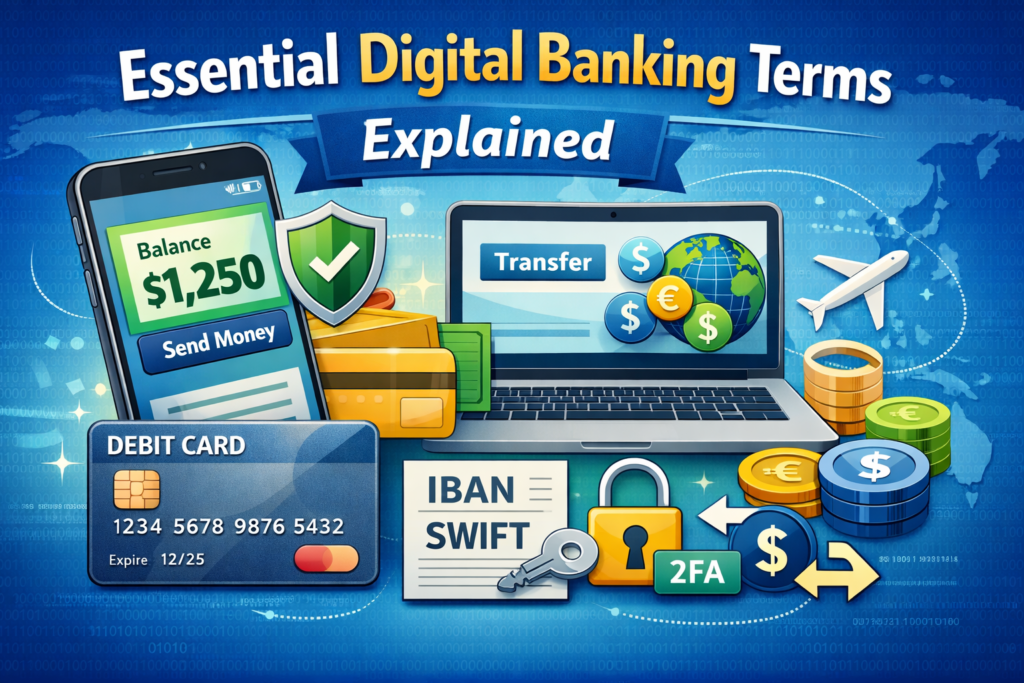
If you’ve ever opened a banking app or read an article about money and thought, “Why does this sound like another language?” you’re not alone. I’ve noticed many people skip terms they don’t understand, only to feel lost later. From what I’ve seen, this is where confusion usually starts – simple words like “routing number” or “transaction” aren’t obvious if you’ve never had to think about them. Understanding these basics makes everything easier, so this article will clearly explain essential digital banking terms in plain English.
Digital, online and mobile banking
We hear these terms a lot, but they aren’t as complicated as they sound. Digital banking is the umbrella concept: using technology to manage your money without visiting a branch. The FDIC notes that digital banking’s main benefits are affordability, convenience and the ability to handle finances remotely. Under that umbrella are online banking and mobile banking.
- Online banking means using a computer and a web browser to check balances, pay bills or transfer money. You can do these tasks anywhere you have an internet connection. It’s designed for larger screens and is sometimes called internet banking.
- Mobile banking brings those same activities to your smartphone or tablet. According to Investopedia, mobile banking involves making financial transactions on a mobile device – from receiving fraud alerts to sending money to a friend. Mobile apps are optimised for smaller screens and often include tools like mobile check deposit and real‑time notifications.
For a broader look at how these services evolved, check out our overview of digital banking basics.
Understanding your account: balances and transactions.
When you log into an account, you might see two balance numbers. Account balance is the amount of money in your account at the start of the business day, including deposits and withdrawals posted the night before. This number may not reflect activity that hasn’t cleared yet.
The available balance is what you can actually spend right now. It updates throughout the day and takes into account holds from pending debit card purchases and deposits. If you deposit a check, for example, the amount shows up in your account balance but may not be available to spend until the hold is released.
A transaction is any exchange of money. Investopedia defines it as a completed agreement in which a buyer and seller exchange goods, services, or financial assets for money. In everyday banking, transactions include deposits, withdrawals, purchases, bill payments, and transfers between accounts. Paying attention to transactions helps you spot unauthorised activity and track your spending.
Payment tools: the debit card
A debit card is a plastic card linked directly to your bank account. When you use it, you are spending money you already have. The Consumer Financial Protection Bureau explains that debit card purchases draw from your account rather than borrowing funds like a credit card. Many cards now have chip or contactless technology for security, and they often come with alerts through your bank’s mobile app. Some accounts allow you to overdraft (spend more than your available balance), but there are usually fees involved. Prepaid cards work differently, because you load money onto them ahead of time; this article focuses on standard debit cards attached to a checking or transaction account.
Bank numbers: routing, IBAN and SWIFT
When you set up direct deposit or make a transfer, you’ll be asked for certain codes that tell the system where to send the money. In the United States, a routing number is a nine‑digit code that identifies your bank or credit union. SoFi describes it like an address: the routing number is the street name, and your account number is the house number. Routing numbers are used for domestic transactions such as ACH transfers and wire payments within the U.S.
For cross‑border payments, banks use international identifiers. One is the IBAN (International Bank Account Number). According to SWIFT, IBAN stands for International Bank Account Number and helps automate cross‑border payment processing. It combines country code, bank code and individual account number in a standardised format so payments can be routed correctly.
Another identifier is the SWIFT code, also known as a BIC (Bank Identifier Code). Investopedia notes that each financial institution on the SWIFT network has a unique eight‑ or 11‑character code. The first four characters identify the bank, the next two the country and the last two the city. When sending money internationally, you provide the recipient’s bank SWIFT code so the payment reaches the right place. For a deeper dive into how these codes are used, the official SWIFT site explains the IBAN system and registration process.
Staying secure: Two‑factor authentication
Using a strong password is important, but it’s often not enough on its own. That’s why many banks require two‑factor authentication (2FA) when you log in or perform sensitive actions. Centier Bank describes 2FA as an extra layer of security: you must provide two different types of information. The first factor is something you know (like your password), and the second factor is something you have or are, such as a code sent to your phone or your fingerprint. This additional verification makes it much harder for someone else to access your account if they guess or steal your password.
Working across borders: currency conversion and transfers
Currency conversion
If you travel abroad or shop on a foreign website, you’ll often see a price in a currency other than your own. Currency conversion is the process of exchanging one currency for another. Western Union defines an exchange rate as the rate you pay to trade your currency for another. These rates fluctuate based on market conditions, a country’s economy and government policies. When you use your debit or credit card overseas, your bank or card network converts the purchase amount to your home currency at the current exchange rate and may charge a fee for the service. Some travellers opt to pay in the local currency because rates offered by the card network are often more favourable than the dynamic currency conversion offered at checkout.
Foreign transaction fee
A foreign transaction fee is a charge that banks and card issuers apply when you purchase in a foreign currency. Investopedia notes that these fees typically range from 1 % to 3 % of the transaction amount. They were originally meant to cover the costs and currency risk associated with cross‑border payments. Before you travel, it’s worth checking whether your bank or card charges this fee; some digital banks advertise “no foreign transaction fee” as an added benefit.
International transfer (remittance)
Sending money to someone in another country involves an international transfer, also called a remittance. The Consumer Financial Protection Bureau defines a remittance transfer as an electronic transfer of more than $15 from a U.S. consumer to someone abroad. By law, remittance providers must disclose the fees and exchange rate before you confirm the transaction and must tell you when the funds will be available. You also have the right to cancel within a limited time and to correct errors. If you’re on the receiving end of an international payment, you may need to supply your bank’s SWIFT code and, in some countries, an IBAN to ensure the funds arrive correctly.
Conclusion: Put your knowledge to work
Learning these essential digital banking terms makes reading other money guides much easier. Now you know that digital banking covers both online and mobile banking, that your available balance shows money you can actually spend, that a transaction is any movement of money, and that routing numbers, IBANs and SWIFT codes help payments reach the right bank. You also understand why two‑factor authentication protects your accounts and how currency conversion, foreign transaction fees and international transfers work.
If you’d like to build on these basics, our article on digital banking basics gives a fuller picture of how modern online banking services work and why they’re so popular. To understand where digital banking came from and why it matters, explore What Is Digital Banking? – it explains how online services evolved from traditional banking and helps contextualise the terms you’ve just learned. With these foundations, you can navigate your financial life online with clarity and confidence.