
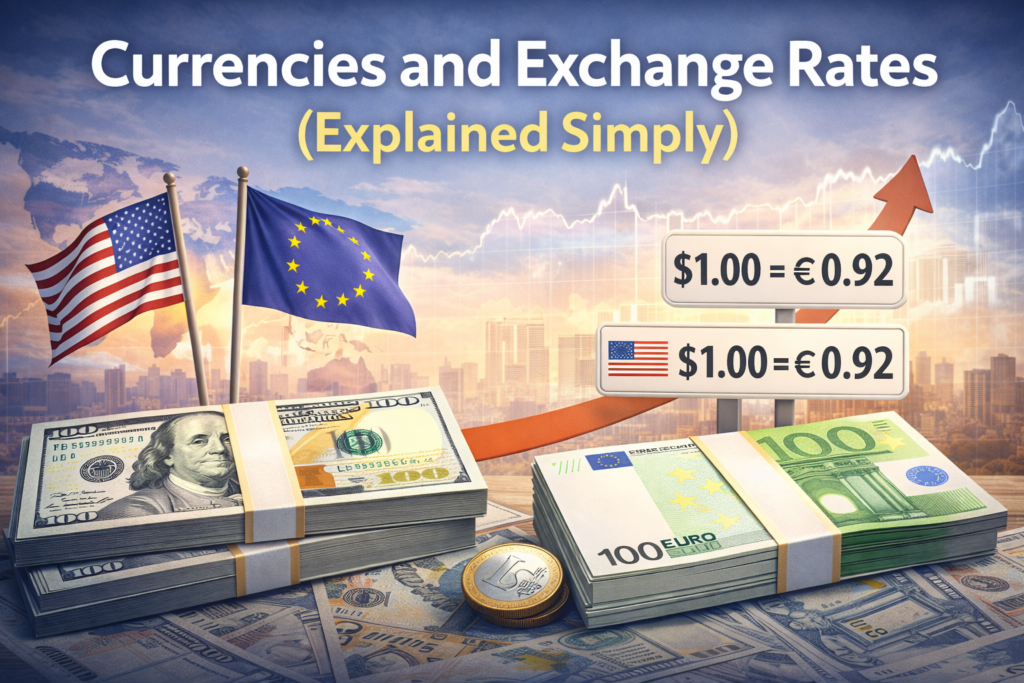
Money feels straightforward at home because everyone uses the same bills and coins. Yet the first time you travel or get paid in another currency, you discover something curious: the same amount of money doesn’t buy the same things everywhere. A cup of coffee that costs $3 in New York might cost €3 in Paris. Those numbers aren’t equal; they are connected by what’s called an exchange rate. This article explains why different currencies exist, what exchange rates really show, why they change over time, and how they matter in everyday life. It builds on the Money Basics pillar by showing how value works across borders.
Table of Contents
Why countries use different currencies
The world doesn’t use one global currency because countries have different economic situations and priorities. According to the Council on Foreign Relations (CFR), most countries issue their own money because they “have unique economic situations and want to make monetary decisions based on their specific interests and needs.” That means nations prefer to control their own supply of money, interest rates and financial policies rather than share a currency that might not fit their circumstances. Some regions, such as the euro area, choose a shared currency, but this requires ceding some control to a central authority and trusting that decisions will benefit all members. For most countries, having a national currency allows them to respond to local conditions, which is why the world has many currencies instead of one.
The idea of money as a shared agreement still holds. Money only works when people trust that others will accept it in the future. When you read about currencies, remember that a dollar, euro or yen is simply a tool societies use to store and exchange value. If you need a refresher on what money really is, our article What Is Money? breaks down those basics.
What a currency is
A currency is the official money issued by a government or central bank. It comes in physical form (notes and coins) and, increasingly, as digital numbers in bank accounts. Currencies let people trade goods and services within a country and make saving and borrowing easier. Each currency has a three‑letter code (USD for U.S. dollars, EUR for euros) set by an international standard. These codes avoid confusion when names differ across languages.
Because each country manages its own currency, the value of one currency compared with another can vary. That comparison is called the exchange rate. Understanding exchange rates helps you see that money’s worth is relative rather than absolute.
What an exchange rate really is
An exchange rate is simply the price of one currency expressed in terms of another currency. The Reserve Bank of Australia notes that a bilateral exchange rate “is the price of one currency expressed in terms of another”. The European Central Bank (ECB) explains that “an exchange rate is the rate at which one currency can be exchanged for another” and that this rate “changes constantly on global foreign exchange markets”. For example, if the euro–dollar exchange rate is €1 = $1.10, you need $1.10 to buy one euro. If the rate moves to €1 = $1.15, the euro has appreciated relative to the dollar, and each euro buys more dollars.
Exchange rates come in two broad types:
- Floating (or flexible) exchange rates. Most major currencies, including the U.S. dollar and the euro, have floating rates. Their value is determined by supply and demand in the foreign exchange market. The RBA notes that under a floating regime, “the value of the currency is determined by the market forces of demand and supply”. Because market conditions change every day, floating rates constantly move up and down.
- Fixed or pegged exchange rates. A few countries choose to keep their currency at a fixed value relative to another currency, often to create stability for investors. CFR explains that some countries “peg” their currency to another—such as Belize pegging its currency at half a U.S. dollar—so its value stays constant. Pegging reduces volatility but requires a country’s central bank to adjust its own supply of money to match the chosen currency.
Knowing whether a currency floats or is pegged helps you understand why its value moves as it does. Most everyday currency changes result from floating rates responding to market forces.
Why exchange rates change over time
Exchange rates change because the supply of and demand for currencies change. CFR explains that “currencies increase in value when lots of people want to buy them … and they decrease in value when fewer people want to buy them … or when a large amount of a currency is lying around in the market”. In other words, if demand for U.S. dollars rises relative to euros, the dollar appreciates; if the supply of dollars increases or demand falls, the dollar depreciates. Here are some key factors that influence supply and demand and cause rates to move:
Economic attractiveness and investment flows
Investors prefer stable, growing economies. CFR notes that “the more people want to invest in a country, the more that country’s currency will appreciate”. For example, if many people want to invest in South Korea’s stock market, they need won; this increased demand drives up the won’s value. Conversely, when investors are uncertain about a country’s future, demand for its currency falls. After the United Kingdom’s Brexit referendum, for instance, uncertainty caused the pound to depreciate.
Commodity prices and trade
If a country exports a commodity widely used around the world, changes in that commodity’s price can shift currency demand. CFR provides the example that Canada’s currency value is tied partly to oil prices: when oil prices rise, foreign buyers need more Canadian dollars to purchase oil, increasing demand and strengthening the Canadian dollar. When prices fall, demand for Canadian dollars drops, weakening the currency. More generally, when a country sells a lot of goods abroad, buyers must obtain that country’s currency, raising its value; when it imports more than it exports, demand for its currency can fall.
Inflation and purchasing power
Inflation—the tendency for prices to rise over time—also influences exchange rates. CFR explains that if a country experiences inflation, the prices of its exports rise, making them less attractive to foreigners, and domestic consumers may buy more imports. Both effects reduce foreign demand for the currency and increase its supply in foreign exchange markets, pushing its value down. A little inflation is normal, but very high inflation (hyperinflation) can drastically weaken a currency.
Our article Inflation 101: Why Prices Go Up Over Time explains how rising prices work and why they matter for money’s purchasing power.
Interest rates and monetary policy
Although this article does not delve into formulas, it’s useful to know that central bank interest rates affect currency values. Higher interest rates often attract foreign capital because investors can earn a better return, increasing demand for the currency. Lower interest rates can have the opposite effect. Central banks also influence currency supply by printing or removing money from circulation; this is sometimes described as “flooding the market” when they want to weaken the currency. However, many central banks, including the ECB, do not actively target an exchange rate; the ECB notes that “the exchange rate is not a policy target”. Instead, they focus on domestic goals like price stability, and exchange rates adjust accordingly.
Expectations and market psychology
Currency traders also react to expectations. If traders believe a currency will become stronger, they may buy more now, pushing up its value. If they expect weakness, they may sell, causing depreciation. These beliefs can change quickly in response to news about economic data, elections or geopolitical events, making exchange rates volatile in the short term.
How exchange rates affect daily life
Exchange rates matter even if you never set foot in a bank’s foreign currency counter. Here are some ways they affect everyday decisions:
Travel and online purchases
When you travel abroad, the exchange rate tells you how much of the local currency your money will buy. A stronger home currency means you can buy more abroad; a weaker currency means your trip is more expensive. Similarly, if you order products from overseas or subscribe to a service priced in another currency, exchange rates determine whether it feels cheap or costly. Understanding rates helps you plan and avoid surprises.
Earning income from abroad
The rise of online work means many people get paid in a different currency than where they live. Freelancers in India paid in euros or dollars convert those earnings into rupees. If the rupee depreciates, workers get more rupees per euro; if it appreciates, they get fewer. Knowing that exchange rates fluctuate helps you decide when to convert or whether to keep some money in foreign currency.
Pricing and budgeting for businesses
Businesses that import goods need to watch exchange rates closely. A U.S. café that buys Italian espresso beans pays in euros. If the euro appreciates against the dollar, the beans cost more in dollars, potentially raising coffee prices. Exporters, on the other hand, benefit when their home currency weakens because their products become cheaper abroad. Exchange rates thus influence pricing strategies and profit margins.
Government and public spending
Exchange rates also affect public finances. When a government has to repay foreign-denominated debt, a weaker currency makes repayments more expensive. Conversely, a stronger currency reduces the domestic cost of foreign obligations. Exchange rates, therefore, factor into fiscal planning and decisions about borrowing.
Why exchange rates are not a scam
It’s easy to think of exchange rates as mysterious numbers set by banks, but they are the result of broad economic forces, not secret manipulation. As CFR explains, most exchange rates “float”—they “constantly change depending on various economic factors”. Governments can choose to peg or manage their currencies, but doing so requires using reserves to buy or sell currency, and they cannot control market forces indefinitely.
Exchange rates move because people are buying, selling and investing across borders. Countries trade goods and services, investors seek opportunities, and central banks set policies that influence economic conditions. When you understand these factors, currency fluctuations make sense. They are a normal part of the global economy, not evidence of anyone “stealing your money.”
Bringing it all together
Currencies and exchange rates might seem like complex topics reserved for economists or traders, but they touch everyday life. Countries have different currencies because they need flexibility to manage their economies. An exchange rate is simply the price of one currency in terms of another, and its value changes as supply and demand shift. Demand rises when a country’s economy is stable and attractive to investors or when global buyers need its exports. Demand falls with uncertainty, falling commodity prices or rising inflation. Most currencies float freely, so exchange rates move constantly, and that movement affects travellers, online earners, businesses and governments.
By viewing exchange rates as a natural outcome of many people making decisions, you can approach currency fluctuations with curiosity instead of fear. Understanding why money’s value differs across countries—and how these differences evolve over time—helps you make smarter choices when you travel, work or manage your finances. After all, once you see exchange rates as just another price in the marketplace, you realise they’re simply part of how money works across our interconnected world.