
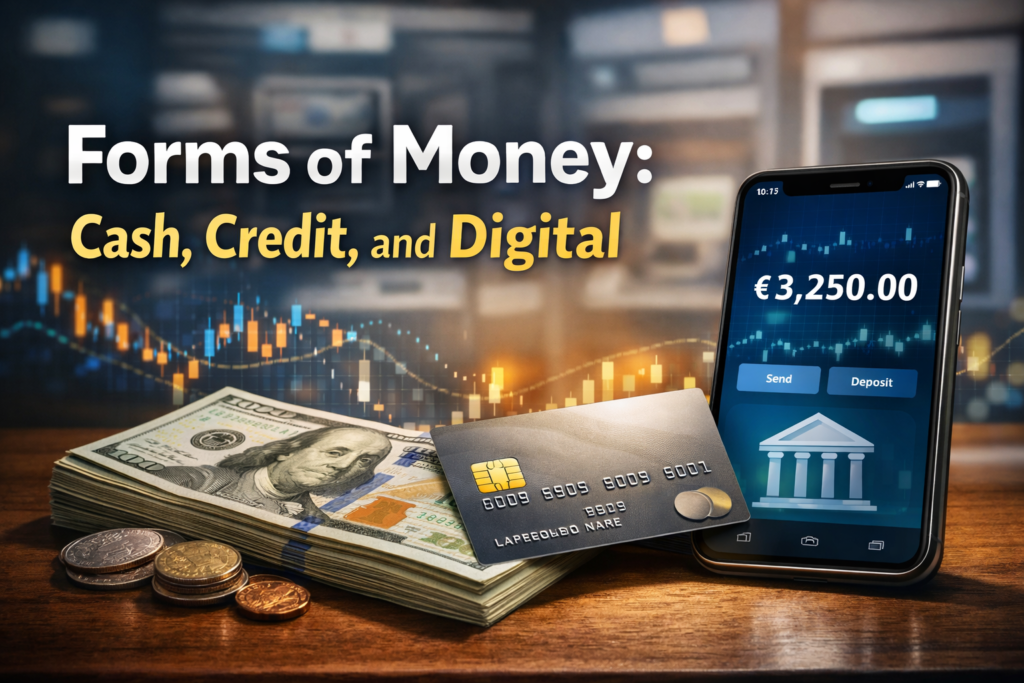
We finish our exploration of money by answering a simple but puzzling question: if money is just one thing, why does it show up as paper notes, plastic cards, and numbers on a screen? Many people feel modern money has become invisible. This confusion comes from mixing up the idea of money with the ways we access it. In this final article, we’ll look at cash, credit, and digital money step by step. You’ll see that each form serves a purpose and that none of them change what money really is.
Table of Contents
Why modern money feels invisible
For most of history, money was something you could hold. Gold and silver coins jingled in pockets. Later, paper notes stood in for those coins. Today, many payments happen without a single note changing hands. You might get paid by direct deposit, tap a card at the grocery store, or see a balance update on your phone. Because the numbers move silently through systems, it can feel like money isn’t real anymore. This feeling is natural, but it doesn’t mean money has changed its purpose. Money is still a shared promise that a certain value will be accepted in exchange for goods or services. The different forms simply reflect how we access that promise.
Cash: tangible money you can hold
What cash is
Cash refers to physical notes and coins issued by a government or central bank. It is the most straightforward form of money. When you pay with a bill or coin, you hand over something that everyone agrees has value. From what I’ve seen, this tangibility makes cash feel comfortable and real. You can count it, store it under a mattress and use it without electricity or an internet connection.
Why cash still exists
Even in our digital age, cash remains part of daily life. Many people use it for small purchases, gifts or splitting a bill. Studies of payment habits show that small cash transactions are still common and that lower‑income households rely more on cash than wealthier households. Cash is also widely rated as the easiest and lowest‑cost way to pay. Its use requires no bank account and no fees. Some people prefer cash for privacy or budgeting because it makes it easier to see how much they have left.
What cash does well
Cash excels at immediacy and anonymity. When you hand someone a five‑dollar bill, the transaction is complete right away, and there is no record of it unless you make one yourself. Cash is useful when card machines go down or when you’re somewhere without reliable internet. It’s also accepted by nearly everyone. These qualities make cash a reliable backup even when other forms are available.
Natural limits of cash
Cash is bulky for large purchases, and it doesn’t work online. You can’t slip a hundred dollars through a computer. Carrying large amounts of cash can be risky, and storing it securely takes effort. In many cases, businesses prefer electronic payments for safety and speed. These limitations led to the development of other ways to access money.
Credit: money borrowed, not created
What credit really is
Credit is not a kind of money in itself; it is a promise that you will pay later. When you use a credit card or take out a loan, a lender provides something of value now in exchange for your commitment to repay later, usually with interest. In everyday terms, you’re borrowing money to make a purchase and agreeing to settle the debt at a future date. This promise is what gives the card its spending power. It does not create new money; it temporarily extends your ability to spend.
Why credit exists
Credit solves timing problems. Suppose your refrigerator breaks a few days before payday. You may not have enough money in your account, but you still need a working fridge. Credit lets you make the purchase immediately and repay once you receive your income. Businesses use credit to buy supplies before they sell their goods. Credit smooths out cash flow and supports economic activity. It also allows people to build a track record that can help them borrow larger amounts when needed.
How credit fits into the system
When you pay with a credit card, the store receives money right away. The credit card company pays the merchant and records your debt. You later repay the credit card company using money from your bank account. Credit and money are intertwined: credit depends on money to settle debts. While credit can make life easier, it is important to remember that it is a loan. This article doesn’t offer advice on whether or how to use credit, only the understanding that it is borrowed money, not free money.
Digital money: numbers that represent value
What digital money actually is
Digital money is money recorded and transferred electronically. It has no physical form; you see it as numbers on a statement or a phone screen. Examples include the balance in your bank account, electronic transfers, debit card transactions and payments through apps. Digital money represents the same currency as physical money—US dollars or euros—but it exists as entries in computer systems. These electronic entries are accepted because everyone trusts that they can be converted into cash or used to make purchases.
Why most money is digital today
Modern economies rely heavily on digital money because it allows value to move quickly and efficiently. When your employer deposits your paycheck directly into your account, both of you save time and transaction costs. Paying bills online, sending money to friends and shopping on the internet are only possible because of digital money. Central banks note that most of the money in the economy exists as digital deposits held at banks, while cash makes up only a small share of the total. Digital transactions are typically faster, easier to track and can be done from anywhere with an internet connection. Central banks themselves explain that most money today exists as digital balances rather than physical cash, which can help reinforce why digital money is a normal part of modern systems.
Why digital does not mean fake
Some people worry that digital money isn’t real because you can’t hold it. In truth, digital money is fully supported by law and regulation. You can convert it to cash at an ATM or withdraw it from your bank whenever you like. The value of digital money is backed by the same legal tender that backs cash. Using digital money may feel different from handing over cash, but it doesn’t change the underlying value. Once people understand that digital money is simply another form of the same currency, the fear tends to fade.
How all three forms coexist
No single form replaces the others
Cash, credit and digital money each have strengths and weaknesses. Cash excels at privacy and immediate settlement. Credit helps bridge timing gaps. Digital money makes large and distant transactions easy. Instead of replacing one another, these forms work side by side. You might keep some cash for emergencies, use a debit card for daily shopping, pay with credit for a large purchase and receive your salary digitally. Having multiple forms makes the system resilient. If one method is unavailable, another can take its place.
Modern systems use all three together
In practice, cash, credit and digital money flow into and out of each other. You can deposit cash into your account to become digital money. You can withdraw digital money as cash. You can pay down credit debt using digital transfers. Merchants often accept all three forms depending on the size of the purchase and their customer base. When considering the entire system, it is helpful to remember that all forms represent the same underlying value.
Closing with clarity
Throughout this Money Basics series, we explored what money is, why it exists and how it behaves. This final article ties those lessons together. Money’s purpose—to serve as a medium of exchange, a store of value and a measure of price—hasn’t changed. What has changed are the ways we access and move money. Cash remains the familiar form you can hold. Credit allows you to borrow against future income. Digital money moves value through networks at the speed of light. Each form offers convenience in different contexts, and together they make up the modern money system. Understanding that these forms are all expressions of the same value can reduce confusion and build confidence.
For a refresher on the foundation of money itself, see our guide on Money Basics: What Money Is, How It Works, and Why It Matters. If you want to revisit why money exists in the first place, our article What Is Money? may help. With these pieces in place, the forms of money should no longer feel mysterious. Money hasn’t become invisible; it has simply evolved into forms that fit our changing lives.