
When people first discover the possibility of earning money online, they often run into two widely used terms: freelancing and content creation. These ideas can feel exciting on the surface, but they also seem confusing. Should you start offering your skills to clients immediately, or build your own platform and audience? Is there a “better” path? Many beginners end up jumping between these directions based on other people’s stories. This article aims to calm those swirling thoughts. It explains freelancing vs content creation in plain language and explores why understanding each concept matters more than choosing quickly. By the end, the goal is simple: you should feel clearer about what these terms represent and why they’re often mixed up.
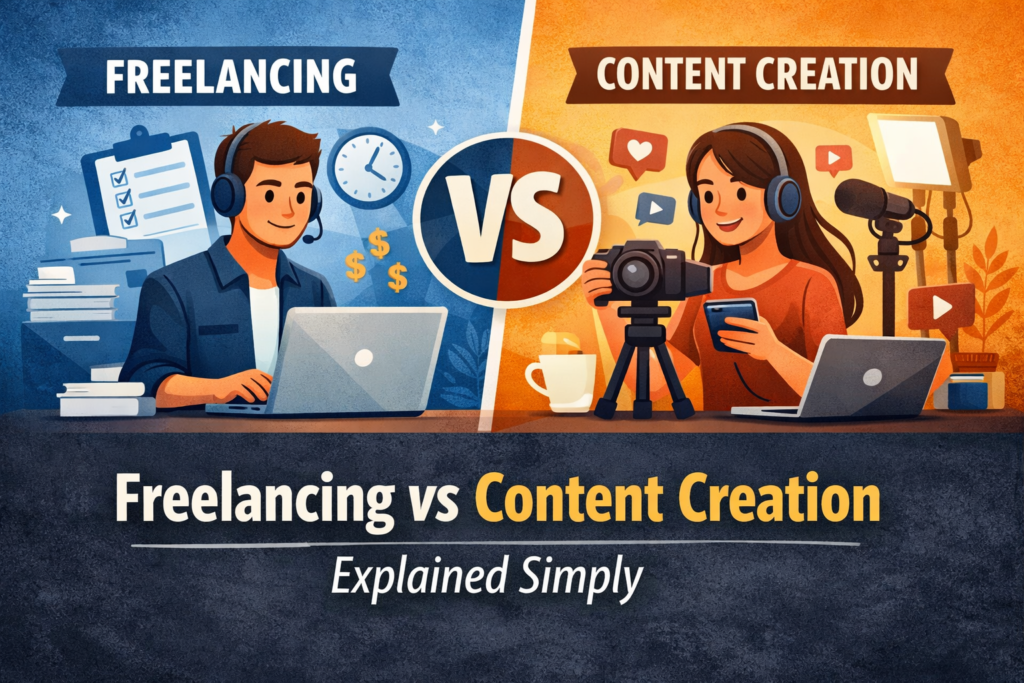
Table of Contents
Why the Difference Matters More Than the Choice
Before diving into definitions, it helps to understand why recognising the difference matters. Beginners often chase multiple ideas at once because they worry about missing out on the “right” opportunity. They read stories of people quitting their jobs after starting a YouTube channel or becoming freelance web designers overnight. The fear of choosing wrong pushes them to dabble in everything. This scattered approach rarely builds depth; it usually creates confusion and burnout. Clarity helps reduce this overwhelm. Once you understand what freelancing and content creation actually involve, it’s easier to focus your energy instead of bouncing between every possibility.
I’ve noticed many beginners struggle here, not because they lack skills, but because they jump from one model to another without grasping how they differ. Knowing how each path works can act like a map. It won’t tell you which road is right for you, but it will help you see where each road leads. That perspective makes it less scary to start small, learn at your own pace, and adjust as needed. For a broader context on finding direction, you can revisit our guide on choosing your online income path. That pillar article discusses why picking a direction matters more than chasing every idea.
What Freelancing Really Means
Freelancing is essentially about selling a skill directly to clients. An article from Investopedia notes that freelancers operate as independent contractors, earning income on a per‑job basis instead of being tied to one employer. This independence allows them to manage multiple projects for different clients. In other words, freelancers trade their time and expertise for payment. They typically agree on a task, deliver it, and get paid once the job is completed.
From what I’ve seen, freelancing can cover a wide range of services. It might involve designing logos, writing blog posts, editing videos, developing websites, translating documents, or providing virtual assistance. The common thread is that a client needs a specific task done. They hire someone to do it and pay for that service. While freelancers often enjoy flexible schedules and the ability to choose projects, this independence also means they face inconsistent income, have to find clients continuously, and manage their own taxes. They control how and when they work, but must also handle their own business responsibilities.
Many beginners are attracted to freelancing because it seems like a straightforward way to make money online. You already have a skill or are willing to learn one, and you start offering it to people who need it. However, it’s easy to overlook the realities: freelancing is time‑bound. You get paid for the hours or projects you complete. When you stop working, income usually stops too. That doesn’t make freelancing bad; it simply means it’s different from other ways of earning online. Understanding this difference reduces disappointment later.
What Content Creation Really Means
The phrase “content creation” is everywhere, but what does it actually mean? The Cambridge Dictionary defines a content creator as someone who produces videos, images, writing, or other material for the internet, often for social media. At its core, content creation involves making things that other people want to watch, read, or listen to. These creations can be informative, entertaining, inspiring, or a mix of all three.
A key difference from freelancing is that content creation doesn’t involve a direct transaction for each piece of work. You build something — an article, video, podcast, newsletter, or online course — and share it publicly. Over time, an audience forms around your work. Income usually arrives indirectly: through ads, sponsorships, digital product sales, or subscriptions. It often takes significant time to see returns because you’re building a platform rather than fulfilling individual client requests. For instance, someone might start a blog about personal finance tips. They spend weeks or months writing helpful articles and growing an audience. Eventually, they may earn from ad revenue or by selling an e-book. The early phase often brings little or no income.
This long‑term nature is why many beginners misunderstand content creation. They expect immediate results, similar to freelancing, and feel discouraged when that doesn’t happen. Content creation is more like planting a garden. It takes consistent effort to see growth. But once it starts blooming, a single piece of content can continue to bring visitors long after you’ve made it. If you’re interested in how to begin this journey without pressure, our piece on starting small with your first online income idea explores gentle ways to explore content creation.
Key Differences
When people ask about freelancing vs content creation, they often want a verdict: Which is better? That question assumes one path must be superior. The reality is that these models serve different purposes. To avoid making judgments, it helps to look at a few practical differences.
Direct vs Indirect Income
Freelancing provides direct payment. You complete a project and receive money from your client. There’s little delay once the work is done. This can be reassuring if you need immediate income. Content creation, on the other hand, offers indirect income. You create something upfront, such as a video or article, but there is no guarantee of payment unless people find value in it and engage. Monetisation often depends on factors outside your control, like advertising platforms or audience size.
Speed vs Patience
Freelancing tends to produce results faster because the timeline is clear: deliver the work, get paid, and move on to the next task. Content creation demands patience. You might spend months building a backlog of content before you start seeing measurable earnings. This slower timeline can feel uncomfortable, especially for beginners who need income quickly. Understanding this can reduce frustration. You’ll know that impatience with content creation isn’t a personal failure; it’s part of how the model works.
Control vs Stability
Another difference lies in control. Freelancers control their time and choose which clients to work with, but their income often fluctuates because it depends on finding and completing projects. Content creators have less direct control over immediate earnings but can build more stability over time. Once a piece of content attracts a steady audience, it can continue to generate income passively. This is why content creation is sometimes described as building an asset. The asset — your article, video series, or digital product — can keep working for you long after the initial effort. Freelancing is more like providing a service; once the service is rendered, its effect is largely complete.
Service‑Based vs Product‑Based Thinking
Freelancing is a form of service‑based income: you offer a specific service to a client in exchange for payment. Content creation is closer to product‑based income: you make something once and share it repeatedly. For a deeper look at these concepts, you can read our piece on service‑based income vs product‑based income. These models influence how you plan your time. Service‑based work demands ongoing effort for each paycheque. Product‑based work requires upfront effort but can bring returns later. Neither is superior; they simply reflect different systems.
Read more about: Service-based income vs product-based income.
Ownership vs Collaboration
Freelancers often collaborate closely with clients. Their work may carry the client’s brand or style, and the end product belongs to the client. Content creators own their work. They decide what to make, when to publish it, and how to present it. This ownership can be empowering. It also brings responsibility: you need to set your own standards, evaluate your audience’s needs, and decide how to improve.
These differences show that freelancing and content creation are not two names for the same thing. One is not inherently easier or harder. Each has its own rhythm and requirements. When you understand these rhythms, your expectations become more realistic. You can plan your time accordingly and avoid the disappointment that comes from treating one model as though it should behave like the other.
Why Beginners Often Choose Wrong
Many newcomers approach online income with enthusiasm but little clarity. They read success stories on social media and attempt to replicate them without understanding what actually happened. For example, someone might see a viral video on a platform and assume content creation is a quick path to cash. They create a few videos, don’t see results, and give up. Others hear that freelancing can be done “from anywhere” and expect immediate, high‑paying clients. When the reality involves negotiating rates, meeting deadlines, and building a portfolio, they feel disappointed.
In my experience, the most common confusion comes from mixing the short‑term nature of freelancing with the long‑term nature of content creation. People expect freelance work to produce passive income or expect content to pay immediately. When those expectations aren’t met, they abandon both paths. Additionally, social comparisons fuel unrealistic pressures. Beginners compare their early efforts to the polished results of people who have spent years building skills or audiences.
Another factor is fear of missing out. When you see many possibilities, it’s tempting to try them all. But spreading yourself thin reduces focus. As our pillar on why choosing the wrong path slows beginners explains, random experimentation can actually delay progress. Trying every new trend doesn’t help you learn how each model works; it usually leads to surface‑level experiences without depth.
Closing Thoughts: Clarity Over Speed
Freelancing and content creation are two valid ways to earn money online, but they work differently. Freelancing is about selling a skill directly to clients — delivering services and getting paid per task. Content creation is about making material that interests or helps an audience and gradually building indirect income. Neither path is inherently better. Each requires different expectations around time, control, payment, and effort. If you’re still exploring, there’s no need to rush. Spend time understanding each system. Reflect on what fits your personality and life circumstances. Start small. You can always adapt or combine paths later once you have experience.
The key takeaway is that clarity reduces overwhelm. Once you know the difference between freelancing and content creation, you can focus your energy instead of bouncing between ideas. You might discover that freelancing suits your need for immediate income while content creation becomes a long‑term project on the side. Or you might choose one and ignore the other for a while. Whatever you decide, remember that both paths require patience and learning.
In an environment that often celebrates quick wins, slowing down and understanding how systems work is a form of empowerment. Let this knowledge guide your next steps. Instead of chasing every possibility, choose clarity first. It’s a calmer way to begin and a more sustainable way to grow.