
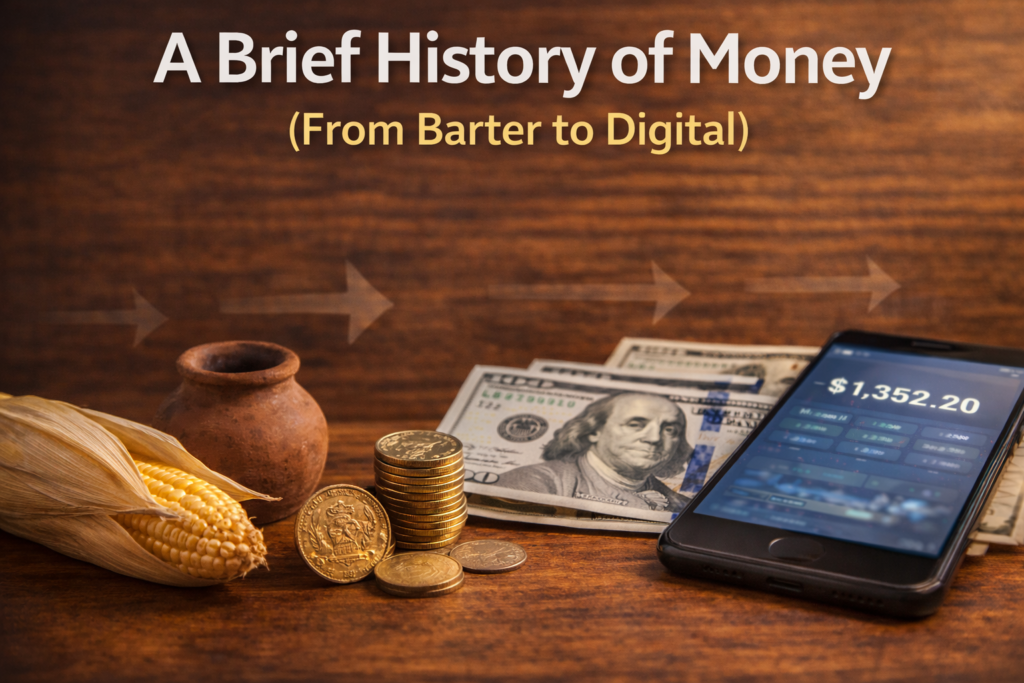
Every day we tap cards or send payments online, rarely thinking about where this system came from. If barter once worked, why did money have to exist at all? From what I’ve seen, confusion about modern money usually starts here. This article tells the story of money in plain language, showing how real problems in trade gave birth to coins, paper notes and eventually digital balances. You won’t find dates or economic jargon here — just a clear narrative about why money keeps changing and why today’s electronic money is still very real.
Table of Contents
Why Barter Couldn’t Scale
Imagine a small village where people exchange goods directly. This is barter: you bring milk to your neighbour in exchange for bread. It works when communities are tiny and needs are simple, but as soon as life becomes more varied, this system begins to crack. There’s no common measure of value, so every trade turns into a negotiation. It only works if two people happen to have what the other wants at the same time, a problem economists call a double coincidence of wants. This friction is why early societies looked for something both sides could accept as payment. Central bank historians note that early trade involved “exchange of goods without value equivalence” and that barter persisted in primitive economies but had serious limitations because there was no common measure. In other words, barter only lasted as long as life stayed simple.
Commodity Money: Trust in Everyday Objects
To solve the problems of barter, communities started using commonly valued items. At first, these were things with everyday utility: cattle, grain, and salt. Cattle were mobile, provided meat and milk, and could reproduce; salt preserved food in a time before refrigeration. Because everyone needed these goods, they became a natural medium of exchange. The Brazilian central bank notes that commodities like cattle and salt became money because they were “universally accepted” and names for money in Latin even derive from pecus (cattle) and sal (salt). This wasn’t yet money in the modern sense, but it was an important step: people agreed to accept a particular good not because it was immediately useful in that moment, but because they trusted others would also accept it.
Metal: Value You Can Carry
As trade expanded, heavy or perishable goods weren’t ideal. Societies needed something more durable, divisible and portable. Metals like bronze, silver and gold fit the bill. They didn’t rot and could be melted into smaller pieces without losing value. The Brazilian central bank explains that metals were valued because they were durable, divisible and portable, and quickly became “the main standard of value. Smiths initially cut metal bars into chunks by weight to make payments. Eventually, authorities stamped pieces of metal with official seals to guarantee their weight and purity, thereby transforming them into the first coins. These coins allowed people to recognise value at a glance, which made transactions faster. Coins also solved the trust problem: everyone knew the issuing authority backed the metal content, so acceptance spread beyond local communities.
Coins to Paper: Making Trade Easier
Carrying large amounts of metal was heavy, dangerous and inconvenient. Over time, merchants and goldsmiths began issuing receipts for the coins and bullion they had deposited. These paper receipts, redeemable on demand, were lighter to carry and quickly passed from hand to hand. Because the issuer promised to exchange the paper for the equivalent amount of metal, the paper notes were trusted. Governments eventually adopted this idea and printed official banknotes. The Banco Central do Brasil notes that coins were used mainly for lower values once paper money became widespread. Paper money started as an IOU for metal, but over centuries, governments stopped allowing redemption of notes for gold. Many worry that this means money lost its value. But by then, money’s value was already based on collective trust and legal backing rather than the metal itself. People continued to accept notes because they knew others would, not because they planned to turn them into gold. When nations finally abandoned the gold standard, money’s power shifted fully to trust, government backing and the productive capacity of the economy.
Early Banks and Credit: Money as Book Entries
Another change happened quietly: most money never existed as coins or paper in the first place. When you deposit money at a bank, the bank doesn’t store your exact notes in a vault for later. It records the deposit in your account and lends most of it out. The deposit becomes numbers in a ledger — a promise by the bank to repay you. Because thousands of depositors rarely withdraw at once, this system works. It also means banks create a significant portion of the money we use through lending. Understanding this helps demystify why money can be both physical and digital; what matters is the trust in the institution recording and honouring the entry.
Why Gold Backing Ended
For centuries, governments promised to exchange paper notes for a fixed amount of gold. This worked until economies grew so large that gold stocks couldn’t back all the money in circulation. If everyone suddenly demanded gold, there wouldn’t be enough. To avoid this problem, countries began to limit redemption or suspend it during crises. The Great Depression and World War II demonstrated that nations needed the flexibility to expand the money supply. One by one, governments severed the link between paper money and gold. Critics sometimes lament this change, but it’s important to remember that gold backing was a trust mechanism. Once governments could maintain trust in their currencies through law, central bank credibility and economic productivity, gold became unnecessary. Removing gold backing didn’t make money fake; it simply shifted the basis of trust from metal to society’s collective confidence.
Digital Money: The Same Trust in a New Form
Today, we rarely hold cash at all. Wages arrive as electronic entries in bank accounts, bills are paid through apps and contactless cards, and our balances are digits on screens. To some, this seems like imaginary money. But digital money works for the same reasons coins and notes did: a trusted issuer promises it will be honoured. The Reserve Bank of Australia explains that a central bank digital currency (CBDC) can be understood as a “digital form of cash.” It is issued by the central bank, accessible to the general public, and “can be exchanged at parity” with other forms of money, such as physical currency or electronic deposits. Digital currency issued by a central bank would function as a widely accepted means of payment, store of value and unit of account. Even without a CBDC, most of our everyday money already lives as digital entries at banks. Those deposits can be converted to cash or used to pay for goods because everyone trusts the system. When you transfer $1,000 from your account to a friend’s, no bags of cash move between banks; their respective ledgers update. The underlying concept — trust in the system — hasn’t changed since people accepted shells or salt.
Why Money Keeps Evolving
Money’s history shows a pattern: a problem emerges, people develop a solution that builds trust and makes trade easier, and that solution persists until a new problem appears. Barter failed because people couldn’t easily trade what they had for what they needed. Commodity money solved that, but it was bulky and local. Metals solved portability and trust issues, but were heavy and scarce. Paper solved weight and transport problems, but needed legal backing when metal redemption ended. Digital money solves the inconvenience and cost of physical cash but requires strong security and institutional trust. Each transition removed friction, allowed economies to grow, and invited the next change. Knowing this history makes modern money feel less scary. It isn’t magic or an illusion; it’s the latest step in a long process of finding better ways to exchange value.
How This Story Fits the Bigger Picture
If you’ve read our main guide on Money Basics: What Money Is, How It Works, and Why It Matters, you’ll remember that money is a shared agreement, not an intrinsic thing. Understanding that foundation helps make sense of money’s history. When early societies needed a common measure of value, they created commodity money. When trade grew, they standardised metal into coins. When mobility and safety mattered, they used paper. And when speed and distance became critical, they moved to digital entries. Each form is different, but the principle is the same: trust. As long as we trust that others will accept a currency, it will function — whether it’s a paper note, a bank balance or a digital token issued by a central bank.
Bringing It Back to You
From what I’ve seen, people often worry that modern money is somehow less “real” because it lacks physical substance. This journey shows that money has never been about the substance itself; it’s about the agreement that it represents value. The salt used as money centuries ago was valuable because everyone needed it, not because salt has magical properties. The paper notes in your wallet are valuable because the community agrees they are; the numbers in your bank account are valuable for the same reason. The next time you swipe a card or send money through an app, remember that you’re taking part in a long story of cooperation. Money’s forms change, but the trust and shared understanding behind it stay the same.
Forms of Money: Cash, Credit, and Digital Money – referenced when discussing digital money’s place in the evolution (optional supporting link).