
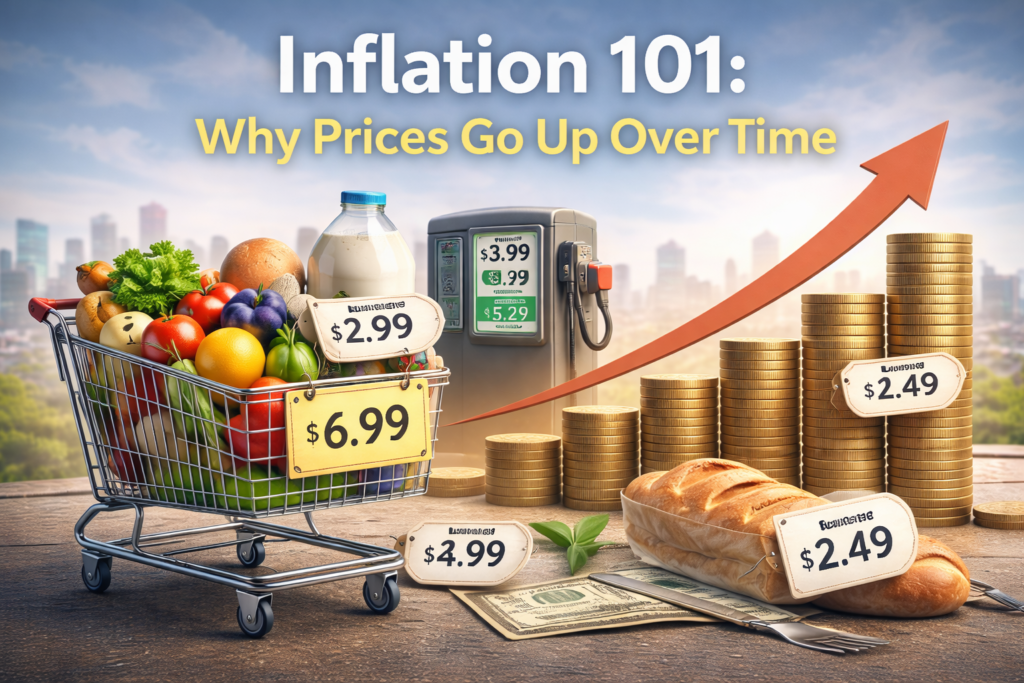
Why Prices Go Up Over Time
Have you noticed that a movie ticket costs more today than it did ten years ago? Or that your favourite snack keeps creeping up in price? Many people feel uneasy when they see prices rise. It can feel like someone is quietly taking money from their pocket. From what I’ve seen, confusion about why prices go up often leads to fear and blame. This article will explain inflation calmly and clearly. By the end, you’ll understand what inflation really is, why it happens, and why it doesn’t mean anyone is stealing your money.
Table of Contents
What Inflation Really Means
Inflation is the general increase in prices over time. It doesn’t refer to the cost of one product or even several items going up; instead, it means that the overall price level for goods and services rises across the economy. Think of it as a rising tide that lifts most prices, not just the price of a single cup of coffee. The International Monetary Fund (IMF) defines inflation as the increase in the cost of a set of goods and services over a period, usually a year. It measures the rate of increase in prices across many items, not just isolated costs.
One way to picture inflation is to imagine your shopping basket. In a given year, you regularly buy bread, milk, soap, fuel, and a dozen other items. Inflation looks at how the total cost of that basket changes over time. If the basket cost $100 last year and $103 this year, the inflation rate is roughly 3 percent. This doesn’t mean every item increased by 3 percent—some may have gone up more, some may have stayed the same, and others may even have fallen. Inflation captures the overall change. To really understand why prices go up over time, it helps to first understand what money actually is and how it works in everyday life, which we explain in our guide on money basics.
Why Prices Don’t Stay Fixed Forever
Prices change for several reasons. One is that the economy and its participants are always in motion. Companies improve products, workers earn pay raises, and raw materials become more or less scarce. If demand for goods grows faster than supply, sellers can charge more. If the cost of production goes up—due to higher wages or energy costs—producers often pass those costs on to consumers. When more money chases the same amount of goods, prices rise. The IMF notes that if the money supply grows too big relative to the size of the economy, the unit value of the currency diminishes and prices rise. In simple terms, more dollars in circulation without more goods to buy means each dollar buys a little less.
Economists sometimes distinguish between “demand-pull” and “cost-push” inflation. Demand-pull inflation occurs when consumer and business demand outpaces the economy’s ability to produce goods and services. For example, if everyone suddenly wants to buy new cars and car factories are already running at full capacity, the limited supply of cars will lead prices to rise. Cost-push inflation happens when the cost of production rises—due to things like supply shocks or higher oil prices—reducing the amount that businesses can produce. When money moves faster between people, businesses, and banks, demand increases, and that movement plays a role in why prices slowly change over time, as explained in how money moves in the economy. The IMF explains that supply shocks can lead to cost‑push inflation, while demand shocks or expansionary policies can boost demand beyond the economy’s capacity, causing demand-pull inflation. Both forces can push prices upward.
Inflation is also influenced by expectations. If people expect prices to rise, they may negotiate higher wages or increase prices to keep ahead, which can contribute to higher inflation. Businesses may raise prices in anticipation of higher costs, and employees may seek raises to cover expected increases in living costs. These expectations can create a feedback loop: expecting inflation can make inflation happen.
Inflation vs. Relative Price Changes
It’s important to distinguish inflation from relative price changes. Sometimes, the price of a specific item goes up because of changes in supply or demand for that item alone. For example, a drought might cause the price of lettuce to spike, or a technological breakthrough might lower the cost of electronics. The Federal Reserve Bank of Cleveland explains that the word “inflation” is often misused to describe any price increase. In reality, true inflation refers to a drop in purchasing power that results from an excess of money relative to the goods available, manifesting as a general rise in all prices and wages. In other words, not every price increase is inflation; sometimes it’s just a relative price change that signals scarcity or abundance.
Understanding this difference helps ease anxiety. If petrol prices rise because of a temporary supply shock, that’s not necessarily inflation; it’s a relative price change. Inflation, by contrast, means that your money buys less across many different goods and services. The distinction matters because the causes and cures are different: supply shortages require production solutions, while broad inflation requires policies affecting money supply and demand.
Why Inflation Happens Naturally
Inflation is a normal feature of most economies. As economies grow, the amount of money in circulation grows too. Central banks like the Federal Reserve expand the money supply to match rising economic activity. A moderate, predictable rate of inflation signals that the economy is growing and people are spending. If inflation were zero or negative (a condition called deflation), people might delay purchases because they expect prices to fall. This can slow down economic activity, leading to fewer jobs and less income. The IMF notes that low, stable, and predictable inflation is good for an economy because it allows consumers and businesses to plan, making contracts and interest rates less distorted; knowing that prices will be slightly higher in the future gives consumers an incentive to make purchases sooner, which boosts economic activity.
Central banks aim for a low and stable inflation rate. In the United States, the Federal Reserve’s Federal Open Market Committee has stated that an annual increase in inflation of around 2 percent in a broad price index is consistent with its goals of maximum employment and price stability. When households and businesses expect inflation to stay low and stable, they can make sound decisions about saving, borrowing, and investing. This helps the economy function smoothly. In the euro area, the European Central Bank targets inflation close to but below 2 percent for similar reasons.
Inflation isn’t a sign of someone secretly taking your money or a conspiracy. It reflects the complex interplay of demand, supply, money supply, and expectations. Periods of high inflation can be damaging, but moderate inflation is part of how modern economies function. Policymakers use interest rates, reserve requirements, and other tools to influence the money supply and demand, trying to keep inflation within a target range.
How Inflation Affects Purchasing Power
The most immediate impact of inflation is that it reduces the purchasing power of money. If your income stays the same while prices rise, you can buy less. The IMF explains that when nominal income doesn’t increase as much as prices, real income (income adjusted for inflation) falls, which lowers the standard of living. This erosion of purchasing power is the single biggest cost of inflation. A dollar or euro today will not buy the same amount of goods and services in the future if prices continue to rise.
However, the effect of inflation isn’t uniform. People with fixed incomes, such as retirees receiving a fixed pension, may find their purchasing power shrinking when inflation is higher than their annual cost-of-living adjustments. Borrowers with fixed-rate debts, on the other hand, can benefit from moderate inflation because they repay their loans with money that is worth slightly less. That’s why mortgage borrowers often prefer moderate inflation, while lenders prefer lower inflation to preserve the value of the repayments they receive. Inflation also influences interest rates: lenders add an inflation premium to interest rates to protect the value of their money over time.
Understanding inflation helps you interpret how news about interest rates, wages, and price changes might affect you. If inflation rises but your wages rise faster, your real income can still increase. Money itself doesn’t physically change over time — it still represents a shared agreement, which is why understanding what money really is makes inflation feel less confusing. If inflation is low and stable, you can plan long-term purchases and investments with more confidence. Knowledge reduces fear.
Why Doing Nothing With Money Reduces Its Power
If inflation reduces purchasing power, then keeping cash under your mattress means your money is silently losing value. For example, if inflation averages 2 percent per year, $100 today will buy goods worth about $98 next year and roughly $90 in five years if prices continue to rise. While we cannot give financial advice, it’s clear that money left unused gradually buys less. This is why people often look for ways to preserve their money’s value by saving in interest-bearing accounts, investing in bonds or stocks, or buying assets that tend to grow in value over time. Even a modest savings account can help offset the effect of inflation because the interest earned adds to your balance. The point is not to encourage any specific investment but to show why understanding inflation matters for everyday decisions.
Why Understanding Inflation Helps You Decide Better
Inflation is sometimes portrayed as theft or as the result of secret decisions by governments or corporations. In reality, it’s a predictable outcome of growth, spending patterns, and money supply. Viewing inflation as a natural part of economic life can reduce anxiety. When you understand that prices rise because more money chases more goods and because production costs change, you can focus on the parts you control: your spending, saving, and earning. You can plan for the future knowing that a moderate increase in prices is expected.
From what I’ve seen, people feel calmer once they realise that moderate inflation is built into our economic system and that policymakers actively work to keep it predictable. High inflation and deflation are problems that central banks aim to avoid, and they use their tools to keep inflation on track. Understanding inflation also helps you see why certain economic news matters. When central banks raise interest rates, it’s often to cool down an economy that’s growing too fast, thereby preventing high inflation. When governments boost spending during recessions, they might accept slightly higher inflation to avoid deflation and unemployment.