
Making a domestic bank transfer rarely gives you pause; it often costs little to nothing, and your money reaches its destination almost instantly. Yet sending $200 abroad can feel like stepping into a different universe. Suddenly, the fees mount, the exchange rate seems questionable, and you have little idea how much the recipient will actually receive.
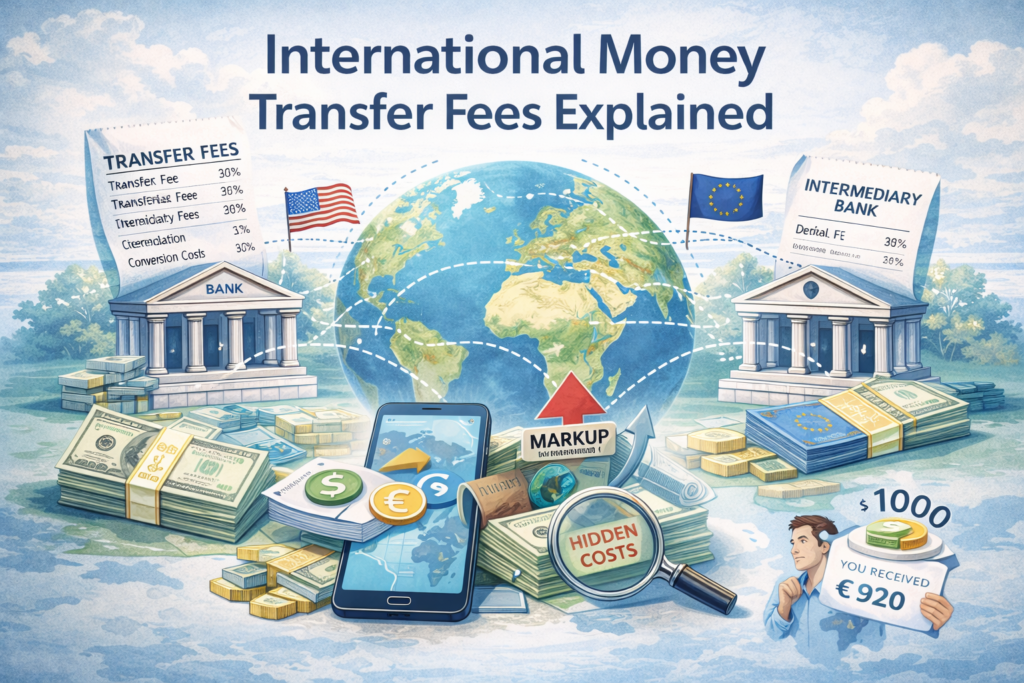
You might hear about international money transfer fees from advertisements or providers promising no fees, only to discover later that the final amount was reduced by currency conversion costs or other deductions. For many people, the puzzle is why international transfers are so expensive and opaque compared with the swift, almost frictionless payments we are used to at home. This article explores international money transfer fees and explains the components that make cross‑border payments costly.
Table of Contents
Transfer provider fees and third‑party charges
When you send money overseas, the first cost you encounter is the fee charged by the remittance provider or bank. According to the Consumer Financial Protection Bureau (CFPB), remittance transfer costs include fees charged by the remittance transfer provider, their agents and third parties. These charges cover the operational expense of processing your transaction, compliance checks and the profit margin for the provider. They can differ widely depending on the provider type. The World Bank’s Remittance Prices Worldwide report shows that banks remain the most expensive channel, with an average fee of 12.66 % in early 2024, while money transfer operators (MTOs) charge much less. Mobile money services and digital remittance apps often offer the lowest fees but may not be available in all corridors or to all users.
International transfer fees also vary by region. The same World Bank report notes that in Q1 2024, the global average cost of sending $200 was 6.35 %. South Asia had the lowest average at 5.16 %, whereas Sub‑Saharan Africa recorded the highest at 7.73 %. These figures, though improving slowly, are still many times higher than the cost of domestic fast payments, which the Bank for International Settlements (BIS) reports are typically less than 1 %.
Fees hidden in correspondent banking chains
Behind many cross‑border payments lies a complex network of correspondent banks. Unlike domestic transfers that pass through one or two systems, international wires often travel across several banks’ nostro and vostro accounts. The World Bank’s Cross‑Border Fast Payments focus note explains that most cross‑border payments are still processed via legacy correspondent banking arrangements; each bank involved charges a fee for its service, and as a result, “it is very difficult for an originating bank to let its customer know” either the total cost or the time a transfer will take. This uncertainty contributes both to higher fees and to delays that can stretch from days to weeks.
The report also notes that regulatory compliance has raised the cost of maintaining correspondent relationships. Since the global financial crisis, banks have reassessed their cross‑border business models because stricter anti‑money‑laundering and counter‑terrorism financing rules have increased compliance costs, leading some banks to exit the correspondent market entirely. Fewer correspondent banks mean less competition and higher charges for the intermediaries that remain.
Exchange rate markups
Even if a transfer provider advertises “no fee,” you should pay attention to the exchange rate markup. When money is converted from one currency to another, the provider typically offers a retail exchange rate that includes a spread over the wholesale interbank rate. The CFPB notes that “the exchange rate offered to consumers often reflects a spread – a percentage difference between the retail exchange rate offered to the consumer and some wholesale exchange rate”. This spread can significantly increase the cost of a transfer, especially for larger amounts.
In the European Union, policymakers recognise that currency conversion charges represent a high cost when different currencies are used by the payer and the payee. Regulation (EU) 2021/1230 emphasises that these charges must be transparent and that currency conversion fees should be expressed as percentage mark‑ups over European Central Bank reference rates. Requiring providers to display mark‑ups helps consumers compare rates and make informed choices, but many markets outside the EU lack such transparency.
Exchange rate costs are not only charged by the sending institution. Receiving banks may apply their own conversion rates if the funds arrive in a different currency. A survey reported in the Financial Stability Board’s (FSB) 2024 Annual Progress Report on Cross‑Border Payments found that receiver‑side fees ranged from 0.1 % to 1.8 % of the payment amount, and when foreign exchange margins were present, they represented a substantial component of the receiver‑side cost. This means that even if you pay a fixed fee to send money, your recipient may receive less once their bank deducts its own conversion or service charges.
Taxes and governmental charges
Apart from provider fees and currency markups, international transfers may attract taxes or regulatory levies. Some countries impose taxes on outgoing or incoming remittances to fund infrastructure or social programs. These charges vary widely by jurisdiction and are often collected at the point of transfer or by the receiving bank. While taxes add to the cost, their impact is generally smaller than the commercial fees and exchange margins discussed above.
Trade‑Offs: Cost, Speed and Convenience
Cross‑border payments force senders to navigate trade‑offs among cost, speed and accessibility. The BIS notes that cross‑border payments remain “more costly and slower” than domestic payments. Payment service providers can accelerate transfers by routing them through faster networks or paying agents in advance, but these methods usually increase costs. For example, providers may offer same‑day transfers for a premium, while economy options take three to five days.
The FSB’s 2024 KPI report shows that none of the main payment use cases (person‑to‑person, business‑to‑person or person‑to‑business) achieved the G20’s 1 % cost target. Costs remain above 3 % in many corridors, and the report notes that no sending region reached an average cost below 1 %. At the same time, the share of payment services settling within one hour decreased slightly compared with 2023. This illustrates the persistent tension between lowering fees and improving speed.
Providers also weigh cost and convenience. Mobile money platforms have driven down remittance prices, particularly in Sub‑Saharan Africa, yet they may require both sender and recipient to have compatible accounts. Banks offer a wide reach but often at a higher price. Fintech firms build user‑friendly apps and promise near‑real‑time transfers, but may mark up exchange rates more than traditional players. Consumers must decide whether paying more for speed or convenience is worth it in a particular context.
Hidden Costs and Why Recipients Receive Less
One of the most frustrating aspects of cross‑border transfers is discovering that the recipient receives less than the amount you sent. Several factors contribute to this outcome:
- Intermediary bank deductions. Every correspondent bank in the payment chain charges a fee. The World Bank notes that each correspondent involved in processing a cross‑border transaction receives a fee for its service. Because these fees are deducted en route and vary by corridor, neither the sender nor the receiving bank can always anticipate the total cost.
- Receiver‑side fees. The FSB survey found average receiver‑side fees ranging from 0.1 % to 1.8 % of the payment amount. These fees may include account credits, foreign exchange margins or service charges at the recipient bank.
- Currency conversion during payout. If the recipient’s account is denominated in a different currency, the receiving bank will convert the funds using its own rate. Even when the sender pays in the recipient’s currency, cross‑border banking practices can result in double conversions, eroding the final amount.
- Deceptive marketing. The CFPB highlights cases where remittance providers marketed transfers as “no fee” or “free” but still charged exchange rate costs or withdrawal fees. Consumers relying on promotional offers may be surprised when recipients receive less because these hidden costs were not fully disclosed.
- Taxes and compliance charges. Some jurisdictions deduct withholding taxes or regulatory levies from remittances. While these may be small, they further diminish the payout.
Understanding these cost drivers can help you set realistic expectations when sending money and encourage greater scrutiny of providers’ terms.
Connecting Fees to the Broader Payment System
International money transfer fees do not exist in isolation; they reflect the structure of global payment networks and interact with various payment systems discussed in the pillar article. Domestic ACH transfers and European SEPA payments exemplify efficient, low‑cost systems. ACH transactions often cost pennies to process and typically settle within one business day, whereas SEPA credit transfers allow euro payments across 41 countries at the same cost as domestic transfers. These systems demonstrate that harmonised rules and shared infrastructure can reduce fees.
When payments leave these regional systems, they enter the SWIFT network and correspondent banking channels. SWIFT is a messaging system, not a settlement mechanism, and it connects more than 11,000 financial institutions. International wires rely on SWIFT to communicate payment instructions, but actual settlement occurs through banks’ accounts, adding layers of cost. For a deeper look at how this network operates, see the supporting article on What is SWIFT and How Do International Wires Work?.
The FSB’s cross‑border payments roadmap aims to bring costs down to 1 % by 2027, but the 2024 KPIs show that progress is slow. Efforts include enhancing interoperability between domestic systems, promoting digital innovation and improving transparency of fees and exchange rates. The European Union’s currency conversion regulation is one example of how policymakers seek to protect consumers from excessive charges. Another initiative is the Single Euro Payments Area, which demonstrates that cross‑border payments can be priced like domestic ones when common rules and infrastructure exist.
Understanding fees also requires considering exchange rates, as discussed in the supporting article How Currency Exchange Rates Affect Your Transfer. Exchange rates are not static; they fluctuate according to market dynamics, and providers may lock in a rate for a given period or offer variable rates. The spread between the wholesale and retail rates can be a significant part of the cost.
Delays in international transfers often go hand‑in‑hand with higher fees. Regulatory checks, time zone differences and batching processes slow down payments, which is why the supporting article Why International Transfers Get Delayed explores compliance and operational hurdles that add time and cost to a transaction. Similarly, the article How SEPA Transfers Work in Europe illustrates how harmonisation within a region can minimise both delays and costs compared with global wires.
Finally, the Pillar Article – Payment Systems & International Money Transfers provides the foundation for understanding the varied mechanisms through which money moves domestically, regionally and globally. The high cost of international transfers underscores the importance of modernising payment infrastructure, improving competition and enhancing transparency. Without these improvements, cross‑border payments will continue to be significantly more expensive than domestic ones.
Conclusion
International money transfer fees are often viewed with frustration, but they make more sense once you understand the structure underlying cross‑border payments. Domestic systems like ACH and SEPA show that transfers can be fast and inexpensive when they operate within a unified framework. The moment a payment crosses borders, however, it enters a web of correspondent banks, regulatory regimes and currency markets that each add complexity and cost. Fees include provider charges, intermediary deductions, exchange rate spreads and sometimes taxes. Exchange rate markups and receiver‑side costs can be significant, and marketing that obscures these charges contributes to confusion. While progress is being made to reduce costs—such as the FSB’s roadmap and EU transparency regulations—the global average remains well above 6 %. By understanding the trade‑offs between cost, speed and convenience, you can choose the best method for your needs and advocate for greater transparency and efficiency in the system.
Commonly Asked Questions
1. Why are international money transfer fees higher than domestic fees? Domestic transfers often rely on efficient payment systems with unified rules and fewer intermediaries, resulting in minimal fees (often under 1 %). Cross‑border payments travel through multiple correspondent banks and regulatory regimes, each adding a fee. Compliance with anti‑money‑laundering rules and currency conversion also raises costs.
2. What is the average cost of sending money internationally? According to the World Bank, the global average cost of sending $200 was 6.35 % in early 2024. Costs vary by region and provider; banks are the most expensive at around 12.66 %, while mobile money services tend to be cheaper. The FSB reports that no region has yet achieved the G20’s 1 % target.
3. Do recipients pay fees as well? Yes. Receiver‑side fees can range from 0.1 % to 1.8 % of the payment amount. These may include account credit fees or currency conversion charges. If the recipient’s bank converts the funds to local currency, it might apply a spread over the wholesale exchange rate.
4. How can I tell if a provider is adding a currency conversion markup? Check the provider’s exchange rate against the mid‑market rate (the rate at which banks trade with each other). The CFPB warns that the retail exchange rate offered to consumers often includes a spread. Providers should disclose this information, but transparency varies. In the EU, regulations require providers to express mark‑ups as a percentage over ECB reference rates.
5. Can hidden fees be avoided? You can minimise surprises by choosing providers that disclose all charges upfront—including transfer fees, exchange rates and potential receiver‑side fees. However, some costs, such as intermediary bank deductions, may remain opaque because they occur within the correspondent banking chain. Understanding the structure of cross‑border payments helps set realistic expectations and encourages you to advocate for more transparent systems.