
When you first discover how many ways there are to earn money online, it can feel like the internet is a buffet and you’re invited to sample everything. It’s easy to go from reading a blog post about selling digital art to watching a video about drop‑shipping, then signing up for a freelance marketplace, all before dinner. There’s a sense of excitement and possibility.
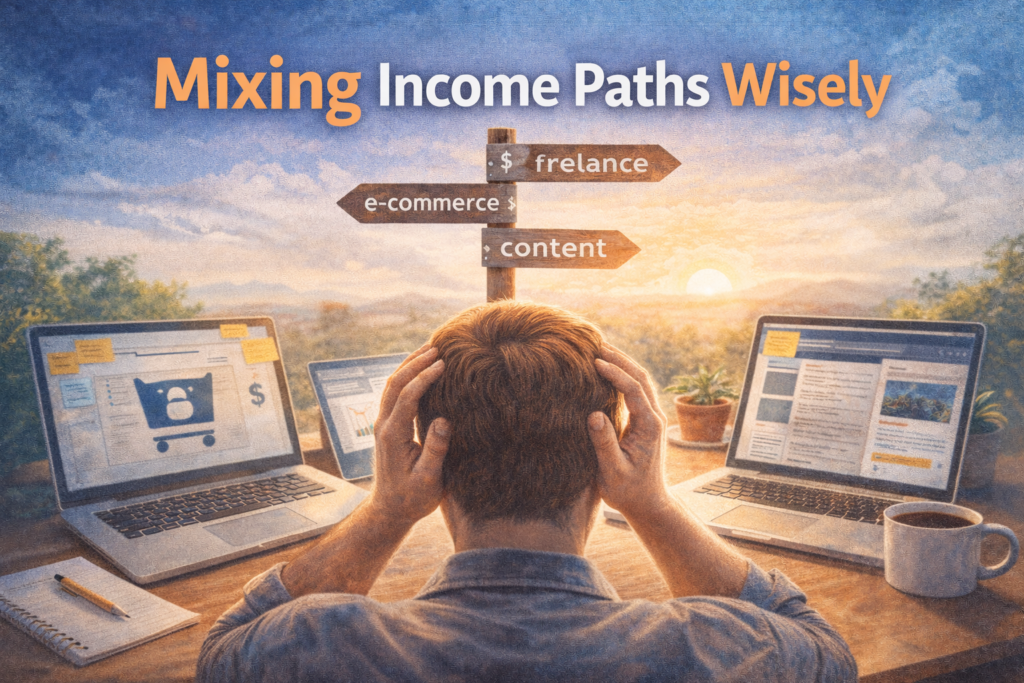
You might think, “Why not juggle a blog, an online store, and a freelance service? If one thing pays off, I’ll be ready.” From what I’ve seen, beginners often feel pressured to explore every path for fear of missing out. This article explores why mixing online income paths feels appealing, why it can lead to mental exhaustion, and why understanding your pace matters more than trying to do it all at once.
Table of Contents
Why Mixing Income Paths Feels Exciting at First
There’s a thrill in the early stages of online work. You hear stories of people turning hobbies into income. You see social media posts that make multiple income streams look effortless. The idea of diversifying seems smart and safe. If you write a few articles, post some videos, and start a small shop, something is bound to work, right? This is the mindset that makes mixing online income paths feel exciting. You’re curious and eager to explore, and you don’t want to miss an opportunity. At this stage, it’s common to browse through different ideas without considering the energy each one demands. When people talk about “choosing your online income path,” they make it sound like picking a favourite dish. In reality, each path is a different way of using your time, and mixing them can quickly fill your plate.
A key reason this feels appealing is that trying many things looks like progress. It feels better to say “I’m working on three projects” than “I’m learning one thing.” Yet doing everything at once can make each activity shallow. The early excitement masks how much mental switching is involved. That’s why Choosing Your Online Income Path suggests understanding your direction before juggling multiple ideas.
Where Overwhelm Begins
Overwhelm doesn’t usually arrive with a bang. It builds quietly as you move between different tasks and ideas. Switching from writing client proposals to managing a small online store to editing videos requires different mindsets. Each switch uses a bit more mental energy than you realise. You might think, “I’m being productive,” when you’re actually spreading your focus thin. This mental switching is not about how efficient you are; it’s about how your brain handles varied tasks. Over time, the excitement of trying everything can turn into exhaustion because there’s no single thread that anchors your efforts.
Beginners sometimes misinterpret this exhaustion as a sign that they’re “not cut out” for online work. That’s not true. The trouble often lies in trying to master multiple directions too quickly. In the One Skill vs Many Skills for Beginners supporting article, the difference between focusing on a single ability and learning a bit of everything is explained. When you combine tasks across different models (for example, freelancing services and building a product at the same time), you’re effectively practising many skills at once. Each task has its own rhythm and learning curve. When those curves overlap, it can feel like you’re always at the steepest part of each one.
Another cause of overwhelm is the invisible workload behind each path. Freelancing isn’t just doing the work; it’s communicating with clients and setting timelines. Content creation isn’t just posting a video; it’s thinking about topics and engaging with an audience. Product‑based work isn’t just building a product; it’s testing, packaging, and supporting it over time. When you mix these without seeing the full picture, the hidden tasks pile up. That’s why many beginners get stuck — not because they lack motivation, but because they underestimate how different tasks conflict and overlap.
The Emotional Side of Online Work Overload
The pressure to try everything is often emotional rather than logical. You scroll through success stories and feel you’re falling behind. You see someone’s polished blog and think, “I should start a blog and a YouTube channel.” Social media feeds rarely show the months of learning behind each successful path. Instead, they display outcomes. This can create a distorted belief that mixing paths is the norm. The fear of choosing the “wrong” path amplifies this. If you pick one direction and it doesn’t work, you worry you’ve wasted time. Conversely, if you choose many at once, you might believe you’re protecting yourself from failure.
Emotionally, comparison is a powerful force. It makes you doubt your pace and question your decisions. When you start a project, you’re excited, but when you see someone else’s progress in another area, you might feel compelled to pivot or add another project. This constant comparison leads to mental fatigue. Starting small with your first online income idea discusses how manageable beginnings allow space to focus without overloading yourself. Without that space, you risk turning every small frustration into a reason to add another project. This adds to the feeling of being stretched thin.
Another emotional factor is uncertainty. Online work is unpredictable. The first months may not bring results, and that uncertainty makes you question your choices. You might think that trying several paths increases your chances, but uncertainty doesn’t decrease just because you have more projects. Instead, the uncertainty multiplies, and your attention divides. The mental energy spent worrying about each path can resemble burnout, even if you’re not physically overworking. Emotional exhaustion happens when your brain constantly evaluates different futures and outcomes. This is why mixing online income paths can be mentally taxing even without long working hours.
Why Slowing Down Sometimes Feels Hard
Slowing down in online work often feels counterintuitive. Everything in the online space moves fast: new platforms, trending topics, fresh techniques. The fear of missing out on a trend fuels the urge to keep adding tasks. People may also equate slowing down with giving up. There’s an unspoken idea that if you focus on one thing, you’re ignoring other opportunities. Yet in reality, slowing down often means doing one thing well and giving yourself time to understand it. The article “Why Choosing the Wrong Path Slows Beginners” explains that jumping from one idea to another often slows progress more than choosing and adjusting thoughtfully.
The challenge is that patience can feel like a delay. When you’re new to online work, you want reassurance that your efforts will pay off. If results are slow, you may think doing more will speed things up. However, more does not always equal faster. Each additional project means learning new tools, building new habits, and managing additional emotional load. It’s difficult to see those costs at the beginning, which is why many people insist on continuing to mix paths. Additionally, there’s external pressure. Friends and family might ask, “Why don’t you also try X?” or “Have you thought about doing Y?” These questions, though well‑meaning, can push you to take on more than you can manage.
Another reason slowing down feels hard is that focus can be uncomfortable. Focusing on one path means facing challenges head‑on. When you mix, you can shift your attention when things get tough. By focusing, you confront roadblocks instead of sidestepping them. That can feel scary, but it’s often where learning happens. Understanding this emotional tension helps you see why trying everything can become a coping mechanism, and why slowing down could actually lead to a more peaceful pace.
Closing Section – Choosing to Understand Your Pace
Feeling tempted to mix multiple online income paths is not a flaw — it’s a normal response to an environment with abundant options. Many beginners experiment with different ideas before finding one that feels sustainable. The key is acknowledging how mixing can create emotional and mental clutter. Trying many things is normal, but it’s helpful to notice when curiosity turns into confusion.
Clarity comes from understanding why you’re drawn to multiple paths and how each one affects your energy. Starting with one or two manageable projects allows you to see how online work fits into your life. It doesn’t mean closing doors; it means opening them one at a time. When you spread yourself thin across multiple paths, you might miss the deeper lessons each path offers. When you slow down and focus, you’re not limiting your future; you’re giving yourself space to learn in the present. Remember that progress is not about how many tasks you juggle but about how well you understand the ones you choose.
Mixing online income paths without burning out is less about productivity and more about self‑awareness. If you feel pulled in many directions, consider why. Is it curiosity? Fear? Comparison? None of these feelings is wrong, but recognising them can help you decide whether to explore or to focus. There is no rush to figure everything out. Online work is always changing, and there will always be new ideas. Your pace matters more than your speed. By honouring that pace, you reduce the risk of mental fatigue and make room for learning. In the end, the decision to mix or focus is yours. This article simply offers a calm perspective to help you understand why both excitement and overwhelm can arise when exploring multiple online income paths.