
If you’ve ever looked at your spending and felt unsure what counts as “normal”, you’re not alone. Needs vs wants sounds simple until you apply it to a real week.
Groceries are essential, but what about a takeaway when you’re exhausted? Transport is necessary, but is the faster route “extra” or just life-saving when you’re late? A subscription might be only $9.99 or €8.99, so it feels too small to matter—until you realise you have several of them and they renew on different dates.
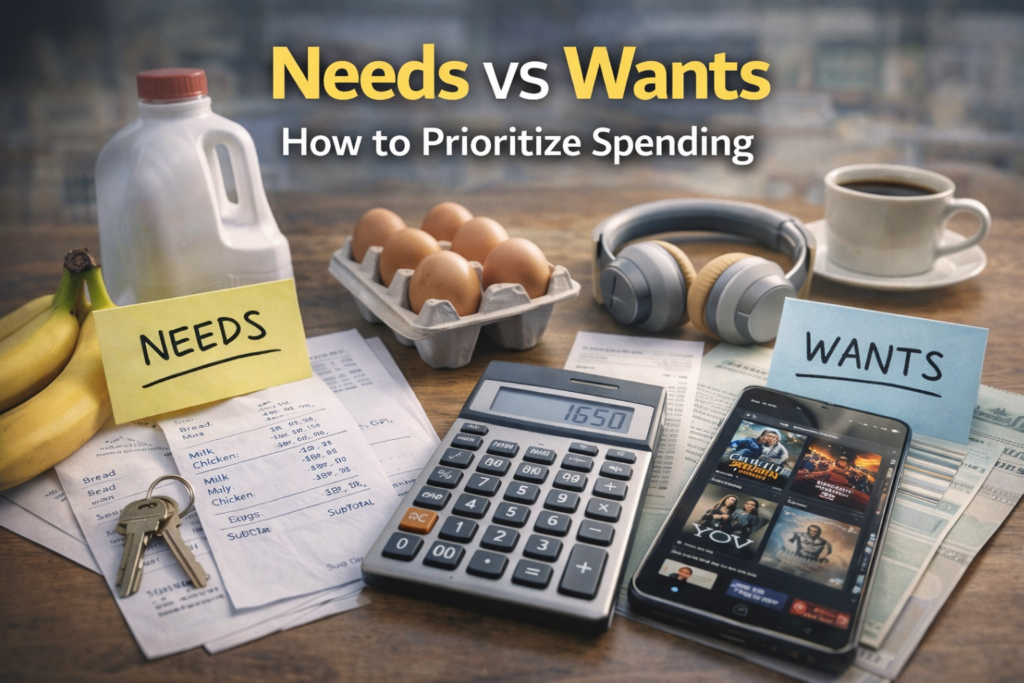
This is the quiet confusion behind spending: not reckless choices, but categories that don’t hold still. Modern life is full of small comfort purchases, automatic charges, and “convenience” spending that doesn’t feel dramatic in the moment.
I think the hardest part is that spending is rarely just about objects. It’s often about time, energy, and relief. When you try to draw a clean line, the line moves.
Table of Contents
Needs vs wants explained.
At a basic level, needs vs wants is a way to sort money decisions into “must keep” and “nice to keep”. The point is not to label anyone as disciplined or careless. The point is to reduce confusion when money feels tight or unpredictable.
Official consumer education often frames it this way: understanding the difference between needs and wants can help you make spending decisions that fit your life.
That wording matters because it leaves room for real life. It admits that “best for you” depends on context. It also hints at the real benefit: once you can name what is essential for your basic stability, you can stop treating every purchase as equally urgent.
If you want to see how this fits inside the broader system—income coming in, money flowing out, and savings acting as a buffer—the pillar guide Money Management Basics: Managing Income, Budgeting, and Building Financial Stability gives the big-picture framework without turning it into a lesson plan.
Needs vs wants in real life: what “needs” actually mean
In everyday budgeting, needs vs wants is less about survival and more about keeping the basics running.
A practical definition used in UK budgeting guidance is close to how most households experience it: essential costs are the things you have no option but to pay, such as rent or mortgage payments, energy bills, and food.
That list is already revealing. “Needs” tend to be the costs that keep your housing stable, keep the lights on, and keep you fed. They also include obligations you can’t ignore without consequences. Even when you’re careful, these costs are not optional layers; they are structural.
There is another reality beginners often miss: needs are not always small. In the United States, the United States Bureau of Labour Statistics reports that housing is the category that continues to make up the largest share of consumer spending.
So when someone says, “I can’t seem to control my money,” the honest answer is sometimes, “A big portion of spending is already committed to basic living.”
Why geography changes needs vs wants
The idea of “needs” also shifts by location. The same income can feel roomy in one place and tight in another, simply because the baseline costs are different.
In the United Kingdom, the Office for National Statistics has shown large regional differences in household spending, with housing costs contributing heavily to the gap between London and other regions. In one Office for National Statistics analysis, spending on housing accounted for much of the difference, and it gives an example where renters in London spent far more weekly on net rent than renters in other areas.
That doesn’t mean London is “bad” and smaller cities are “good”. It means needs vs wants are partly shaped by where you live. A London commuter’s transport costs might be a clear need. In a smaller town, a car payment and fuel might carry that role. In New York, a monthly transit pass might be essential for work; outside a city centre, the need might look like parking plus insurance.
The category stays the same. The lived definition changes.
Needs vs wants also have a “grey middle”
Even with a definition, some costs sit in between.
A phone plan can be a need for work and safety, but the upgraded plan might be a want. Groceries are a need, but certain brands and add-ons might be wants. Clothing can be essential, while frequent shopping becomes optional.
This grey middle is not a sign you’re doing it wrong. It is a sign that real spending isn’t binary. Needs vs wants works best when it’s treated as a hierarchy, not a courtroom verdict.
If you want a clear view of how a monthly budget is usually organised—so “needs” and “wants” have somewhere to land on the page—Budgeting 101: How to create a simple monthly budget explains the structure in plain language, without pushing templates or strict rules.
Needs vs wants: what “wants” really represent
“Wants” often get described as if they were mistakes. In real life, they are usually something else: comfort, convenience, social life, or identity.
A budgeting guide might describe non-essential spending as the costs you could cut back on if you wanted to, often listing items such as holidays, leisure, and entertainment.
Read that carefully. It doesn’t say wants are pointless. It says they’re optional. That’s an important difference.
A want might be dinner out after a long week, a streaming service that makes evenings feel less lonely, or small upgrades that make daily life smoother. These purchases are not always about luxury. They are often about relief.
This is why needs vs wants can feel emotional. People are not robots. They use money to manage time and energy as well as possessions.
The quiet power of recurring wants
Many wants don’t show up as big, obvious purchases. They show up as recurring charges.
A subscription that renews automatically can feel almost invisible. A set of small monthly services—music, films, storage, apps—can quietly form a second “utilities” bundle you didn’t mean to build. A £10 charge can be easy to ignore when it’s isolated, but repeated charges change the shape of the month.
This is not just a budgeting issue. It’s how people naturally organise money in their minds.
Research in behavioural economics describes “mental accounting” as the way individuals and households organise, evaluate, and keep track of financial activities. It includes grouping spending into categories (housing, food, and so on) and sometimes constraining it with implicit or explicit budgets.
In other words, people don’t experience money as one big pot. They experience it as labelled pieces, and those labels influence what feels acceptable.
A subscription can slip through because it lives in a mental category that feels harmless: “small”, “monthly”, “already agreed”, “not worth thinking about”. Needs vs wants is partly about noticing those labels.
The trade-off layer: when needs vs wants shape your month
Here is the calm truth: needs vs wants become urgent when there isn’t much margin.
When income is stable but spending expands slowly, tension grows quietly. It might not feel like overspending. It feels like a month that has less room than it used to.
When income fluctuates, unclear priorities create risk. If your pay varies—freelancing, commission, irregular shifts—the month needs stronger boundaries between what must be protected and what can flex.
This is why “trade-offs” are the real topic here. Every month has a limited amount of money and a limited amount of flexibility. If more money goes to optional layers, less remains for buffers. If more goes to fixed obligations, the flexible part becomes tighter.
Why stress makes prioritising harder
Money pressure doesn’t just change the numbers. It changes attention.
Academic work on scarcity (presented by a Princeton University researcher and hosted by the Federal Deposit Insurance Corporation) argues for a very human view: limited resources affect how people focus, plan, and follow through. Under scarcity, decision-making can narrow, and juggling becomes harder.
This matters for needs vs wants because the hardest spending decisions often happen when you are already tired. That’s when optional spending can feel like a need, because it offers immediate relief: time saved, comfort gained, friction reduced.
This isn’t moral weakness. It’s a predictable pattern when life runs close to the edge.
Needs vs wants meet cash flow timing
Even when a month “adds up, timing still matters. Subscriptions renew on one date. Rent leaves on another. A large grocery shop hits when the fridge is empty, not when it’s convenient.
Cash flow guidance from the Consumer Financial Protection Bureau explains that a cash flow budget is about tracking the timing of income and expenses to make sure you have enough from week to week.
That is exactly where small “wants” can become larger than expected: not because they ruin the entire month, but because they land during a tight week.
If you want to explore that timing idea more deeply—how “fine for the month” can still feel tight on a specific week—Tracking Income and Expenses: Understanding your cash flow focuses on the rhythm of money in and out without turning it into a tracking tutorial.
Needs vs wants as part of the bigger money system
It helps to zoom out again. Needs vs wants is not a standalone trick. It connects to three larger pieces of money management:
A monthly budget gives structure. It names categories so your money isn’t a blur.
Cash flow adds timing. It shows which weeks are naturally tight.
Savings and buffers add resilience. They turn surprises into manageable events, instead of chain reactions.
This is why the Consumer Financial Protection Bureau describes financial well-being in terms that go beyond income alone: control over day-to-day, month-to-month finances, ability to absorb shocks, and freedom of choice.
Prioritising needs before wants supports that “control” feeling. Keeping some flex in the middle supports the “freedom” feeling. Neither extreme works for long.
If there is one calm takeaway, it is this: needs vs wants is not about restriction. It is about alignment. It helps you see which costs hold your life up, and which costs sit on top of it.
F&Q‘s
Is needs vs wants the same as essential and non-essential spending?
Most people use them the same way. “Needs” often map to essential costs like housing, food, and energy. “Wants” often map to non-essential spending such as leisure and entertainment.
Why do groceries feel like a need, but dining out sometimes feels like one too?
Because spending is also about time and energy. If you’re exhausted, you may experience convenience as necessary, even if it isn’t essential in the strict sense.
Do subscriptions always want?
Not always. Some subscriptions support work or communication. Others are leisure. Many are mixed, which is why they often feel “invisible” rather than clearly optional.
What if my “needs” already take most of my income?
That’s common, especially in high-cost areas where housing takes a large share of spending. In that situation, the needs vs wants line may be less about choice and more about recognising what is fixed.
Do needs vs wants change when you live in an expensive city like London or New York?
Yes. The baseline costs can be higher, so the “needs” layer takes up more of your monthly space, even with similar habits.
Why do small wants add up more than one big purchase?
Because recurring costs repeat quietly. They can blend into the month and become part of your “normal” without a clear moment when you agreed to the total.
Can a want ever become a need?
Sometimes, depending on work requirements and personal circumstances. The category is often less important than understanding the trade-off it creates.
Is it unhealthy to cut all wants?
It often isn’t sustainable. Wants can be part of a balanced life. The point of needs vs wants is to understand priorities, not to erase enjoyment.