
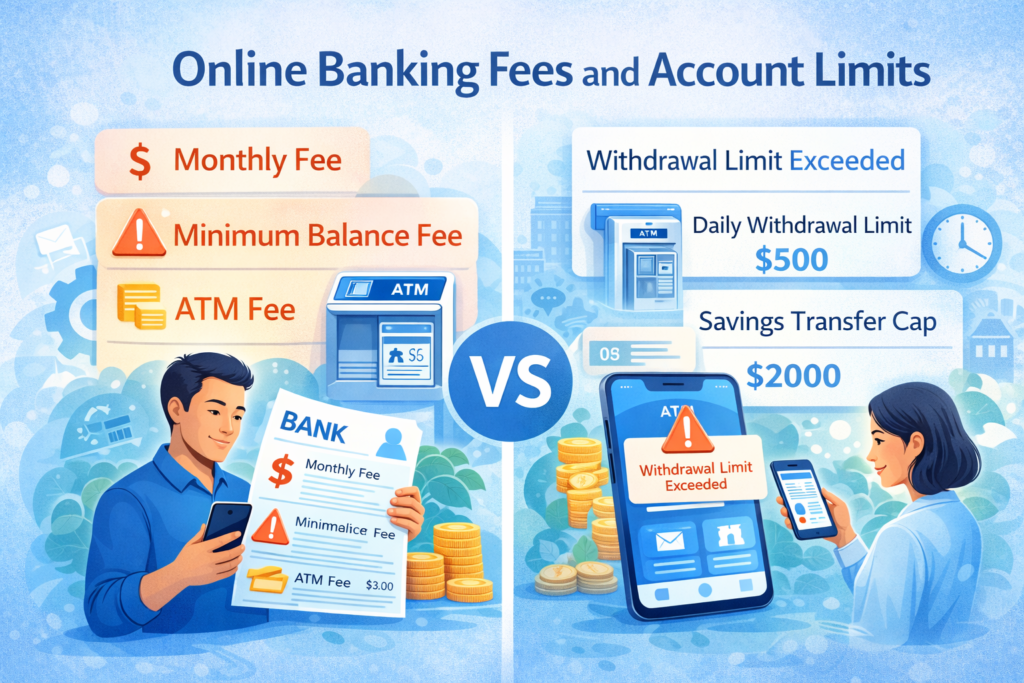
When you open a bank account online, you might assume there are no strings attached. Then a monthly maintenance fee shows up on your statement, or a transfer fails because you’ve reached your limit. I’ve noticed fees confuse people more than almost anything else, and from what I’ve seen, limits often feel hidden until they matter. This article demystifies online banking fees and account limits. We’ll define the most common charges and caps in everyday language, explain why they exist, and offer simple examples so you can build trust in your digital banking experience.
Many beginners misunderstand the role of fees and limits. Seeing money leave your account for reasons you don’t expect can feel like a penalty, and a limit can feel like an unnecessary barrier. In reality, both are part of how banks operate safely. Understanding these terms helps you navigate online banking fees and account limits with confidence.
Understanding Online Banking Fees
Bank fees come in several forms, but they all serve a similar purpose: to compensate banks for the services they provide. A financial education guide explains that fees help offset day‑to‑day operating costs and pay for account features like ATM reimbursement or rewards. You can think of online banking fees and account limits as the subscription price for using your account’s digital tools.
Monthly Maintenance Fees
Banks often charge a monthly maintenance fee just for keeping an account open. The amount is usually small, but it adds up over a year. Many institutions will waive this fee if you meet certain conditions, such as enrolling in direct deposit, maintaining a minimum balance, or making a set number of transactions. If you see this charge on your statement, ask whether you can avoid it by switching to paperless statements or linking another account. Understanding these online banking fees and account limits ahead of time can save you money.
Minimum Balance Fees
Some deposit accounts require a minimum balance. If your balance falls below the required amount, you may pay a fee. Banks use these requirements to ensure they have enough reserves for loans and other obligations. Keeping a buffer in your account not only avoids the fee but also helps the bank maintain liquidity. For beginners, minimum balance fees can be frustrating, but they are a standard part of online banking fees and account limits.
ATM Fees
ATM fees are another common expense. When you use an ATM outside your bank’s network, your bank may charge a fee, and the ATM operator might charge one too. These fees cover the costs of operating machines and connecting different banking networks. Using in‑network ATMs or finding accounts that reimburse out‑of‑network fees can minimise this charge. Understanding this aspect of online banking fees and account limits helps you plan cash withdrawals and avoid extra costs.
Overdraft and NSF Fees
If you try to spend more than you have in your account, the bank can deny the transaction and charge a nonsufficient funds fee, or it might allow the transaction and assess an overdraft fee. These fees compensate the bank for covering your purchase or for the administrative costs of reversing a transaction. They can be significant, so monitoring your balance and setting alerts is important. Knowing that overdrafts are part of online banking fees and account limits encourages careful spending.
Why Banks Charge Fees
Fees might feel like penalties, but they are part of the business model that keeps digital banking available. Maintenance fees fund branch and technical operations, ATM fees pay for equipment and network access, minimum balance fees support reserve requirements, and overdraft fees cover the risk of customers spending beyond their means. Recognising that online banking fees and account limits are tied to real costs can help you view them more objectively.
Exploring Account Limits in Digital Banking
Account limits place caps on how much you can withdraw, transfer, or spend from your account over a certain time period. These limits are part of online banking fees and account limits because they work hand in hand with fees to protect customers and banks. They may feel restrictive, but they’re designed to prevent fraud, comply with laws, and encourage healthy financial habits.
Daily Cash Withdrawal Limits
Banks usually set a daily cash withdrawal limit for ATM transactions. Many financial institutions cap withdrawals at about \$200 to \$300 per day. This policy isn’t arbitrary. It reduces potential losses if your card is lost or stolen, as a thief can’t empty your account in a single day. If you need more cash, you can plan multiple withdrawals or contact your bank for options. Remember that these caps are part of online banking fees and account limits aimed at securing your money.
Savings Withdrawal Limits
Many savings accounts restrict the number of electronic transfers you can make each month. Before 2020, Regulation D limited certain savings withdrawals to six per month; though the rule has been relaxed, many banks still enforce similar caps. Transactions that count include online or phone transfers, debit card payments, and automatic transfers. Exceeding the limit can trigger a small fee or result in your savings being converted into a checking account. Knowing these limits is key to managing online banking fees and account limits effectively.
Transfer and Payment Limits
Apart from savings withdrawal limits, banks also set caps on electronic transfers and payments. Regulation E requires banks to disclose that such limits exist. For security reasons, they may not always disclose the exact numbers. These limits help banks detect unusual activity, comply with anti‑money‑laundering rules, and avoid large errors. If you plan to send a large payment or transfer, check with your bank first to avoid hitting a limit unexpectedly. Understanding these caps is a key part of navigating online banking fees and account limits.
Why Limits Exist
Limits serve as guardrails. They manage risk by capping how much money leaves an account, help banks meet regulatory requirements, and remind customers that savings accounts aren’t meant for frequent transfers. Limits vary by customer and account type. New accounts may have lower caps until you build a history, and banks adjust limits for security or operational reasons. Knowing your limits lets you plan transactions and avoid frustration.
Examples and Everyday Scenarios
Consider these real‑life examples to see how online banking fees and account limits work in practice:
A freelancer receiving payments. Some banks let you transfer unlimited funds from a payment platform, while others cap the amount you can move each day. If a payment exceeds the cap, part of it may be delayed so the bank can verify the transaction. If you receive large payments often, ask about your bank’s limits and whether they can be adjusted.
Travelling abroad. When you use an overseas ATM, your bank may charge an out‑of‑network fee, the foreign ATM operator may charge a fee, and there may be a small currency conversion fee. Understanding these online banking fees and account limits helps you decide whether to withdraw larger amounts less often or use your card for purchases instead.
Saving for emergencies. Weekly automatic transfers from your checking account to savings count toward the monthly limit. If you exceed the limit, your bank might charge a small fee or convert your account. Planning fewer, larger transfers helps you stay within limits while still building savings and illustrates how awareness of online banking fees and account limits can save you money and stress.
Avoiding Surprises and Building Trust
The best way to avoid surprises is to educate yourself. The FDIC suggests comparison shopping, reading fee schedules, and asking whether monthly fees can be waived. Writing down your transactions or checking your account regularly also helps you stay within limits. Some banks provide low‑fee accounts that waive certain charges. Instead of trying to eliminate every cost, think about which features and services you actually use and choose an account accordingly. Treat online banking fees and account limits as part of the price of convenience.
Understanding limits is equally important. Ask about daily cash withdrawal caps, monthly savings transfer limits, and daily transfer limits. Banks can often adjust limits temporarily for large purchases or transfers. Limits aren’t meant to stifle your freedom; they protect your money and keep the system running smoothly. Knowing the rules ahead of time reduces frustration and helps you plan.
I think most frustration comes from not knowing these rules early. By learning about online banking fees and account limits before you run into them, you can set realistic expectations and avoid unnecessary stress. Fees aren’t hidden traps; they fund the services you use. Limits aren’t obstacles; they safeguard your account. A little knowledge goes a long way toward building trust with your bank and managing your money confidently.
Conclusion
Digital banking makes money management convenient, but it still operates within a framework of fees and limits. Monthly maintenance, minimum balance, ATM, and overdraft fees compensate banks for providing services. Daily withdrawal caps, savings withdrawal limits, and transfer caps protect your funds, help banks comply with regulations, and encourage good financial habits. By understanding online banking fees and account limits, you can make informed choices, avoid surprises, and focus on managing your finances rather than worrying about hidden charges or unexpected denials. For more insight into how digital banking works overall, see our comprehensive guide on digital banking basics, and refer to resources like the FDIC for up‑to‑date consumer information.