
Many newcomers are drawn to the idea of earning money from home, but quickly become overwhelmed by the variety of online income models they encounter. Scrolling through forums and social media, they see videos promising a six‑figure lifestyle and lists of “top ways to earn online.” It is easy to assume that all online income paths are basically the same or that there is a single secret method. In truth, “earning online” covers a range of structures, each with its own rhythm, rewards, and responsibilities. When you hear someone say they are a freelancer, a blogger, a course creator, or a remote employee, they are referring to very different systems of work. This article does not rate or promote any particular model; instead, it maps out the landscape so you can understand how money flows online.
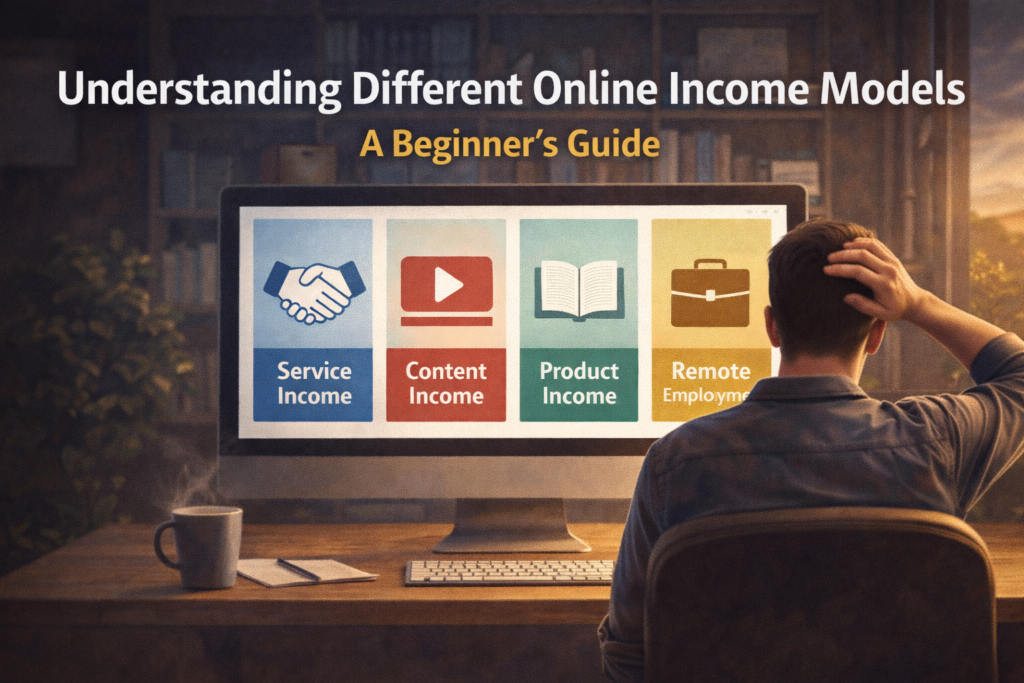
Uncertainty often stems from conflicting messages. One advertisement might claim that creating a digital product is the only way to achieve “passive income,” while another might insist freelancing is the fastest route to cash. New learners often attempt to follow multiple approaches simultaneously and become discouraged when results do not appear immediately. The goal here is to provide clarity rather than hype. We will define what an online income model actually is, explain the main categories, compare how effort, payment timing, and risk differ across models, and explore why confusion happens. By understanding these structures, you can make more thoughtful choices without feeling pressured to adopt a particular approach.
Table of Contents
What an “Online Income Model” Actually Means
When people speak about online income models, they are referring to the underlying structure of how money is earned and delivered in a digital setting. An income model outlines who pays you, what you provide in return, how long it takes to get paid, and whether the work must be repeated or can be scaled. Many beginners assume that earning online is a single activity, but the structure behind a freelancer’s invoice differs greatly from that of a blogger earning from advertisements or a creator selling a digital course.
In a service‑based model, you exchange your time or skills directly for payment. For example, a freelance graphic designer might agree to design a logo for a small business, send an invoice, and then wait for the client to pay. According to the New York City Department of Consumer and Worker Protection (DCWP), if a freelance contract does not specify a payment date, the hiring party must pay the worker within 30 days after the work is completed. In contrast, a content creator builds an audience first and earns money indirectly through advertising or sponsorships. The creator may spend months producing articles or videos before seeing significant revenue. A digital product seller invests time upfront to create an e‑book, online course, or software, and then sells it repeatedly. Understanding these different structures helps you see why timelines and payment flows vary so much.
The Main Types of Online Income
To make sense of the many ways people earn on the internet, it helps to group them into broad categories. While terminology varies, four major online income models cover most approaches: service‑based income, content‑based income, product‑based income, and remote employment. Each category has distinct characteristics and suits different personalities and goals.
Service‑Based Income
In a service‑based model, you get paid for delivering your expertise or effort. This category includes freelancing, virtual assistance, consulting, tutoring, and many other remote services. You might write articles, design websites, provide bookkeeping, or teach languages via video calls. The money flow is straightforward: a client agrees to pay you a certain amount, you perform the work, and you receive payment—often via bank transfer such as the Automated Clearing House (ACH) system in the United States or the Single Euro Payments Area (SEPA) system in Europe. Because you are exchanging time or skill directly for money, income can begin quickly once you secure a client. However, it can fluctuate based on the number of projects you have and how quickly clients pay invoices. Under the DCWP’s Freelance Isn’t Free Act, if a written contract lacks a payment date, the client must pay within 30 days of completion.
Service‑based work often requires ongoing client communication, proposal writing, and follow‑up. Some people enjoy this variety and direct interaction, while others find the unpredictability stressful. A clear contract sets expectations for deliverables, timelines, and payment terms. If you want a deeper understanding of what freelancing entails, including how freelancers invoice and the differences between an employee and an independent contractor, see our guide on What Is Freelancing? For those interested in recurring service work beyond one‑off projects—such as virtual assistants, tutors, consultants, or coaches—the article Offering Online Services (Virtual Assistance, Consulting, Tutoring) explains how long‑term client relationships operate and why reliability is key.
Content‑Based Income
Content‑based income revolves around building an audience and earning from that audience’s engagement. A blogger writes articles, a YouTuber produces videos, and a podcaster records audio episodes. These creators do not get paid directly for each hour they work. Instead, they earn when an audience watches, reads, or listens. Revenue comes from advertisements, sponsorships, or affiliate links. A common path is to sign up for an ad network or partner program, which pays a small amount per thousand views or clicks. Affiliate commissions are another option: you recommend a product and earn a percentage if someone buys through your link. However, these income streams depend on consistent traffic and trust. If only a few people visit your blog or channel, earnings will be minimal. Developing quality content and growing an audience takes time and patience.
Because content income starts slowly, many creators support themselves through other work in the early stages. Once a website or channel gains traction, income can become more predictable. However, it remains sensitive to changes in platform algorithms, advertiser budgets, and audience behaviour. For a practical overview of how bloggers, video creators, and other media producers build and monetise their work, our supporting article Content Creation as Income covers the various revenue streams and the patience needed to grow them. When you want to understand how affiliate commissions and display advertising actually work—and why traffic levels are crucial—our piece Affiliate Marketing & Online Ads (Explained Simply) demystifies those mechanisms.
Product‑Based Income
Product‑based income involves creating something once and selling it many times. Digital products range from e‑books and online courses to templates, stock photos, software, and printable planners. For example, a person might write a detailed €29 guide on starting a small urban garden or produce a $49 course on basic coding for beginners. After the initial creation, each additional copy sold requires little extra cost, so profit margins can be high. However, developing a high‑quality product demands significant upfront effort: planning the content, producing the material, editing, and packaging it attractively. Marketing is also essential because even the best product will not sell if no one knows it exists.
Unlike a service‑based model, you are not limited by the number of hours in a day. Once a digital product is available, it can be sold at any time to customers worldwide. The challenge lies in building credibility, generating traffic to your sales page, and providing ongoing support or updates. For a deeper dive into the mechanics of this model, including profit margins and scalability, see Selling Digital Products (Explained for Beginners). That article explains how to price products, where to host them, and what work is needed before income appears.
Remote Employment
Remote employment is often confused with freelancing, but it is a distinct online income model. In a remote job, you are an employee of a company, just like a traditional in‑office role, but you perform your duties from home or another location. You may work full‑time or part‑time, receive a salary or hourly wage, and have access to benefits such as health insurance or paid leave. The payment flow resembles a conventional job: the employer pays you regularly via direct deposit or bank transfer. You must meet job responsibilities, follow a schedule, attend virtual meetings, and comply with company policies. While remote employment offers stability and predictable income, it provides less autonomy than freelancing because you report to a manager and cannot easily choose your projects.
This model suits people who prefer steady pay and the structure of an employer‑employee relationship. It is particularly attractive to those who want to work from home but do not wish to run a business or find their own clients. For more context on how remote jobs differ from freelancing and self‑employment—including salary versus project fees, structured hours versus flexibility, and the benefits and constraints of each—see Remote Work Basics (Online Jobs vs Freelancing).
How Effort Differs Across Online Income Models
One reason people struggle to choose an online income path is that the level of effort varies widely. Service‑based income typically requires ongoing participation. A freelance web developer, for instance, must meet client deadlines, respond to feedback, and adjust their design until the project is complete. If they stop working, income stops. The upside is that income can start relatively quickly once a client agrees to a project. However, after delivering, they may wait days or weeks for payment. In contrast, content creators invest hundreds of hours into writing articles, shooting videos, or recording podcasts before they see substantial returns. The effort is front‑loaded; once a library of content exists, it can continue to attract visitors and earn revenue with less additional work.
Digital product creators also front‑load their effort. They might spend months researching, writing, filming, or coding. Once their product is ready, sales can occur around the clock, but marketing is essential to sustain demand. Remote employees have a different rhythm: they contribute consistent effort during designated hours and receive scheduled pay. They do not have to worry about client acquisition or marketing, but they must perform according to job requirements and may have less flexibility in their daily tasks.
This difference in effort influences how people experience their work. Some enjoy the direct feedback and immediate earnings of service‑based work. Others value the independence and scalability of content or product models, even if results take longer to manifest. There is no universal best choice; the right fit depends on your skills, goals, and personal preferences.
How Payment Timing Works
Cash flow varies across online income models, and understanding when money arrives can prevent frustration. Freelancers and other service providers often wait between 14 and 30 days after submitting an invoice. The New York City DCWP specifies that if a contract does not include a payment date, the hiring party must pay the worker within 30 days of completing the work. Some clients pay faster; others adhere strictly to agreed terms. In addition, payment may arrive via different systems: in the United States, many clients use ACH transfers, while European clients may use SEPA. You are responsible for tracking invoices and following up on late payments.
Content creators typically receive advertising revenue monthly. If you are monetising a YouTube channel, for example, the platform calculates earnings based on views and pays out once per month, once a minimum threshold is met. Affiliate programmes often pay commissions 30 to 60 days after a sale, allowing time for returns or cancellations. Because income depends on traffic volume and advertiser demand, monthly earnings can fluctuate. Digital product sellers may receive payment as soon as a sale is processed via a payment gateway. However, platforms sometimes hold funds for a short period to handle refunds or fraud checks. Remote employees enjoy the most predictable payment schedule: they are usually paid every two or four weeks according to company policy.
By recognising these patterns, you can plan expenses and savings more effectively. If you choose a model with delayed payments, maintaining a financial cushion becomes important. If you choose a model with variable earnings, such as content creation, patience and long‑term planning are essential.
Comparing Risk and Stability
Each online income model involves its own form of risk. Service‑based income depends heavily on client relationships. If a client cancels a project or pays late, your income is affected. To mitigate this, many service providers require deposits or retainers. Content creators rely on platform algorithms and audience interest. A change in a search engine’s algorithm or an advertising policy can reduce traffic or revenue overnight. This model also requires continual adaptation to shifts in audience behaviour. Digital product sellers face market risk: trends change, competitors emerge, and buyers may lose interest. The challenge is to keep products updated and to continue promoting them effectively.
Remote employment provides more stability because you earn a regular salary. However, it is not risk‑free: companies may restructure, reduce staff, or change remote work policies. In all cases, diversification—combining more than one model—is a strategy some people use. For example, a freelance writer may produce content for clients while developing a digital course on the side. This way, if client work slows, course sales may provide a cushion. Understanding risk helps you set realistic expectations and make informed choices.
Short‑Term and Long‑Term Time Horizons
Another source of confusion is the timeline for seeing results. Some online work paths yield income almost immediately, while others may take months or years to mature. Short‑term options include freelancing, virtual assistance, and micro‑tasks. You perform a task and receive payment shortly after. However, the amount you earn is directly tied to the hours you work. Long‑term options, like building a blog, establishing a YouTube channel, or developing a digital product, require sustained effort without initial pay. Traffic and sales usually grow slowly, but once established, income can continue with less daily labour.
Many people blend short‑term and long‑term approaches. They might freelance to cover living expenses while slowly creating a product or building an audience. If you are curious about how immediate gigs differ from longer projects and how to balance them, our article Short‑Term Gigs vs Long‑Term Online Income compares the pace and scalability of various options. Knowing the approximate timeline helps you set goals and avoid discouragement when long‑term efforts do not pay off right away.
Why Confusion Happens
Beginners often mix up income models because social media and advertisements blur the distinctions. One post might describe a person earning “passive income” from a digital product, while another suggests that “being your own boss” through freelancing provides freedom and high pay. These messages tend to emphasise success stories and downplay the long hours, failed projects, or slow growth that often precede visible results. Moreover, terms like “passive income” are frequently misunderstood; even digital products and content require maintenance, customer support, or regular updates to remain relevant.
Another reason confusion arises is that individuals try to apply metrics from one model to another. For example, they might judge the success of a blog by how much it earns in the first month, when blogs typically take months to gain traction. They might expect clients to pay instantly for freelance work, not realising that invoicing systems often involve waiting periods. To address personal alignment and help you reflect on which model fits your life—without prescribing a choice—our article Choosing the Right Online Income Model for You offers questions and considerations that make this decision more grounded. Confusion lessens when expectations align with reality.
Closing
Understanding online income models is the first step toward a sustainable digital career. Rather than chasing the latest trend or copying someone else’s strategy, take time to learn how each model operates. Service‑based work offers immediacy and direct interaction with clients but comes with variable income and the responsibility of managing invoices. Content‑based paths require patience and consistency, with the promise of income that can continue without constant production. Digital products demand significant upfront effort but can scale when coupled with effective marketing. Remote employment provides stability and structure for those who prefer working under an employer’s umbrella.
Different structures suit different personalities, schedules, and risk tolerances. Income urgency, long-term goals, skills, and preferences for flexibility versus routine all play a role in determining the chosen path. No model is inherently superior; each has trade‑offs. By exploring the models calmly and reflectively, you prepare yourself to make decisions that align with your circumstances. If you are unsure, start small—perhaps take on a short freelance project or publish a single blog post—and observe how it feels. Before diving deeper, revisit the supporting articles linked throughout this pillar for more detail on each model. With clarity and patience, your online income journey can be informed, realistic, and true to your personal aspirations.