
For many people, saving money basics can feel impossible when paycheques are tight or unpredictable. It’s common to think, “I don’t earn enough to save,” yet the struggle often runs deeper. The difficulty usually isn’t just income level; it’s about clarity and priorities.
When budget categories blur, it’s hard to tell what surplus (if any) exists. If income is irregular—so one month you have extra, and the next barely covers bills—you may never get into a steady saving habit. And without a clear separation, saving can feel like “stealing” from today’s needs, leading to resistance or guilt.
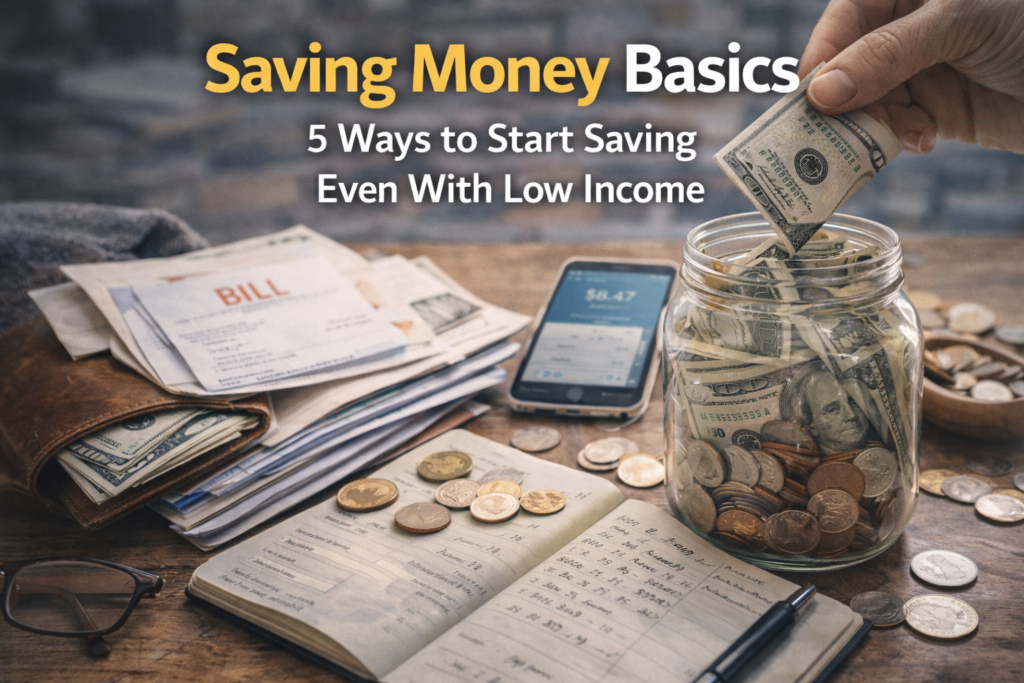
This confusion is normal. In fact, financial educators note that many people delay saving not because of a lack of money, but because there’s no clear “place” for savings in their routine. In a sense, saving becomes an afterthought rather than a plan.
Saving money basics: what saving actually represents
Saving money is not about having extra cash left over. It’s about creating future flexibility and choice. Even small amounts can add up to meaningful buffers.
Think of saving like planting a seed. Each small deposit builds the plant a little more. Over time, consistent saving can become a sturdy oak of security. For example, saving $200 a month (even from a modest income) yields $2,400 in a year. That sum might not buy a luxury item, but it is a concrete step toward stability—an extra cushion for unexpected bills.
Official guidance often reframes saving as a positive, structural habit. The Consumer Financial Protection Bureau describes financial well-being partly as having the ability to absorb shocks. In that view, savings are not a reward; they’re an essential buffer. This mindset shift can make saving feel less about sacrifice and more about gradual preparedness.
The role of separation in saving
Part of why saving feels unreal is that we don’t always treat it like a regular expense. In practice, one of the most effective tricks is clear separation between spending and saving.
Imagine two jars on a table: one labelled “Spending” and the other “Savings”. When your income arrives, you immediately move some money into the Savings jar. What’s left goes into Spending. This “pay yourself first” approach prevents small purchases from creeping into your savings by mistake.
Practically, this might mean opening a separate savings account or setting up an automatic transfer each payday. MoneyHelper’s budgeting guide explicitly recommends moving the amount you intend to save to a separate account as soon as you get paid. In other words, treat your savings deposit like a non-negotiable bill. That psychological separation helps you stick to the plan without constantly deciding whether to spend or save each dollar.
By separating your savings, the remaining budget for spending becomes clearer. The money you “see” in your current account is genuinely disposable. This clarity alone can make saving much easier, because it turns saving from a vague goal into a specific, scheduled event.
READ: Money Management Basics: Managing Income, Budgeting, and Building Financial Stability
Saving on a low or irregular income
It’s often said that you should save before you spend, but that sounds easier on a steady salary. When your income is irregular—like for freelancers, gig workers, or seasonal earners—saving requires flexibility and planning.
One practical perspective is to plan for the lowest expected month. If your income varies between $1,500 and $3,500, consider budgeting as if you’ll only have $1,500 every month. Anything above that “minimum” can go into savings. This way, you avoid assuming a windfall that might not come.
During a higher-income month, it can help to treat the extra as an opportunity to catch up on saving. You might automatically stash a larger chunk during those months. Conversely, in leaner months, you remind yourself not to touch the savings for routine needs. This approach is less about motivation and more about consistency within variability.
A helpful analogy is thinking of savings as a “buffer account.” In good times, you build it up; in lean times, you rely on it instead of cutting essential spending. This idea ties into cash flow: you can read more about aligning irregular income with monthly cash flow in Tracking Income and Expenses: Understanding Your Cash Flow. That article explains how using a buffer account is part of smoothing out income bumps, not about market timing or speculation.
Saving as a bridge to an emergency fund
Behind every savings plan is a deeper goal: resilience. Small savings habits eventually translate into a real financial cushion. Think of saving money basics as laying the first bricks of that cushion.
Once you’ve separated savings and started the habit (even modestly), it naturally leads to considering an emergency fund. An emergency fund is essentially the collection of your past savings, set aside for unforeseen costs. No sudden catastrophe is required to benefit from it; even routine surprises become easier to handle.
Building that fund is the next step, but the saving habits you form now are the structure you’ll use. Without a savings habit, an emergency fund is just a vague idea. With consistent savings, an emergency fund is a concrete goal you’re already working toward.
F&Q’s
Is saving really possible on a low income?
Yes. Saving isn’t only for high earners. It’s about prioritising consistently. Even £20/$20 a month adds up over time, especially if it means skipping a few small luxuries and moving that money to savings first.
What is “pay yourself first”?
It means setting aside your savings the moment you get paid, before any other spending. This makes saving automatic. Consider it another bill to “pay,” which ensures it happens. (Consumer guidance encourages this approach.)
How much should I save each month?
There’s no single number. A common suggestion is the “50/30/20” rule: 20% of income to savings. But that’s just a guideline. The key is to start with an amount you can consistently move to savings, even if it feels small.
What if I have irregular income?
Focus on covering essentials first. Plan your baseline budget on the lowest income you expect, and treat any extra as potential savings. Over time, aim to save during high-income periods for future low months.
Should I keep my savings in cash or a bank?
Generally, keep emergency savings in a safe place like a savings account. The goal is easy access, not high returns. Some people even keep a small cash emergency fund at home for immediate needs, but most choose a bank account to earn a bit of interest and avoid the temptation of spending it.
What is an emergency fund, and is it the same as saving?
Saving money basics start with building savings. An emergency fund is a dedicated stash of those savings meant only for unexpected expenses (car repairs, medical bills, etc.). You start by saving, and then you decide which part becomes that dedicated fund.
Can saving small amounts really make a difference?
Absolutely. Saving $25 a week (about $100 a month) is $1,200 a year—enough to cover many surprises. It also builds discipline. Consistent small savings grow into larger amounts over time.
Why should I save if I already have debt or bills?
This depends on personal priorities, but many advisors say keeping a small emergency buffer even while paying down debt can prevent new debt if something urgent arises. It’s about balance: you manage essentials and debts, but also leave a little margin so you aren’t forced to borrow more at the first hiccup.