
If you’re new to earning money online, you’ve probably heard people talk about service‑based income and product‑based income. At first glance, they might look similar. Both are ways of making money on the internet, and both have success stories attached to them. Yet many beginners get lost when trying to understand what separates them. The confusion often arises from vague marketing language or the assumption that every online business operates in the same way. This guide aims to clear up that confusion. It won’t tell you which path is “best” or how to get rich quickly. Instead, it will explain how each model works and why knowing the difference helps you make calmer decisions.
What Service‑Based Income Really Means
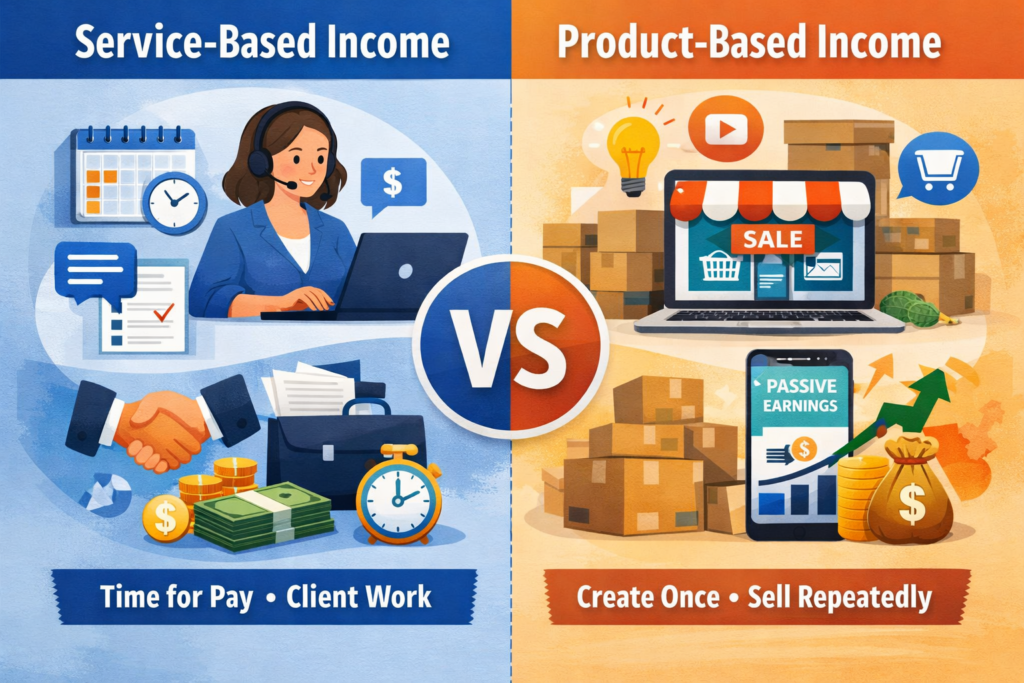
When people speak about service‑based income in the online world, they’re talking about selling their skills or knowledge directly to someone else. In practice, this often involves tasks done for clients or customers who need a specific problem solved. Think of it as trading your time, expertise, or effort for a fee. Examples include writing a report for a small business, editing a video for a brand, or consulting on a topic you know well. You deliver the service, and the client pays you for that delivery. There are no products stored in a virtual warehouse, and there is no need to build an audience before you can begin. From what I’ve seen, beginners tend to understand service work because it mirrors traditional jobs: you do the work, you get paid.
Two features define service‑based income. First, it usually requires direct interaction with clients. Your working hours are often tied to someone else’s schedule or deadlines. Second, the income is closely linked to the time you invest. If you don’t perform the service, there is nothing for the client to pay for. For people who like clear tasks and immediate feedback, this structure can be reassuring. It also tends to be easier to enter because you only need one skill and a client ready to hire you. Our supporting article on Freelancing vs content creation simply explores how selling skills compare to creating content.
What Product‑Based Income Really Means
Product‑based income is different because it involves creating something that can be sold more than once. In the online space, this could be a digital download, an online course, a music track, or even a template that others use in their own work. You invest time and resources upfront to build or design the product, and then you make it available for customers to purchase repeatedly. While physical products also exist, this article focuses on digital items because they align with most beginner online income paths. Building a product usually means thinking beyond the immediate sale: you need to consider who needs it, how it will be delivered, and how to keep it useful over time.
The structure of product‑based income is less tied to individual transactions. Once the product is complete, the marginal cost of selling it again is very low or even zero if it’s entirely digital. This can be appealing because it suggests the possibility of earning while you sleep. However, there is a catch. Product income usually takes longer to build. You might spend weeks or months creating something before anyone is willing to buy. Even after launching, reaching customers often requires marketing or audience building. If you’re curious about starting with small projects, the article “Starting Small with Your First Online Income Idea” offers a gentle introduction to this mindset.
Key Differences Without Ranking Them
So how do these models differ? Time vs. scalability is one difference. In service‑based work, your earnings are directly tied to how much time you spend working. In product‑based work, the earnings potential can grow beyond the initial time investment because one product can be sold repeatedly. Control vs. stability is another difference. Service income often provides more predictable pay once you have steady clients, but you depend on external requests. Product income offers more control over your own schedule, yet the money may come in waves and require ongoing marketing.
There is also the timing of effort. A service can start generating income quickly if someone hires you today. A product, on the other hand, may not bring any income until it is finished and promoted. Finally, consider consistency patterns. Service work tends to have shorter cycles — you deliver and get paid — while product work requires patience, testing, and sometimes changes based on customer feedback. None of these trade‑offs makes one model superior to the other. They simply highlight that the paths operate differently. For a broader discussion on choosing a direction, you can read the pillar article Choosing Your Online Income Path, which addresses why focusing on the process instead of platforms matters.
Why Beginners Often Misunderstand These Paths
It’s easy to see why people mix up service and product income. Many online stories blur the boundaries between them. A blogger might share success from selling an ebook and freelance design services in the same post, making it look like a single strategy. Social media often promotes the idea that “multiple streams” are essential from day one, which leads beginners to try both models without understanding the demands of each. I’ve noticed many beginners mix these ideas and then feel overwhelmed when progress is slow.
Another misunderstanding arises from the skills involved. People assume that someone who can create a digital product must also be good at marketing it, or that a freelancer can easily switch to product sales. In reality, each model requires different skills and different mindsets. Service work relies on client communication and project management. Product work focuses on long‑term planning, feedback loops, and sometimes technical setup. Understanding this distinction can prevent the frustration of working hard on the wrong tasks. If you’re curious about how focusing on one skill compares to juggling many at once, the article One skill vs many skills for beginners offers a helpful contextscreenshot.
Closing Section: Clarity Over Speed
Both service‑based income and product‑based income have a place in the online world. Neither path is inherently better; they simply suit different personalities, goals, and circumstances. The most important takeaway is that clarity matters more than rushing into action. By understanding how each system works — service income being immediate and client‑driven, and product income being long‑term and creator‑driven — you can choose a direction that matches your current stage. You might start with one model and later expand, but there is no need to force a decision before you’re ready. Learning what makes each path unique is a step toward making thoughtful choices rather than reacting to every idea that appears in your feed.