
For many newcomers exploring ways to earn online, the terms short‑term gigs and long‑term online income sound similar yet feel worlds apart. Someone might scroll through microtask platforms, instantly seeing small payouts for simple tasks. Meanwhile, influencers talk about building blogs, courses, or membership communities that eventually earn money while you sleep.
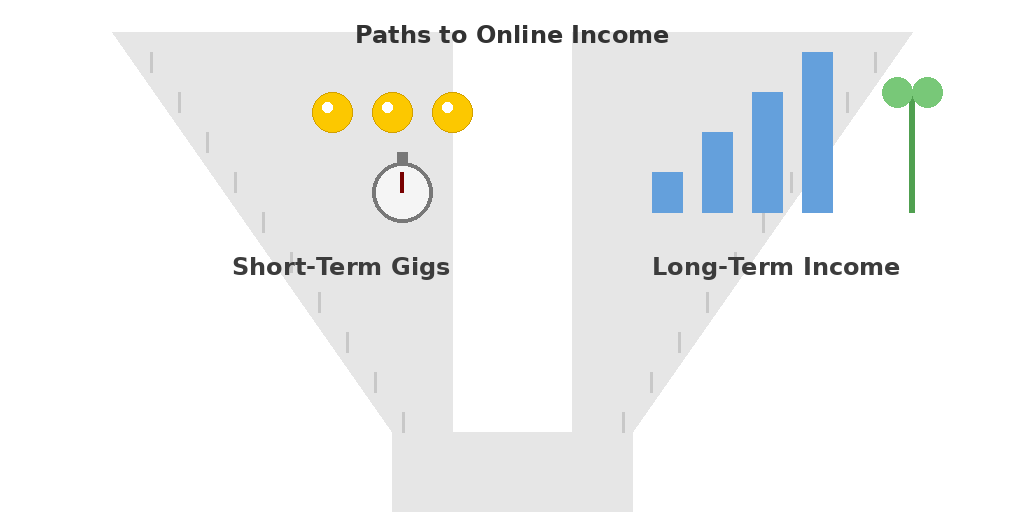
This mix of fast cash and slow burn can be confusing. Are short‑term gigs a sustainable livelihood? Is long‑term income a myth? Readers often ask whether microtasks are just stepping stones or if they can substitute a full salary. To begin untangling these questions, we first need to understand what each model is, how it fits into the wider landscape of earning online, and why each approach shapes your daily life differently.
Table of Contents
Defining Short‑Term Gigs
When you think of short‑term gigs, you likely imagine microtasks, surveys, one‑off freelance assignments or small digital jobs. The unifying feature is that you perform a discrete task and receive a small payment almost immediately. On platforms where you answer questions, label images, transcribe audio or complete quick design jobs, the money flows directly from client or platform to your account: task → completion → small payment → you. Some tasks pay via PayPal, some via ACH transfers in the United States or SEPA in Europe. The important point is that the work is repetitive, the barriers to entry are low, and you exchange your time directly for money.
Because short‑term gigs pay on completion, they appeal to people who need immediate cash. Students, caretakers, or anyone seeking to supplement a primary job might appreciate the speed and simplicity. The downside is that payments are small and there is little room for expansion. You might earn a few dollars per task, but scaling up means doing more tasks, not building a system that pays you in your sleep. There’s also no ownership: if the platform or client disappears, so does your income.
Connecting to the system: For a broader understanding of how individual clients influence income, consider how a freelancer’s pay changes when they rely on project‑based work. Our article [What Is Freelancing? (Simple Explanation)] shows how freelancers invoice clients, handle tax and benefits, and manage cash flow when their income depends on contract work rather than a salary. Understanding freelancing sheds light on why microtasks share some characteristics with contracted work while lacking the autonomy and earning potential of longer projects.
What Counts as Long‑Term Income?
By contrast, long‑term income refers to models where you build an asset first and earn from it over time. Instead of collecting a few dollars for each completed assignment, you invest effort in creating something that generates ongoing returns. There are many types: writing blog posts that attract readers, producing videos for YouTube, developing online courses or guides, designing templates, offering subscription services, or managing long‑term client retainers. The money flow looks more complex: effort → build an asset → traffic or trust → ongoing income. While the initial work might be unpaid, these assets can deliver income for months or years.
Long‑term income takes patience. It often starts slowly and may require months of publishing content before you see significant revenue. For instance, a blogger might write dozens of articles before search engines begin sending traffic. A course creator may spend weeks recording and editing modules before the first sale. However, once these assets exist, they can reach large audiences and generate money from advertising, sponsorships, product sales, or membership fees.
We need to stress that long‑term income is not passive in the beginning. You may hear about “passive income,” but the reality is that it takes consistent work to build your audience and maintain trust. Once established, though, the workload can shift from production to maintenance. This distinguishes long‑term models from short‑term gigs, where income stops the moment you stop working.
Connecting to the system: To understand this creation process more deeply, our discussion of digital products in [Selling Digital Products (Explained for Beginners] shows how authors, course creators, and software developers put substantial effort into building something once and then earn from each sale, sometimes for years. It also explains why marketing and audience trust matter just as much as the product itself.
Comparing Speed and Stability
A major difference between short‑term gigs and long‑term models is the trade‑off between speed and stability. Short-term gigs offer speed: you do a task, you get paid, often within hours or days. But the payment is small, and there is no guarantee of future work. In long‑term models, income is slower to start but can scale and stabilise once traction appears. This pattern exists across content creation, digital products, and service retainers. For example, a YouTube channel might earn little in the first months, but as subscribers grow, each new video builds on the previous ones, leading to more views, more ad revenue, and potential sponsorships. A digital template might sell only a handful of copies at first; as marketing improves and word‑of‑mouth spreads, sales can snowball.
Another part of stability is how income responds to external changes. Short-term gigs rely on platforms or clients. If a microtask platform changes its policies or a client stops offering tasks, your work dries up immediately. Long‑term income models also depend on platforms—YouTube can change its advertising algorithm, and search engines adjust ranking. But because you own your content or product, you have some resilience. A decline in one channel can be offset by growth in another. People who build an email list, for example, can communicate directly with their audience regardless of platform changes.
When evaluating these trade‑offs, think about your current needs and long‑term goals. If you need money quickly to pay a bill, short‑term gigs may help. If you want to build something that provides stability in a year, investing time in content or products might be worthwhile.
Connecting to the system: For a structured overview of how different models fit into the broader landscape of online earnings, our main guide [Understanding Online Income Models] (the pillar article) maps out service‑based, content‑based, product‑based, and employment models. That guide shows where quick gigs fit in and how long‑term projects intersect with audience building.
Risk and Effort Differences
All earning models involve risk and effort, but they differ in type. For short‑term gigs, the risks are low commitment and low financial stakes. You can try tasks without investing much time or capital. The effort is immediate and repetitive: each task has similar difficulty, and each payment is similar. There is minimal risk of failure, but minimal reward.
Long‑term models carry different risks. The time you spend creating something may not pay off right away. You might build a product or a blog that never gains traction. You may need to learn marketing, handle customer support, or invest money in tools and software. The reward is that if your product or content resonates, the upside is far greater than any microtask could provide. You own the asset you create, and it can generate income even while you’re asleep.
Effort also differs. Short jobs require no planning beyond the current task. You can log in, select a job, complete it, and receive payment. Long‑term models demand planning, consistency, and sometimes collaboration. A course creator must outline modules, design materials, film, edit, and market the final product. A service provider building a subscription may spend months refining their offer, creating systems to deliver consistent value, and maintaining relationships. This extra effort can be daunting, but it also builds skills and experience that benefit future projects.
Choosing Between Immediate Cash and Future Potential
So which path should you choose? The answer depends on your circumstances and personality. If you need immediate cash flow, short‑term gigs can provide small payments quickly. They are also a way to explore different types of online work without a big commitment. However, if you are willing to wait and invest your time, long‑term models may eventually produce larger, more stable income.
Many people combine both. For example, someone might spend evenings doing microtasks to pay bills while using weekends to write blog posts or develop an online course. Or a freelance designer might accept quick one‑off jobs to maintain cash flow while building a library of templates to sell repeatedly. This blend allows you to meet short‑term needs while investing in a future asset.
An important consideration is mental energy. Switching between immediate and long‑term tasks can be challenging. Short jobs often require focused attention and can be mentally draining if done in volume. Long‑term projects require sustained creativity and strategy. It’s normal to feel tired when combining both. That’s why planning and prioritising are crucial.
Understanding Payment Systems
Payment mechanics differ across models. Short-term gigs typically provide immediate payment via digital wallets or bank transfers. You finish a task, and the platform might credit your account instantly or within a few days. Transaction fees can reduce your earnings, and currency conversion matters if you work with international platforms. Contracts are minimal or nonexistent, so payment terms are simple.
Long‑term models often involve more complex payment structures. Creators who earn from ads on their blog or videos receive monthly payouts with minimum thresholds. Affiliate marketers may wait for approval before commissions are released. Product sellers might use third‑party platforms or payment processors that hold funds before depositing them in your account. Service retainers involve contracts specifying payment schedules, deliverables, and termination clauses. It’s essential to understand these terms so you can manage cash flow. You might have to wait longer for money, but the amounts could be larger.
Combining Models in Real Life
Let’s look at a hypothetical example. Maria lives in London and works part-time. To supplement her income, she spends two hours each evening completing microtasks. She earns about $20 (£16) per day from labelling photos and completing surveys—enough to cover groceries. Meanwhile, she is passionate about gardening and writes blog posts about urban gardens. After six months of publishing weekly posts, her blog began to attract readers through search engines. She signs up for an ad network and earns a small amount monthly. She also writes an e‑book about balcony gardening and sells it for €15. Every time someone buys her guide, she earns without doing additional work.
Maria’s journey illustrates how short‑term gigs and long‑term projects can coexist. The microtasks offer immediate financial support, while the blog and e‑book provide an asset that grows over time. Over a year, the book sales began to exceed the daily microtask income, allowing Maria to reduce her task hours and focus more on content creation. Eventually, she receives a retainer from a gardening app to produce monthly content, blending service‑based income with her product sales.
Facing Common Misconceptions
People often misunderstand both models. One myth is that short‑term gigs can replace a full salary. While some individuals earn a reasonable part‑time income, very few sustain a full salary from microtasks alone. The main reasons are low pay rates and the inability to scale. Another myth is that long‑term online income is easy or passive. As our examples show, success comes from consistent effort, learning new skills, and navigating platform algorithms.
It’s also common to hear that short‑term gigs are a waste of time. This view overlooks the immediate value they provide and how they can fund larger projects. A more balanced perspective recognises that both models serve different needs at different times in your life.
Finally, some people believe there is a perfect formula for online success. In reality, circumstances differ widely. Living costs in New York may be higher than in other regions, influencing how quickly one can shift from short tasks to long‑term building. Someone in Berlin might combine remote employment with digital product sales. Recognising your unique context helps you choose the right mix.
Closing Reflections
At the heart of this comparison is the understanding that earning online is not one size fits all. Short-term gigs give you a way to earn quickly, but they lack ownership and scalability. Long‑term models require patience and diligence, but they offer the possibility of ongoing income. Many people find a balance, using quick tasks to support themselves while building something more durable.
Before diving into either model, reflect on your financial needs, available time, and temperament. Are you comfortable with delayed gratification? Do you have spare hours to invest in building an asset? Or do you need immediate cash? There is no wrong answer. The key is clarity—understanding the structure of each model and how it fits into your life. That clarity empowers you to choose deliberately rather than drift toward whichever opportunity appears first.
Frequently Asked Questions
Q: What are some examples of short‑term gigs?
They include microtasking on platforms that pay per task, online surveys, small freelance jobs, short translation or transcription tasks, and quick graphic design assignments.
Q: How much can you earn from short‑term gigs?
Rates vary, but most microtasks pay a few cents to a few dollars per task. It is rare to earn more than a part‑time income unless you dedicate many hours.
Q: How long does it take to earn from long‑term income models?
It depends on the model and your commitment. Some people start earning within three to six months, while others may take a year or more. Building an audience or a product requires time.
Q: Can I switch from short‑term gigs to long‑term projects?
Yes. Many people use quick tasks to support themselves while gradually shifting their focus to building assets. Once your long‑term income grows, you can reduce or stop microtasks.
Q: Is long‑term online income passive?
Not at first. Building a blog, course, or service requires active work. Once established, the income can be semi‑passive, but you still need to maintain and update content or products.
Q: Are short‑term gigs worth it if I have a full‑time job?
They can be useful for extra cash or to test the waters of online work. However, they may be tiring if you already have a busy schedule. Consider your energy and time before taking on additional tasks.
Q: Do I need special skills for long‑term models?
You need at least one valuable skill—writing, teaching, design, programming, research, or a specialised knowledge area. You also need to learn marketing and audience engagement over time.
Q: Can I combine multiple long‑term models?
Absolutely. Many successful creators earn from a mix of content ads, product sales, affiliate commissions, and service retainers. Diversifying can reduce risk.
Q: What payment methods are common across these models?
Microtasks typically use PayPal, Payoneer, or bank transfers. Long‑term models might pay through advertising networks, affiliate programs, or direct sales via Stripe or other payment processors.
Q: How can I stay motivated when income is slow?
Focus on your reasons for building an asset and celebrate small milestones—publishing your first article, making your first sale. Surround yourself with supportive communities and remember that consistency compounds over time.