
If you’ve ever wondered whether to switch or stick online income path, you know how heavy that question can feel. Perhaps you started your digital journey with excitement, followed a plan, and now face a moment of stillness. Maybe your earnings have not grown as quickly as hoped, or your interest has shifted. In those quiet moments, you might think, “Is this the right path for me?” or “Should I change direction?” Such questions are common, and they arise not because of failure but because you care about where you are headed.
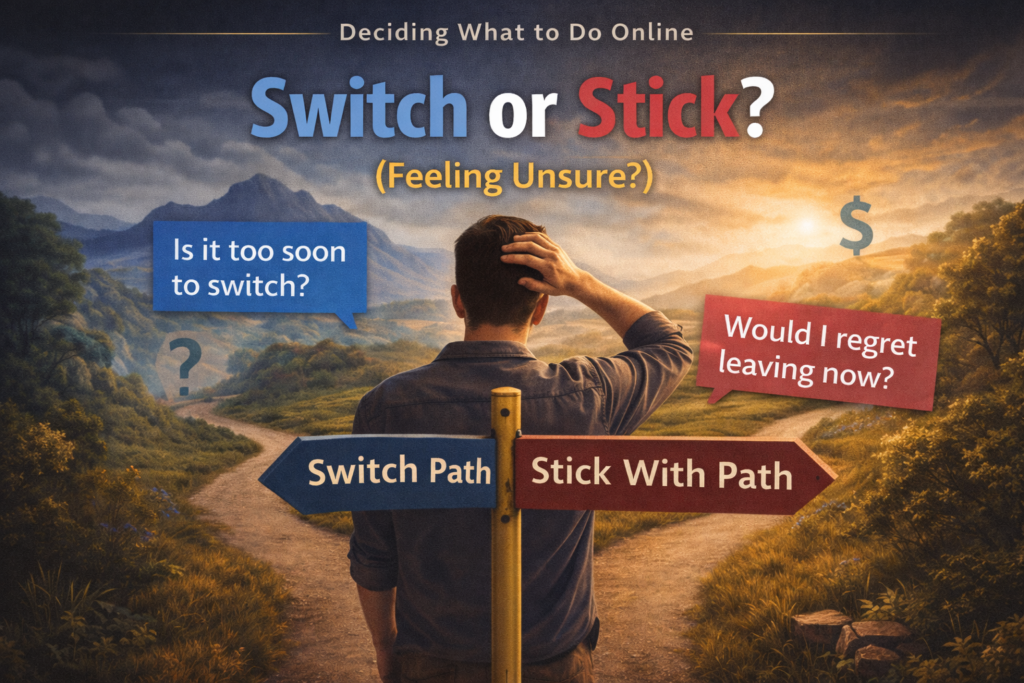
The pause between continuing and switching is more than a financial calculation; it is an emotional pause. People in London juggling freelance projects or entrepreneurs in New York building digital stores often hit a point where their expectations and reality meet. From what I’ve seen, this pause can feel like standing at a crossroads. You are aware of the work you have done, yet unsure whether to invest more time in it or look for another opportunity. Your worry may not be about money alone but about time, energy, and personal growth. These feelings are valid and deserve space.
This article does not aim to give you a checklist for deciding whether to switch or stick. Instead, it explains why the question appears and why uncertainty accompanies early stages of online work. By understanding the nature of doubt, you can view it less as a problem and more as a natural phase of growth. The goal is to provide context that eases anxiety and encourages calm reflection. It is not a decision guide; it is a companion piece to help you make sense of your feelings.
Table of Contents
Why the “Switch or Stay” Question Happens
Uncertainty often grows when the novelty of online work wears off. In the beginning, the excitement of a new platform or project drives you forward. You may spend late nights learning a payment system like ACH or SEPA, setting up a digital wallet, or exploring ways to invoice clients in dollars or euros. During this honeymoon phase, questions about switching rarely arise because everything feels new. As time passes and the work becomes routine, doubts can surface. Small obstacles that seemed insignificant become more noticeable. It is during this normal plateau that the question of whether to switch or stick to the online income path often emerges.
Learning itself can cause uncertainty. As you gain more knowledge, you realise how much there is to learn. When you take on a role that requires creative skills, technical knowledge, or client management, the learning curve can feel steep. You might see others progressing faster and wonder if you are on the wrong track. Our central guide, Choosing Your Online Income Path, emphasises that direction matters more than any specific platform. When the direction no longer aligns with your interests or lifestyle, doubt naturally follows. The question is not a sign of defeat but a reflection of growing awareness.
Another reason the question appears is the gap between expectations and results. If you entered a field with the belief that progress would be steady, hitting a slow period can be unsettling. Delayed payments from clients, fluctuating demand, or unfamiliar regulations can create friction. I’ve noticed many beginners reach this moment after their first few projects. They realise that earning online is not always linear and start wondering if another path would suit them better. The uncertainty stems from misaligned timelines rather than an inability.
The Feeling of Slow Progress
One of the main triggers for questioning whether to switch or stay is the perception of slow progress. After a few months, you might review your numbers and feel that the pace is too slow. You might compare your earnings to those of peers or weigh the time invested against other opportunities. This perception is influenced by many factors, including your initial expectations and the examples you see online. Slow growth can feel like stagnation, even when you are building a foundation that is invisible from the outside.
Progress in online work is rarely consistent. There are times when you gain new clients quickly, or a piece of content resonates with a wider audience, and other times when nothing seems to move. When growth pauses, it can trigger the thought that you have chosen incorrectly. It helps to recognise that slow progress does not necessarily mean the path is wrong. Our earlier article on Why choosing the wrong path slows beginners explores how mismatches between skills and tasks can make work feel harder. However, slowness can also simply reflect the nature of building a sustainable online practice. Understanding this can ease the pressure you put on yourself.
External influences can amplify feelings of slow progress. Social media often highlights quick wins and success stories while glossing over the quiet periods between achievements. You may see people sharing earnings screenshots or growth charts from New York or Berlin and feel like you are falling behind. From what I’ve seen, comparing personal milestones to curated snapshots can distort reality. When your pace differs from the highlight reel, doubt about whether to switch or stick online income path naturally arises. Recognising this distortion helps you view your progress more fairly.
Comparing Yourself to Others Online
Another source of uncertainty is the habit of measuring your progress against others. With global connectivity, it is easy to see what freelancers across the Atlantic are doing. You might read about a London designer who doubled their income with a new approach or a Paris writer who landed a major contract. These stories can inspire, but they can also create pressure. The urge to switch paths because someone else succeeded at something different is strong, but may not reflect your own situation.
Comparison becomes even more complicated when you mix multiple paths. Many people combine content creation, freelance services, and digital product sales. Balancing different income sources requires careful energy management. Our article on Mixing online income paths without burning out discusses how blending activities can be both rewarding and draining. When you see others thriving on a combination of tasks, you might question whether your single focus is wise. Yet what works for them may not fit your circumstances. Each path has its own rhythm, and combining them without clear reasons can lead to burnout rather than growth.
In addition, online platforms seldom show the full picture. You might know someone’s revenue but not their expenses. A freelancer’s $10,000 month in dollars may include marketing costs, software subscriptions, and taxes that are not visible on social media. Similarly, euro earnings may not account for healthcare or local taxes in countries like Germany or Spain. Comparing your net income to someone else’s gross can lead you to conclusions that do not reflect reality. Understanding these hidden variables reduces the urge to make hasty changes based on incomplete comparisons.
Understanding Growth Without Clear Signals
Growth in digital work often lacks clear milestones. Unlike a salaried position with set promotions, online income can grow slowly and unpredictably. You might be improving your skills, building networks, or refining your process without visible results. This invisible growth is essential but hard to measure. The absence of clear signals can make you question whether to switch or stick online income path. Yet these quiet periods can be some of the most productive times for learning and adjustment.
Beginners may expect external validation to confirm they are on the right track. When that validation does not appear, doubt can creep in. Our piece on Starting small with your first online income idea encourages focusing on manageable steps rather than big leaps. By observing small improvements—like mastering an invoicing tool, understanding VAT, or communicating more effectively with clients—you build confidence. These incremental victories may not look like traditional success markers, but they signal growth and help ease uncertainty.
It is also important to recognise that not all growth feels comfortable. Sometimes you are developing discipline by sticking to a routine; other times you are learning to pivot when something genuinely does not fit. Growth can involve both staying and switching. The absence of immediate feedback does not mean you are standing still. I’ve noticed many beginners assume they need to see numbers to justify continuing, but often their biggest growth happens before the metrics catch up. Viewing growth as a combination of skills, resilience, and insight helps you navigate the ambiguity without rushing into a decision.
Closing Section — Calm Clarity
Uncertainty about whether to switch or stick to your online income path is not a flaw; it is a sign that you are thinking carefully about your direction. It shows you are attentive to your progress and open to adjusting your path if needed. Doubt often emerges when reality does not meet expectations, when progress feels slow, or when comparisons cloud judgment. Understanding that these feelings are part of the learning phase helps you approach them with patience rather than panic.
As you continue your online work journey, remember that both switching and staying are natural parts of growth. You may choose to explore new options when your interests evolve, or you may decide to deepen your knowledge in the path you are on. Neither choice is inherently right or wrong; what matters is that you make it from a place of understanding rather than fear. This article has not provided a decision matrix because there is no universal formula. Instead, it has offered context to reassure you that doubt is normal and that clarity comes from reflection, learning, and time.