
Many newcomers hear the term and immediately wonder, what is freelancing? They often imagine an easy path to freedom—working from a laptop at the beach, picking clients whenever they like, and earning steady money without a boss.
But once they look closer, uncertainty begins to surface. Is a freelancer the same as an independent contractor? Are freelancers paid the way employees are? What happens during slower months? These questions can bring doubt and frustration, especially when social media presents freelancing as effortless success. This article responds to that confusion calmly by explaining what freelancing actually means, how payments work, why income can vary, and what expectations are realistic.
What is Freelancing
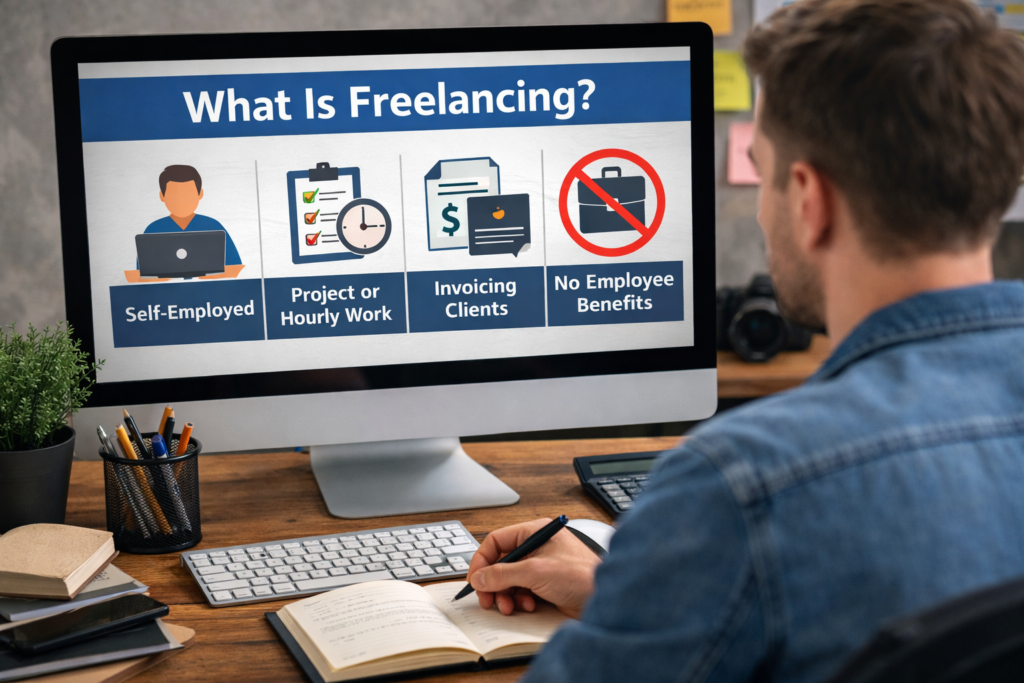
Freelancing is offering your skills directly to clients without becoming an employee. You run your own business, choose your projects, and invoice clients for each job. According to the United Kingdom’s government guidance on employment status, a self‑employed person works for themselves and takes responsibility for their business success; they are not paid through the Pay As You Earn (PAYE) system and do not have the statutory rights of employees. Freelancers typically submit quotes or bids to secure work, complete tasks without direct supervision, and issue invoices to get paid.
To clarify roles: a freelancer is self‑employed, working for multiple clients but remaining responsible for their own taxes and benefits. A remote employee works off‑site but is still an employee; they have a salary, benefits, and work under employer control. A contractor might be self‑employed or an agency worker, depending on the context. A self‑employed person runs their own venture and decides how to operate. Freelancers fall under this self‑employed umbrella. Understanding these distinctions helps you see freelancing as its own structure—neither employee nor company, but somewhere in between.
If you want a broader look at how freelancing fits within the larger landscape of online income structures, our main guide, Understanding Different Online Income Models, explains how various models operate and differ.
How Freelancers Get Paid
In freelancing, payment structures vary by project and client. The most common methods are:
- Project-based pricing: You charge a flat fee for the entire project, regardless of hours spent. This works well when the scope is clear (e.g., designing a logo or writing a blog series).
- Hourly pricing: You set an hourly rate and track your time. This is useful when project requirements may change or when clients need ongoing support.
- Retainers: A client pays you a recurring fee (monthly or quarterly) to perform a set amount of work or reserve your availability. Retainers create a stable income but require ongoing commitment.
- Milestone payments: Large projects can be broken into phases, with payment due at each milestone (e.g., deposit upfront, mid‑project payment, and final payment upon completion). This balances security for you and trust for the client.
Realistic payment timing is crucial. Freelancers often wait for funds after submitting an invoice. The New York City Department of Consumer and Worker Protection notes that if a freelance contract lacks a payment date, the hiring party must pay within 30 days after the work is finished. In practice, many contracts specify payment within 14–30 days. You send an invoice, the client processes it, and the money arrives via bank transfer—often through the Automated Clearing House (ACH) system in the United States or the Single Euro Payments Area (SEPA) in Europe.
To avoid cash flow problems, it helps to set clear payment terms in your contract. Stating “due within 14 days of invoice” or “50% deposit due at project start” prevents misunderstandings. Retainers, while not always available, offer a more stable timeline because you know when payments are due.
Income Fluctuation and Stability
Freelancers often encounter income peaks and valleys. A month full of projects can bring a high income; the next might be quieter. This variability stems from several factors: client demand, payment timing, scope changes, and seasonal trends. No work means no pay. That reality can be unsettling, but it also creates opportunities. Many freelancers build stability by:
- Diversifying clients: Working with more than one client reduces risk if one relationship ends.
- Seeking retainers: Ongoing contracts ensure regular income.
- Maintaining a savings buffer: When invoices take longer to process, a savings cushion covers expenses.
Contrary to common myths, freelancing is not instant freedom. You remain accountable to clients and must manage communications, deadlines, and expectations. Yet freelancing also provides flexibility—choosing your schedule, picking projects aligned with your skills, and setting your rates.
For a comparison between freelancing and remote employment, our article Remote Work Basics (Online Jobs vs Freelancing) explains how remote employees differ from freelancers regarding salary, benefits, structure, and independence. If you’re evaluating whether a secure salary or more flexible project work suits you better, that resource will offer perspective.
Realistic Expectations and Communication
Freelancing carries responsibilities beyond core skills. You must communicate clearly with clients, set boundaries, and deliver on promises. Projects often evolve, and scope creep can occur if you don’t manage expectations. Good freelancing involves:
- Professional communication: Responding promptly to emails, updating clients on progress, and clarifying details.
- Clear contracts: Outlining deliverables, timelines, payment terms, and ownership rights.
- Trust-building: Meeting deadlines and maintaining quality builds client trust, leading to referrals and repeat work.
- Self-discipline: Without a manager, you must create your schedule, track your hours, and handle administrative tasks like invoicing.
Freelancing is not a shortcut to easy money. It requires dedication, patience, and adaptability. But when you align your freelancing work with your skills and interests, it can be rewarding and empowering.
Connecting to the Broader Online Income System
Freelancing is one piece of the wider online income puzzle. It sits alongside other models like content creation, digital products, and remote employment. Each has its own effort, payment timing, risk, and scalability. Many people blend freelancing with other models—freelancing for immediate income while slowly building a blog or product. Understanding how freelancing fits into this ecosystem helps you plan a diversified online career.
For a deeper look at how short-term work compares to long-term income strategies, our piece Short-Term Gigs vs Long-Term Online Income discusses the pace, stability, and scalability of different approaches. It explains why short gigs offer quick cash but limited scalability and why building long-term income takes patience but can become more sustainable.
Conclusion
Freelancing is fundamentally about offering your skills directly to people who need them. You control your workload, set your rates, and manage your clients. It differs from employment in crucial ways: you don’t receive paid leave or employer-sponsored benefits, and you handle your own taxes and insurance. Businesses weigh many factors when determining whether a worker is an employee or an independent contractor; no single factor is decisive. Likewise, a remote worker is considered an employee if the employer controls what work is done and how it’s performed, even when the work is done remotely.
As a freelancer, you can design a career that fits your interests and schedule, but you must be ready for variability and self-management. Use clear contracts, set realistic payment terms, and communicate openly. Recognise that freelancing offers flexibility and autonomy—balanced by the need for discipline and adaptability. With realistic expectations and good client relationships, freelancing can be a fulfilling way to earn online.
Frequently Asked Questions
1. Is freelancing a form of self-employment?
Yes. Freelancers run their own business and are responsible for their success or failure. They choose clients and projects independently.
2. How does freelancing differ from remote employment?
A remote employee works for a company and receives a salary, benefits, and employer directives, even if working from home. A freelancer is self‑employed and invoices clients for projects.
3. Do freelancers have to pay their own taxes?
Freelancers handle their own taxes and often pay quarterly estimated taxes. They are not subject to payroll tax withholding like employees.
4. What is a typical payment timeline for freelance work?
Payment terms vary, but many invoices are due within 14–30 days. Some contracts require deposits upfront or milestone payments.
5. Can freelancers work for multiple clients at once?
Yes. Freelancers often work with several clients simultaneously, which helps diversify their income.
6. How do retainer agreements work?
A client pays a recurring fee to reserve a freelancer’s time or to cover a set amount of work each month. Retainers provide stability for both parties.
7. Do freelancers receive employee benefits?
No. Freelancers do not receive paid holidays, sick pay, or health insurance from clients. They must arrange their own benefits.
8. Is freelancing a good long-term career?
It can be, especially if you build strong client relationships, diversify your services, and manage income variability. It suits those who value autonomy.
9. What happens if a client doesn’t pay?
Contracts should specify payment terms and penalties for late payment. Freelancers can enforce terms by withholding deliverables or taking legal action if needed.
10. How can a beginner start freelancing?
Identify a marketable skill, build a portfolio, network or join freelance platforms, and start with small projects. Focus on clear communication and reliable service.