
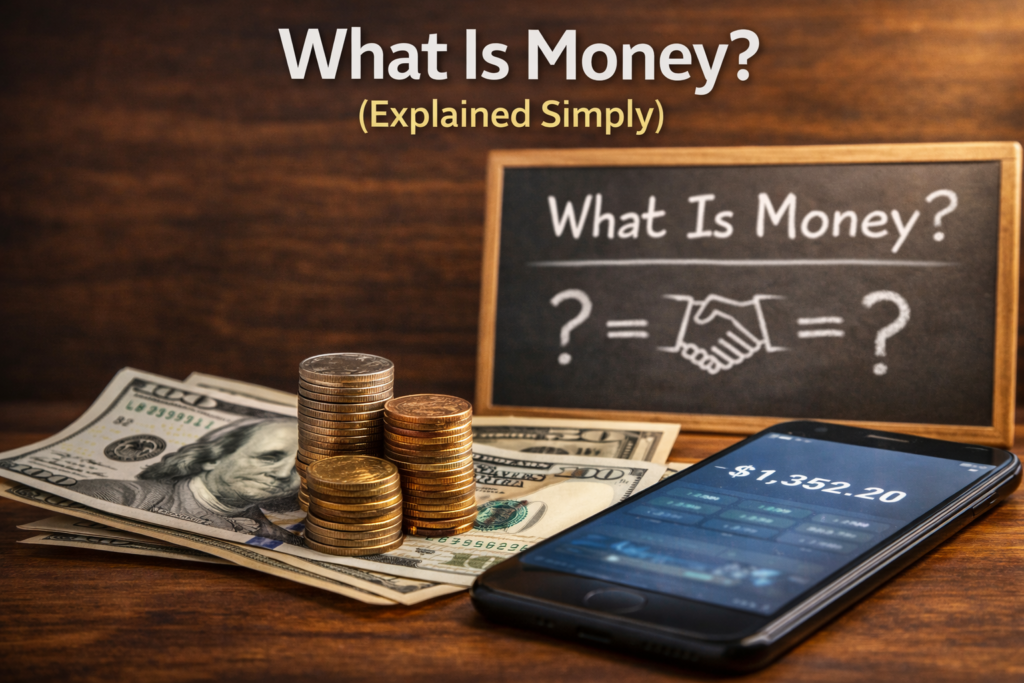
We all use money, but what is it?
If someone handed you a note and asked, “What is this?” you might say, “It’s money,” and move on. Most of us use money every day without thinking much about what it actually is. I’ve noticed that confusion usually starts when someone asks you to explain why a piece of paper or a number on a screen can buy things. Understanding money starts with recognising it isn’t magic; it’s a human agreement that simplifies our lives.
Money basics can feel obvious, yet they hide important ideas. Money Basics: What Money Is, How It Works, and Why It Matters dives into the bigger picture, but this article focuses on the core question: what makes something “money”?
Table of Contents
Money is a shared agreement
Money has taken many forms throughout history: shells, rum bottles, copper ingots, gold coins, paper notes and today’s digital bank records. According to the Reserve Bank of Australia, these diverse tokens aren’t linked by what they’re made of but by what people believe they can do. At any point in history, people trusted these items as a reliable way to pay, a way to quote prices, and a way to store value. In everyday terms, money works because society collectively agrees to treat certain tokens as money.
Think about the cash in your wallet. It has little intrinsic use—you can’t eat it or build a house with it—yet you can exchange it for groceries or a bus ticket because everyone around you agrees it’s valuable. That agreement is reinforced by laws (such as “legal tender” status) and institutions like central banks, but it ultimately rests on trust. If people stop believing in a currency—say, during hyperinflation in Zimbabwe—it quickly loses its power.
Why paper, coins and digital numbers work
Physical money: paper and coins
Paper money and metal coins are tangible; you can hold them and see them change hands. Historically, some money—like gold coins—had value because the metal itself was worth something. But modern paper notes are examples of fiat money. They aren’t backed by gold or silver; they’re valuable because governments declare them legal tender and because we all trust that declaration. When you buy a coffee with cash, the barista accepts your paper note without questioning its worth because they know others will accept it later.
Digital money: numbers on a screen
Today, most money isn’t physical at all. Your salary likely appears as numbers in a bank account. When you use a debit card or a mobile app, you’re authorising your bank or payment service to adjust those numbers. The Bank Policy Institute explains that the public uses different forms of money: central bank money (physical cash and balances banks hold at the central bank), commercial bank money (digital balances in our checking or savings accounts) and non‑bank digital money held at payment services like PayPal or Venmo. These digital balances are accepted as money because banks and payment firms promise they can be converted to cash and because society trusts those promises.
Imagine paying a friend back using a mobile wallet. You send $200 digitally, and your friend sees their balance increase by the same amount. No physical cash moves, but both of you trust the app to keep accurate records and allow future spending. Digital money counts as real money because the agreement and trust behind it are the same as for physical cash.
The three roles of money
When people try to define money, they often mention the “functions” of money. But definitions can feel like lectures. Instead, let’s explore what money does in your life.
1. Money makes trading easier (medium of exchange)
Without money, people would have to barter. Imagine you’re a musician whose car needs fixing. You’d need to find a mechanic willing to accept a concert performance instead of a monetary payment. That’s unlikely. A Federal Reserve education resource describes this problem as the “coincidence of wants”—you’d need someone who wants exactly what you offer at exactly the moment you need their service. Money solves this problem because it’s widely accepted for goods and services. You can perform concerts for people who pay you money, then use that money to pay your mechanic. Everyone trusts that money will be accepted, so trading becomes simple.
Think of money as a lubricant in the machine of exchange. Whether you’re buying groceries, paying rent or selling an online service, money moves smoothly between parties because we all agree to accept it. This “no questions asked” feature is essential. When you hand over money, no one needs to test its value—it’s accepted because society says so.
2. Money measures value (unit of account)
Money is also a yardstick. If you want to compare the price of a laptop to a bicycle, you could say the laptop costs 100 bushels of corn, and the bicycle costs 50 bushels. But that’s awkward. Money lets us put everything on the same scale. Prices expressed in rupees or dollars make it easy to compare and plan. When you track your spending, you’re using money as a unit of account—listing items by how many rupees they cost.
This measuring function makes budgeting possible. If you earn $20,000 a month, you can allocate $5,000 to rent, $3,000 to food and so on. Without a common unit, you’d be juggling multiple items—how many kilograms of rice equals one bus ride? Money simplifies these decisions.
3. Money lets you store value for later (store of value)
If you work today and receive money, you don’t have to spend it immediately. You can save it and use it next week or next year. Money holds value over time, unlike perishable goods like corn or milk. The Federal Reserve notes that while money isn’t a perfect store of value (inflation slowly erodes its purchasing power), it’s more effective than storing many other items. You wouldn’t want to store your wealth in tomatoes, but you’re willing to save part of it in a savings account or under your mattress (even if that second option isn’t recommended).
Because money stores value, you can plan for the future. You can save up for a holiday, an emergency fund or education. Without this function, long‑term planning would be nearly impossible. It’s also why people worry about inflation—it reduces how much value money holds over time.
Why trust is everything
Money’s power rests on trust. We accept paper, plastic or pixels because we believe others will, too. That belief comes from our collective experience, from laws that protect our right to use money, and from institutions like central banks and banks that manage money creation and payment systems. When this trust wavers—say during political crises or hyperinflation—money can lose its value quickly.
This trust is why even digital money works. You can’t see or touch the numbers in your bank account, but you trust the bank to honour them. You might even use a payment service that isn’t a bank, like a mobile wallet. The Bank Policy Institute notes that non‑bank digital money is managed by payment firms and settles transactions on their own books. People accept these payments because they trust the service will let them withdraw or transfer money when needed.
Trust also explains why counterfeit money is illegal and why counterfeiting is damaging. If fake notes circulate widely, people might question whether any note is real, eroding trust in the currency. Laws against counterfeiting protect that trust and, by extension, the money system itself.
Money’s value doesn’t come from the material
A common misconception is that money is valuable because it contains valuable material. While gold coins once had intrinsic value, modern money does not. Fiat money—today’s paper notes and digital dollars—has value because governments declare it legal tender and because people agree. Even digital currencies like Bitcoin, which some call a “store of value,” rely on trust. Bitcoin’s value depends on the belief that someone else will accept it later. Without that shared belief, it would be just numbers.
Money’s usefulness comes from its characteristics: it’s durable, portable, divisible, uniform, of limited supply and acceptable. A cow, for instance, can be valuable, but it’s not easily divisible or portable. Twenty‑dollar bills are small, consistent and easy to divide into smaller denominations. Digital money is even more portable—it can be transferred instantly across the world—but it still relies on a limited supply and acceptance by others.
Examples from everyday life
To make these ideas concrete, consider a few scenarios:
Sending money digitally. You owe a friend for movie tickets. You open an app, type in the amount and hit send. The app subtracts money from your balance and adds it to your friend’s. No cash changes hands, but both of you trust the app. Digital money is still real money because the agreement behind it is the same.
Paying for groceries. You load up your basket at the local market. At checkout, you tap your card or hand over cash. The cashier doesn’t need to evaluate what you’re offering; they know the money is accepted anywhere. This is money acting as a medium of exchange.
Tracking your monthly budget. You sit down to review your spending. You list rent, food, transport, streaming subscriptions and more—all in the same currency. Money as a unit of account allows you to compare and plan these expenses.
Saving for a goal. You decide to save $1,000 a month for an emergency fund. Each month, you put money aside. It stays valid and can be used later, showing money as a store of value. Though inflation might reduce its purchasing power slightly, it still stores value better than goods that spoil.
Why understanding money matters
Many people grow up using money without ever learning what makes it tick. I think money feels simple until someone asks you to explain it. Grasping that money is a shared agreement, not a material thing, changes how you think about spending and saving. It also helps you see why laws, banks and payment systems exist—to maintain the trust that makes money work.
Understanding money also prepares you for more advanced topics. Knowing why a $500 note buys what it does today but might buy less next year leads naturally to discussions about inflation and how to protect your purchasing power. Recognising that most money is digital helps you appreciate modern banking and the rise of mobile payments. If you’re curious about the different forms money takes, see Forms of Money: Cash, Credit, and Digital Money for a deeper dive.
Final takeaway
So, what is money? It’s not the paper itself or the metal in coins or the numbers on your phone. Money is a shared agreement that certain tokens—physical or digital—can be used to pay for goods and services, measure value and store value over time. It works because we all trust that it will be accepted later. Without that trust, money would just be paper, metal or numbers.
By viewing money as an agreement rather than an object, you gain clarity. You see why people accept paper notes and digital payments with confidence. You understand why laws and institutions protect money’s integrity. And you’re better prepared to learn about how money moves, why it changes value and how to manage it wisely in your own life.